







Periodic Table Of PRIMES (PTOP) and the Goldbach Conjecture--- How to Make with Fractals
Periodic Table Of PRIMES (PTOP) & Goldbach Conjecture
Reginald Brooks
Copyright ©, 2019-20, Reginald Brooks. All rights reserved.
Abstract: PTOP (Periodic Table Of Primes) & the Goldbach Conjecture
The Odds Prime Sequence (PS) — 3,5,7,11,13,17,19,23,29,31,37,… is well known and well studied. What is not well known is that the PS forms a fractal — PS-Fractal — that builds a relationship between all other PRIMES and the EVEN numbers that their sums provide, resulting in the PTOP (Periodic Table Of PRIMES).
If, to a vertical presentation of the PS, one combines at each sequential prime step in that sequence, a new PS — whose length equals said prime step — a series of Prime Pair sets (PPsets) will form a zig-zagging diagonal “Trail” downward to the right. As the PS grows, so, too, does the PPsets Trail grow — increasing by one for each prime step. This rate of growth far exceeds the rate of growth of the Prime Gaps.
This is significant as follows: as the Trails grow in length diagonally they accumulate overlaps of the previous Trails such that any accounting of the number of PPsets so present horizontally on any Row, will always be greater than, or equal to, one. The sum of the PPset members equals the EVEN number corresponding to that Row. Goldbach’s Conjecture is proved.
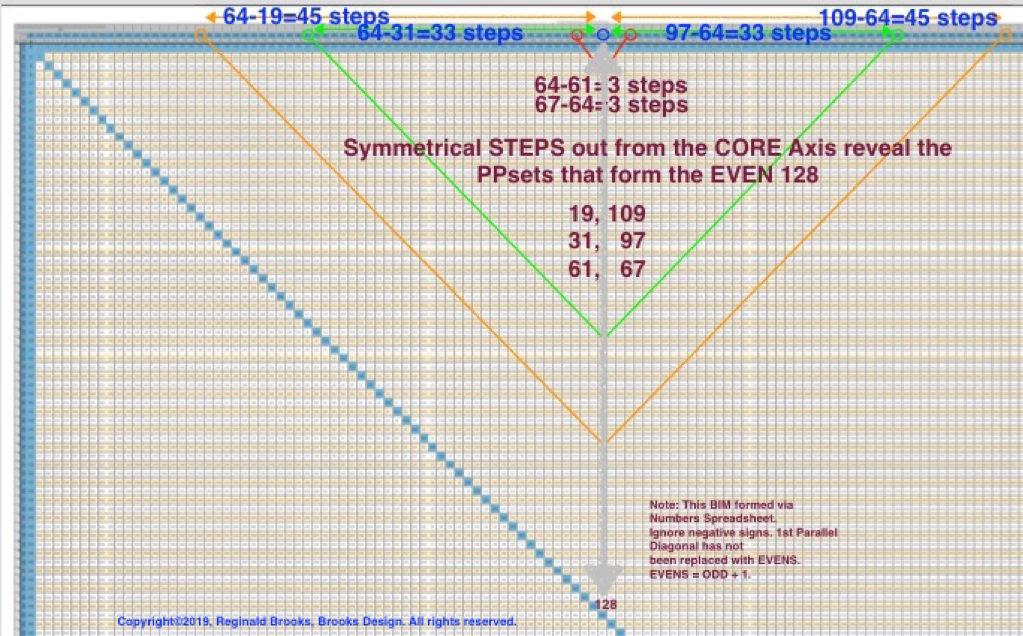
Additionally, the Primes reveal another pattern to their fractal-like behavior. While best seen directly on the BBS-ISL Matrix (BIM), it may be described as follows: the members of any PPset lie symmetrically to either side of any given EVEN/2, directly on the BIM Axis.
For EVEN 128, 128/2=64=coreAxis. PPset members symmetrical.
Internally, they form a 90° Right-angle isosceles triangle whose apex lies on the straight-line path between the EVEN/2 and the EVEN. This geometry is built into the BIM and as the BIM expands to infinity, so, too, does this geometry. ALL EVENS are characterized as having one or more Right-isosceles triangles composed of two Primes whose products equal the apex value and whose sum equals the EVEN.
The PS — 3,5,7,11,13,17,19, 23, 29, 31, 37, 43, …— of course, goes to infinity. Here, we limit the PS-Fractal — i.e., truncate it — to the point where the two members of the PPset (P1, P2) equal each other, e.i., PPset (5,5), and end the Trail. That part of the PS-Fractal that is limited will be naturally picked up by subsequent PPset Trails. The redundancy reduction helps us see the pattern! Reginald Brooks December 8, 2019, updated January 25, 2020
PRIMES Index can be found here: http://www.brooksdesign-ps.net/Reginald_Brooks/Code/Html/MSST/TPISC/TPISC_IV_Details/PRIMES_index.html
“PTOP: Periodic Table Of PRIMES & Goldbach Conjecture” is also available as an ebook in Apple Books within iTunes. http://books.apple.com/us/book/id1491237017