
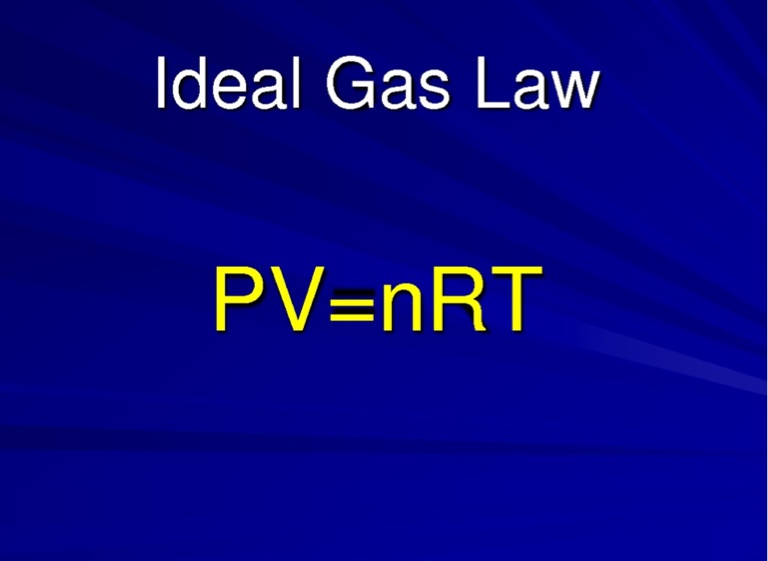






Ideal gas law
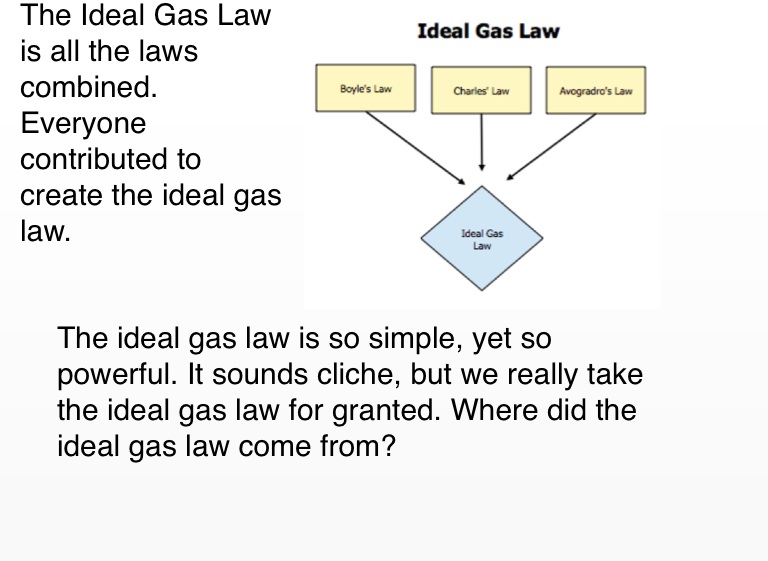
The Ideal Gas Law is all the laws combined. Everyone contributed to create the ideal gas law.
The ideal gas law is so simple, yet so powerful. It sounds cliche, but we really take the ideal gas law for granted. Where did the ideal gas law come from?
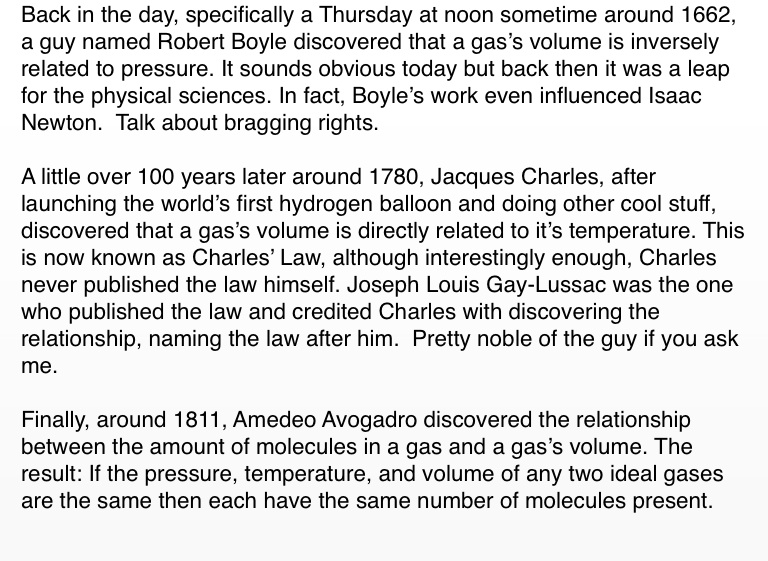
Back in the day, specifically a Thursday at noon sometime around 1662, a guy named Robert Boyle discovered that a gas’s volume is inversely related to pressure. It sounds obvious today but back then it was a leap for the physical sciences. In fact, Boyle’s work even influenced Isaac Newton. Talk about bragging rights. A little over 100 years later around 1780, Jacques Charles, after launching the world’s first hydrogen balloon and doing other cool stuff, discovered that a gas’s volume is directly related to it’s temperature. This is now known as Charles’ Law, although interestingly enough, Charles never published the law himself. Joseph Louis Gay-Lussac was the one who published the law and credited Charles with discovering the relationship, naming the law after him. Pretty noble of the guy if you ask me. Finally, around 1811, Amedeo Avogadro discovered the relationship between the amount of molecules in a gas and a gas’s volume. The result: If the pressure, temperature, and volume of any two ideal gases are the same then each have the same number of molecules present.
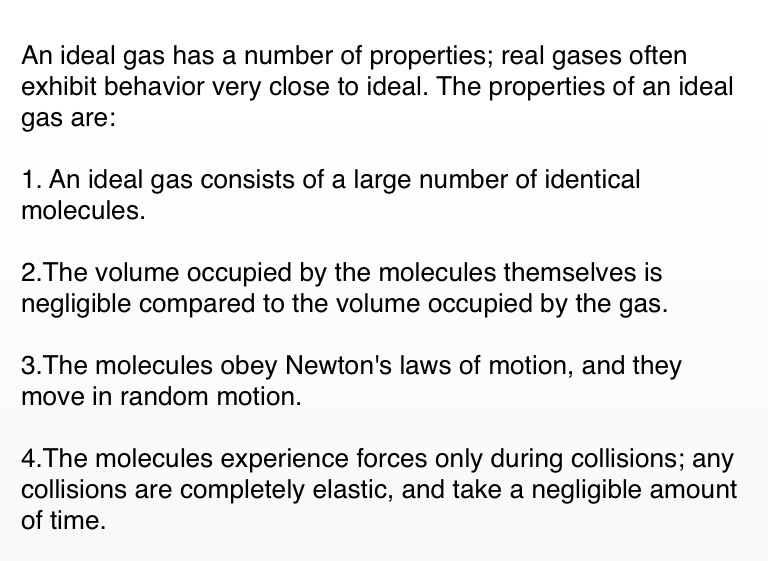
An ideal gas has a number of properties; real gases often exhibit behavior very close to ideal. The properties of an ideal gas are: 1. An ideal gas consists of a large number of identical molecules. 2.The volume occupied by the molecules themselves is negligible compared to the volume occupied by the gas. 3.The molecules obey Newton's laws of motion, and they move in random motion. 4.The molecules experience forces only during collisions; any collisions are completely elastic, and take a negligible amount of time.
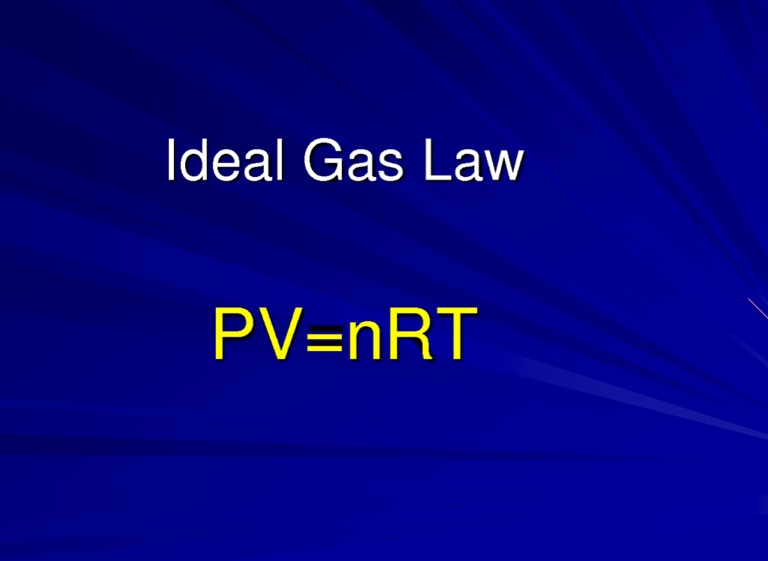
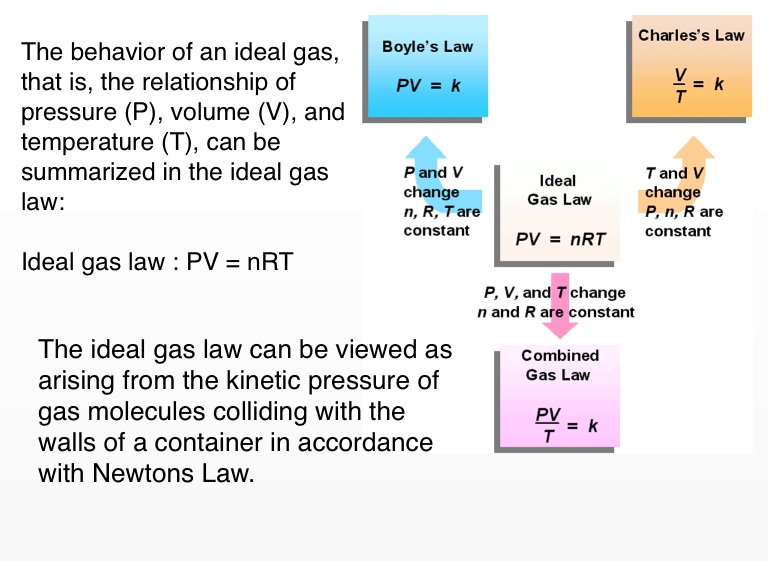
The behavior of an ideal gas, that is, the relationship of pressure (P), volume (V), and temperature (T), can be summarized in the ideal gas law: Ideal gas law : PV = nRT
The ideal gas law can be viewed as arising from the kinetic pressure of gas molecules colliding with the walls of a container in accordance with Newtons Law.
How is the Ideal Gas Law used in everyday life?
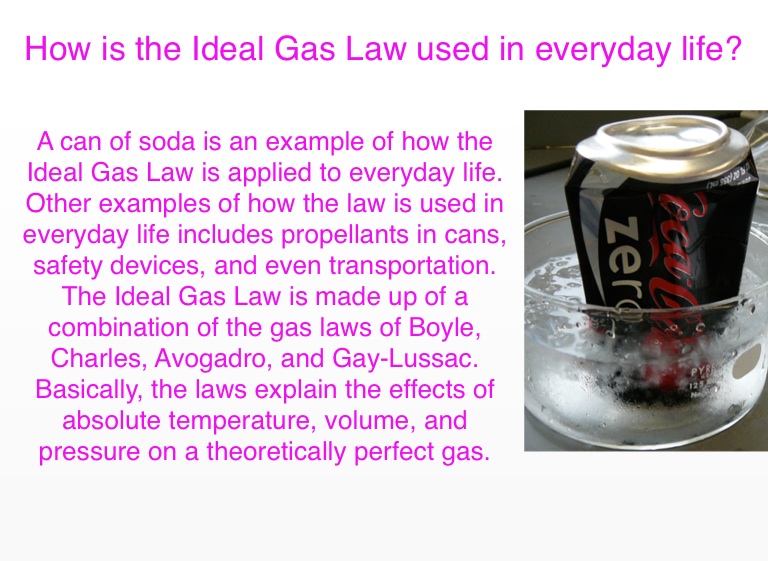
A can of soda is an example of how the Ideal Gas Law is applied to everyday life. Other examples of how the law is used in everyday life includes propellants in cans, safety devices, and even transportation. The Ideal Gas Law is made up of a combination of the gas laws of Boyle, Charles, Avogadro, and Gay-Lussac. Basically, the laws explain the effects of absolute temperature, volume, and pressure on a theoretically perfect gas.
Example Problem! 🙉🎒📝✏️📚
4.00 moles of a gas are at a pressure of 6.70 atm in a 11.0 L container. What is the temperature of this gas?
Step one: The first thing you would want to do in an ideal gas problem is identify what your unknown is. The unknown is what the question is asking you to find.
Step Two: Rearrange the equation so that the unknown is by itself on the left of the = sign. This is known as "Solving for the unknown". Using some algebra rearrange PV=nRT.
Step Three: Now we simply plug in the numbers into our rearranged equation to find T.
=225K📚
Step One: The unknown is the temperature of the gas.
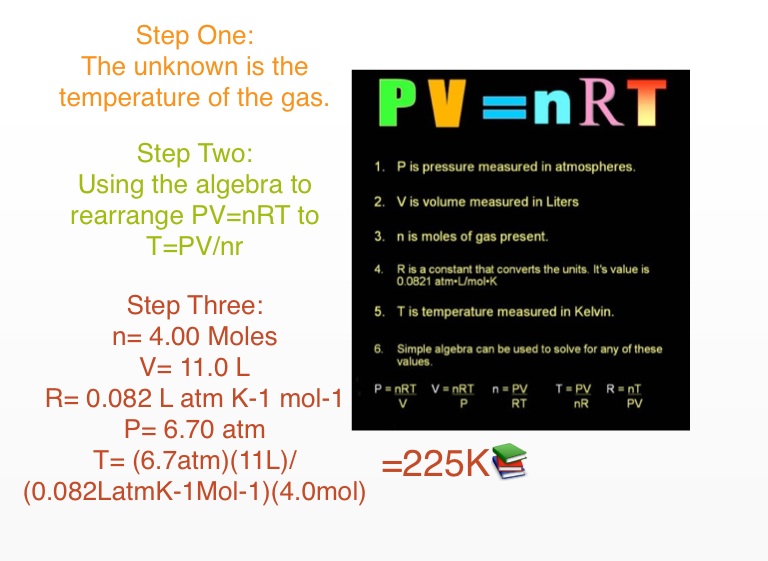
Step Two: Using the algebra to rearrange PV=nRT to T=PV/nr
Step Three: n= 4.00 Moles V= 11.0 L R= 0.082 L atm K-1 mol-1 P= 6.70 atm T= (6.7atm)(11L)/(0.082LatmK-1Mol-1)(4.0mol)