






Invertebrates
Invertebrates
by Daniel Juan Santigosa
Your Logo
Sponges
1.- SPONGES, CNIDARIANS AND ECHINODERM
Sponges are the simplest type of animal that exists. They live in water and are attached to rocks the seabed. Sponges are often irregular in shape. Their bodies have lots of small holes that allow water to pass in and out. They eat microscopic organisms in the water that filter through their body.
Cnidarians
1.- SPONGES, CNIDARIANS AND ECHINODERM
Cnidarians have jelly-like bodies with radial symmetry. They have very simple bodies with an opening at one end. This opening acts as a mouth and an anus. They have soft tentacles to catch their prey. All cnidarians are aquatic and most live in the sea. Sea anemones, corals and jellyfish are cnidarians.
Echinoderm
1.- SPONGES, CNIDARIANS AND ECHINODERM
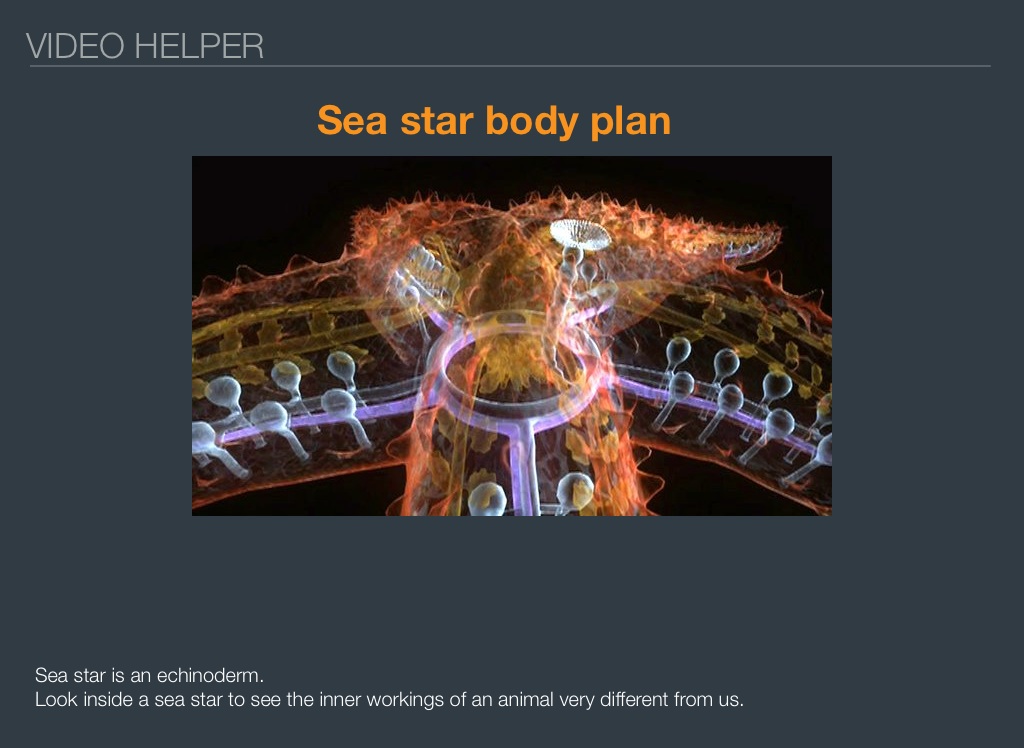
Echinoderms have radial symmetry. Starfish typically have five or more arms which radiate from a central point where their mouth is. Echinoderms are invertebrates with hard plates under their skin. Some, like sea urchins, have movable spines on the outside of their bodies. They live at the bottom of the sea. They crawl slowly on hundreds of tuber-like feet.
Sea star body plan
VIDEO HELPER
Sea star is an echinoderm. Look inside a sea star to see the inner workings of an animal very different from us.
Worms
2.- WORMS AND MOLLUSCS
Worms are animals with long, soft bodies and moist skin. They do not have legs; they move by wriggling. Most worms live in the sea or in fresh water. Some live on land, like earthworms. Some worms are parasites. They live in the intestines of other animals and eat their food.
Molluscs
2.- WORMS AND MOLLUSCS
Molluscs have soft, moist bodies, which are often protected by a shell. They do not have legs. Most molluscs live in water, but slugs and snails live on land.
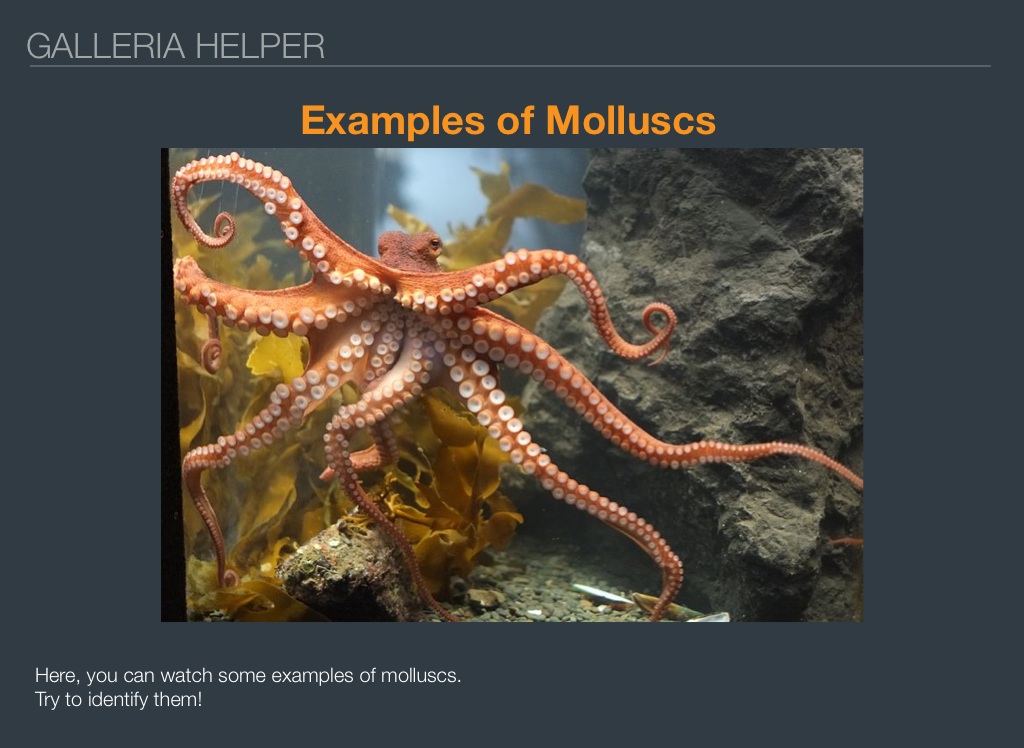
* Gastropods usually have a shell that they hide in when they sense danger. They move by sliding on a slimy, mocus substance thay they excrete. Ex. slugs and snails * Bivalves have one shell divided into two moving parts, called valves, which they close when they sense danger. They usually stay in one place. They eat small organisms that are in the water. Ex. mussels and clams * Cephalopods have no protective external covering, but some have a shell hidden under their skin. All cephalopods are marine animals. They have eight to ten tentacles that help them to swim and catch their prey. Ex. Squid, cuttlefish and octopuses
Examples of Molluscs
GALLERIA HELPER
Here, you can watch some examples of molluscs. Try to identify them!
3.- ARTHROPODS
Characteristics Arthropods are the largest animal group on Earth. The most characteristic feature of arthropods is their external skeleton. The articulated exoskeleton (external skeleton) is made up of hard, small plates that cover the body. Like a human skeleton, it supports and projects the body, but it is external. This makes arthropods invertebrates. Arthropods have jointed legs. They also have antennae and eyes
Arthropods can be classified into 4 groups:
3.- ARTHROPODS
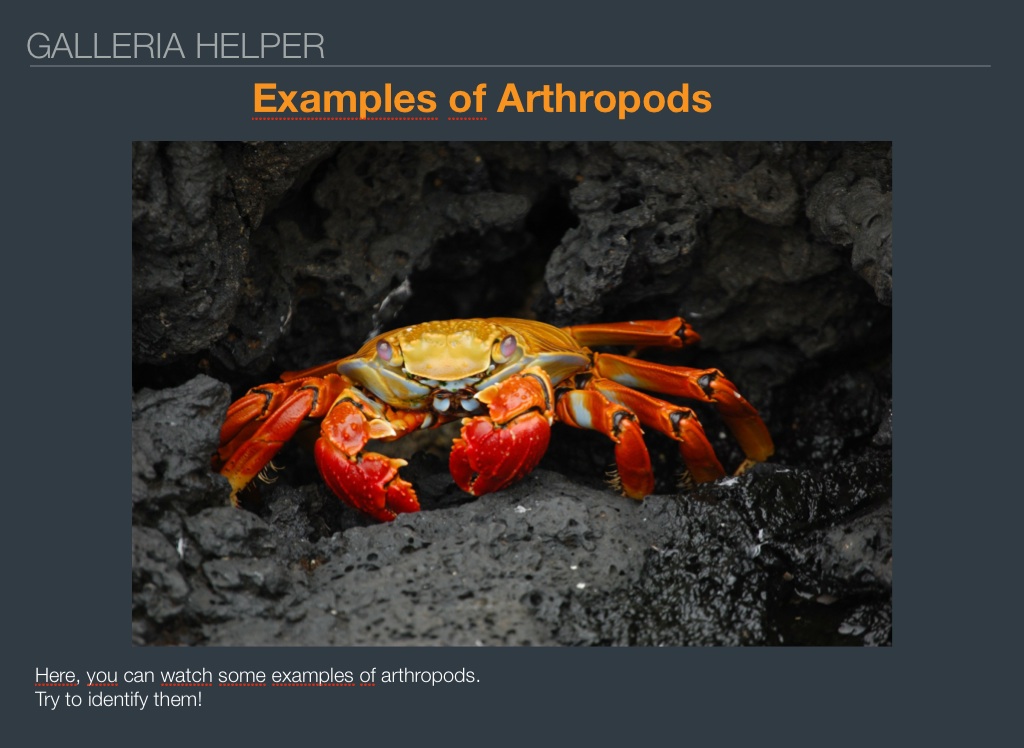
* Crustaceans usually have 10 legs. Their exoskeletons contain a mineral substance that makes them very hard. Most crustaceans live in the sea. Lobsters, crabs and prawns are crustaceans. * Arachnids have 8 legs and long bodies. Most are terrestrial and carnivorous. Spiders and scorpions are all arachnids. * Myriapods have many legs and long bodies. They need a damp environment to survive, and mostly live on or under the ground. Myriapods eat insects and othe small animals. Centipedes and millipedes are examples of myriapods. * Insects are the most numerous group of arthropods. Many insects also have wings. Most are found on land, but some live in fresh water. Bees, butterfly, grasshoppers, mosquitoes and beetles are all insects.
Examples of Arthropods
GALLERIA HELPER
Here, you can watch some examples of arthropods. Try to identify them!
5,000
TRACTION
sign ups in first week
INVERTEBRATES
“I can’t believe how this product really is!” - Jane
amazing
On this slide, we suggest you answer these questions: - What are your timeline and milestones to date? - Add your press mentions, partnerships, & awards - Share customer testimonials, big clients & growth