







Culture 6 Individual and Values
Culture 6 Individual and Values
This e-book discusses individual culture, the relation between individual and group, uses values as a proxy for individual culture and mentions the theory on post-modern society.
Pieter van Nispen Senior Lecturer and Researcher, retired
March 5th, 2018
Table of Contents
page
page
page
page
page
Introduction and Overview
Individual
Values, Beliefs and Norms
European Values Study
Transformation in Central and Eastern Europe
page
page
page
page
page
Individual and Group
Pinto
Towards Post-Modern Society
Exercise
Further Reading
Contents
Introduction
This document is part of larger project to bring the reality and theory of culture together. At its core it the website www.culturalcompetence.eu. At the bottom of the triangle model of culture individual culture is depicted as a person juggling balls with some balls on the ground. The idea is that a person is subconsciously going through all the cultures s/he is a member of to find the appropriate one for dealing with the situation at hand. The balls on the ground indicate that you are not always successful. At the same time you might also not find an appropriate culture in your repertoire, necessitating adaptation to a new culture (enculturation). This idea of individual culture as the net result of all previously experienced cultures also clarifies why generalisations on culture are so difficult and why dealing with culture ultimately boils down to the individual. Research may assist by providing background information and ways and means of doing
things but the individual has to determine what works for him or her. At the same time culture is an interface between the individual and the group and this e-book mentions that briefly. However, most space is devoted to values, beliefs and norms as a proxy for individual culture, including the theory on post-modern society, based on the values research. Overview This document moves from the specific to the general. It starts with the individual but the information on individual and culture is insufficient. However, values have been researched in quite some detail and may serve as a proxy for individual culture (the mix of values). From values the e-book moves to individual and group. Finally, the e-book discusses two wider ranges examples of the study of values, the transformation in Central and Eastern Europe and the emerging post-modern society.
Contents
Individual
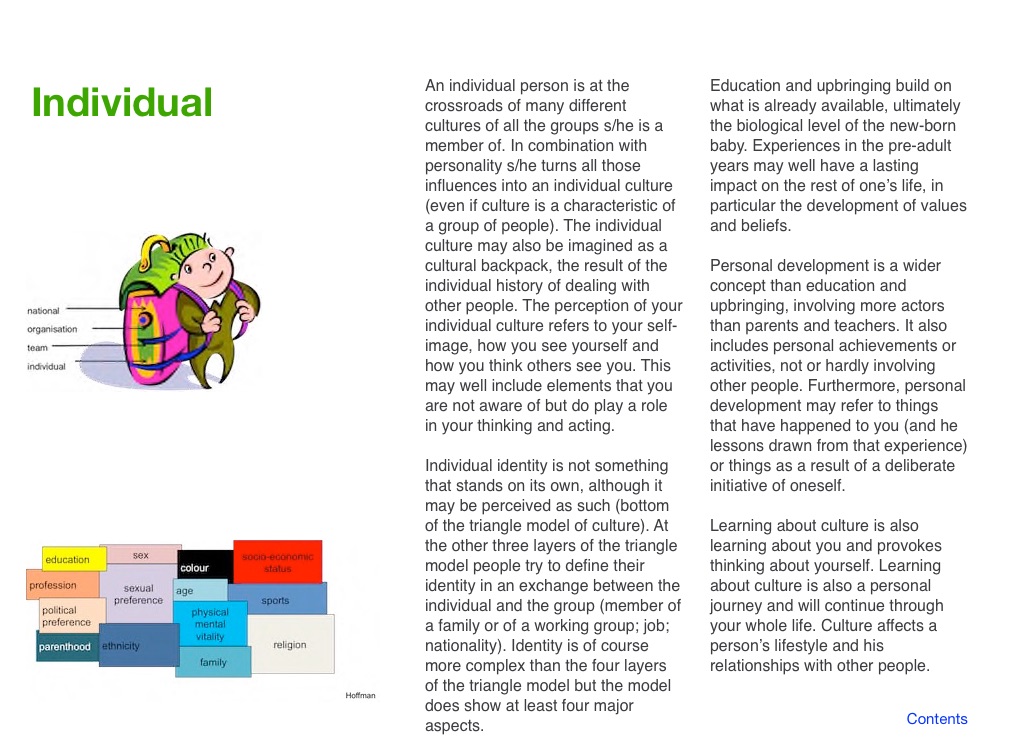
An individual person is at the crossroads of many different cultures of all the groups s/he is a member of. In combination with personality s/he turns all those influences into an individual culture (even if culture is a characteristic of a group of people). The individual culture may also be imagined as a cultural backpack, the result of the individual history of dealing with other people. The perception of your individual culture refers to your self-image, how you see yourself and how you think others see you. This may well include elements that you are not aware of but do play a role in your thinking and acting. Individual identity is not something that stands on its own, although it may be perceived as such (bottom of the triangle model of culture). At the other three layers of the triangle model people try to define their identity in an exchange between the individual and the group (member of a family or of a working group; job; nationality). Identity is of course more complex than the four layers of the triangle model but the model does show at least four major aspects.
Education and upbringing build on what is already available, ultimately the biological level of the new-born baby. Experiences in the pre-adult years may well have a lasting impact on the rest of one’s life, in particular the development of values and beliefs. Personal development is a wider concept than education and upbringing, involving more actors than parents and teachers. It also includes personal achievements or activities, not or hardly involving other people. Furthermore, personal development may refer to things that have happened to you (and he lessons drawn from that experience) or things as a result of a deliberate initiative of oneself. Learning about culture is also learning about you and provokes thinking about yourself. Learning about culture is also a personal journey and will continue through your whole life. Culture affects a person’s lifestyle and his relationships with other people.
Values
Concept Values are at the core of culture and have a strong influence on our thinking and feeling (see Culture 1). They are subconscious basic orientations about good and bad, true and false. The implied importance of the topic notwithstanding, the definition of values remains elusive and research difficult, because they are below the surface (subconscious). One of the difficulties is that some researchers make a distinction between values and beliefs and others do not. If you do make the distinction, both are fundamental orientations but they differ about what and how they are expressed. Another point is that values (and beliefs) are developed in the pre-adult years, i.e. before turning 25 at a maximum. Whether you develop, choose of accept these values in a rational way or through emotional conviction, a major part of this process happens during puberty; not the most stable period of your life!
Definitions ▼ Values: fundamental orientations about good and bad; emotional convictions; relative ▼ Beliefs: fundamental orientations about true and false; rational convictions; absolute ▼ Norms: daily application of values Values are a construct, derived from behaviour and communication. Systematic measurement is done through questionnaires.
The value of values is not defined in financial terms but in terms of what makes us human.
Contents
Contents
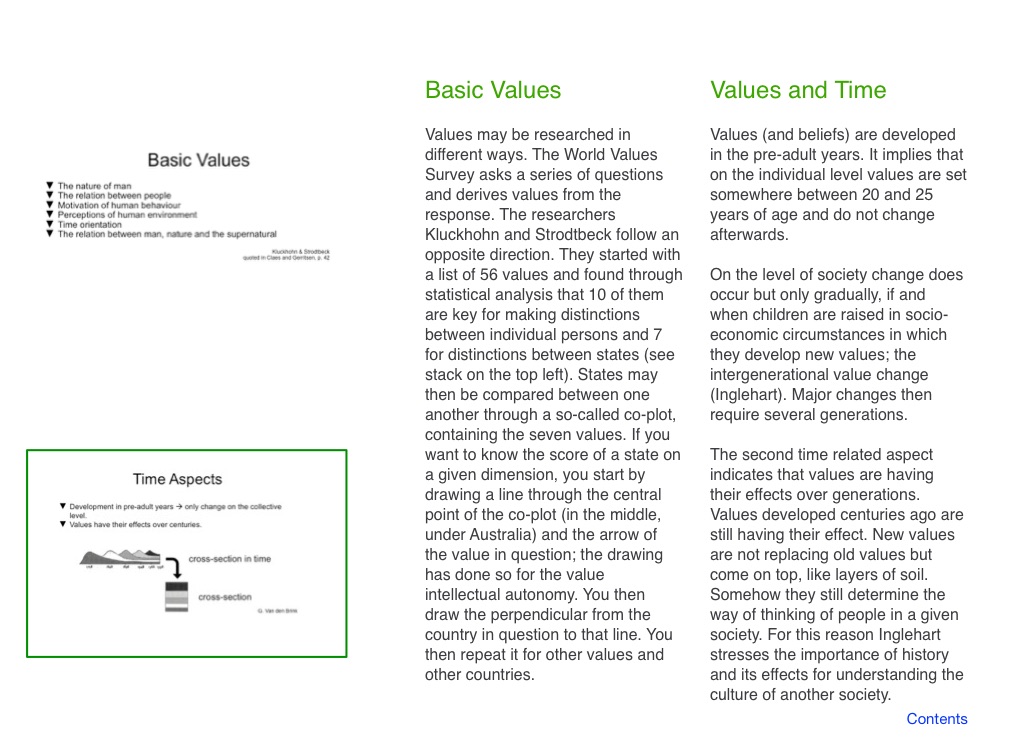
Basic Values Values may be researched in different ways. The World Values Survey asks a series of questions and derives values from the response. The researchers Kluckhohn and Strodtbeck follow an opposite direction. They started with a list of 56 values and found through statistical analysis that 10 of them are key for making distinctions between individual persons and 7 for distinctions between states (see stack on the top left). States may then be compared between one another through a so-called co-plot, containing the seven values. If you want to know the score of a state on a given dimension, you start by drawing a line through the central point of the co-plot (in the middle, under Australia) and the arrow of the value in question; the drawing has done so for the value intellectual autonomy. You then draw the perpendicular from the country in question to that line. You then repeat it for other values and other countries.
Values and Time Values (and beliefs) are developed in the pre-adult years. It implies that on the individual level values are set somewhere between 20 and 25 years of age and do not change afterwards. On the level of society change does occur but only gradually, if and when children are raised in socio-economic circumstances in which they develop new values; the intergenerational value change (Inglehart). Major changes then require several generations. The second time related aspect indicates that values are having their effects over generations. Values developed centuries ago are still having their effect. New values are not replacing old values but come on top, like layers of soil. Somehow they still determine the way of thinking of people in a given society. For this reason Inglehart stresses the importance of history and its effects for understanding the culture of another society.
Contents
European Values Study
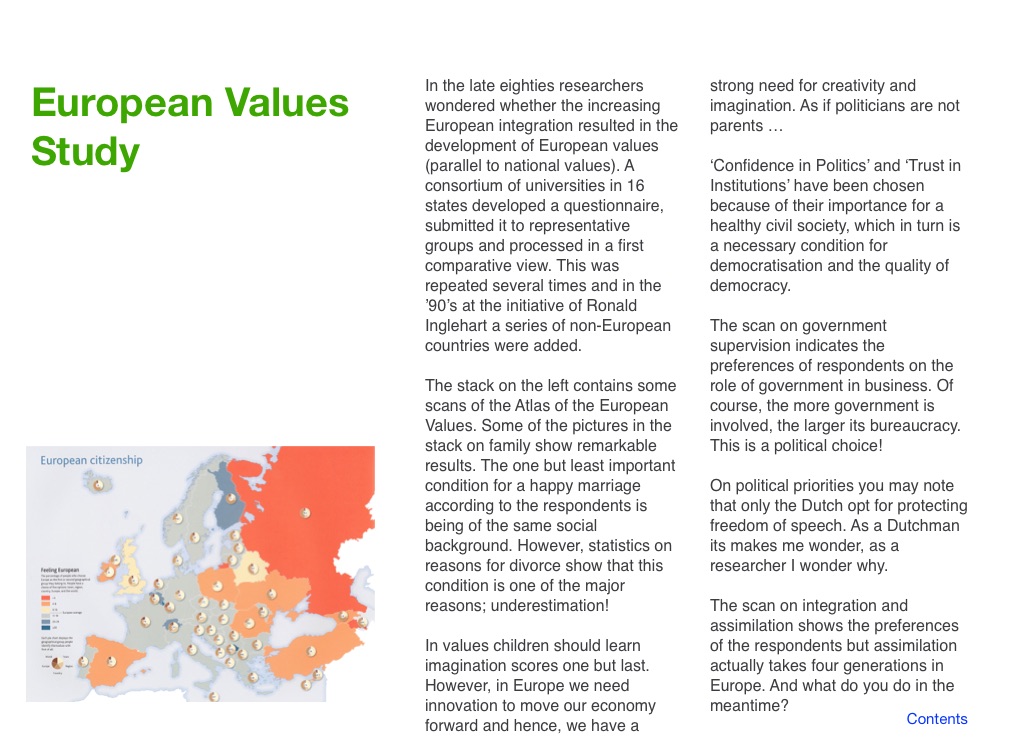
In the late eighties researchers wondered whether the increasing European integration resulted in the development of European values (parallel to national values). A consortium of universities in 16 states developed a questionnaire, submitted it to representative groups and processed in a first comparative view. This was repeated several times and in the ’90’s at the initiative of Ronald Inglehart a series of non-European countries were added. The stack on the left contains some scans of the Atlas of the European Values. Some of the pictures in the stack on family show remarkable results. The one but least important condition for a happy marriage according to the respondents is being of the same social background. However, statistics on reasons for divorce show that this condition is one of the major reasons; underestimation! In values children should learn imagination scores one but last. However, in Europe we need innovation to move our economy forward and hence, we have a
strong need for creativity and imagination. As if politicians are not parents … ‘Confidence in Politics’ and ‘Trust in Institutions’ have been chosen because of their importance for a healthy civil society, which in turn is a necessary condition for democratisation and the quality of democracy. The scan on government supervision indicates the preferences of respondents on the role of government in business. Of course, the more government is involved, the larger its bureaucracy. This is a political choice! On political priorities you may note that only the Dutch opt for protecting freedom of speech. As a Dutchman its makes me wonder, as a researcher I wonder why. The scan on integration and assimilation shows the preferences of the respondents but assimilation actually takes four generations in Europe. And what do you do in the meantime?
Contents
Transformation in Central and Eastern Europe
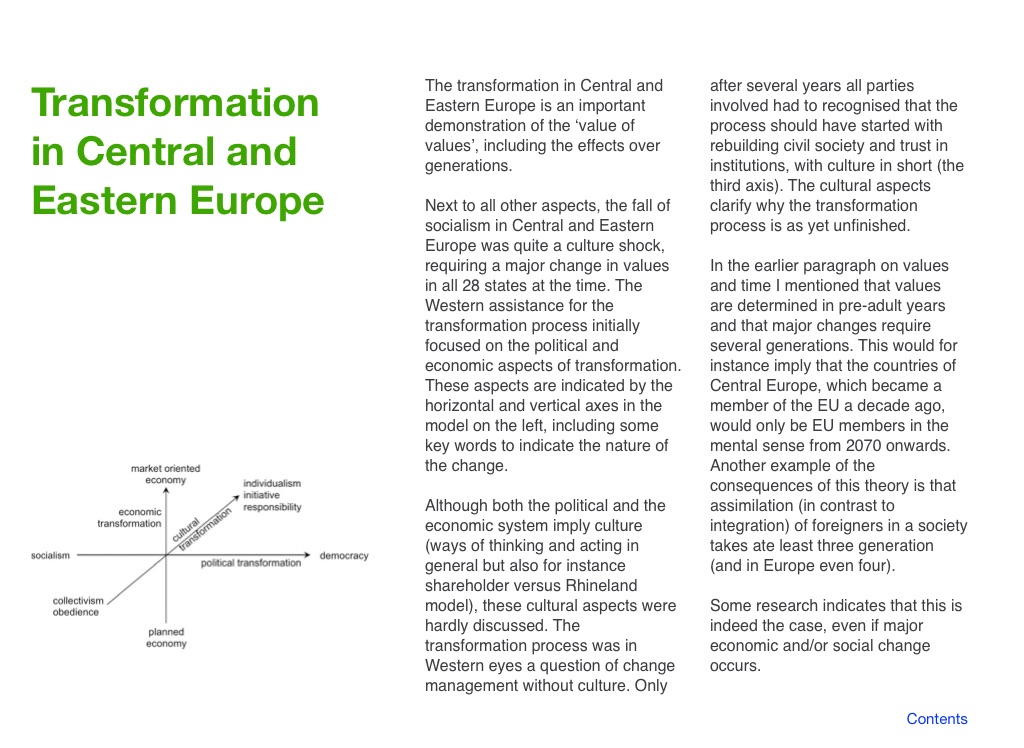
The transformation in Central and Eastern Europe is an important demonstration of the ‘value of values’, including the effects over generations. Next to all other aspects, the fall of socialism in Central and Eastern Europe was quite a culture shock, requiring a major change in values in all 28 states at the time. The Western assistance for the transformation process initially focused on the political and economic aspects of transformation. These aspects are indicated by the horizontal and vertical axes in the model on the left, including some key words to indicate the nature of the change. Although both the political and the economic system imply culture (ways of thinking and acting in general but also for instance shareholder versus Rhineland model), these cultural aspects were hardly discussed. The transformation process was in Western eyes a question of change management without culture. Only
after several years all parties involved had to recognised that the process should have started with rebuilding civil society and trust in institutions, with culture in short (the third axis). The cultural aspects clarify why the transformation process is as yet unfinished. In the earlier paragraph on values and time I mentioned that values are determined in pre-adult years and that major changes require several generations. This would for instance imply that the countries of Central Europe, which became a member of the EU a decade ago, would only be EU members in the mental sense from 2070 onwards. Another example of the consequences of this theory is that assimilation (in contrast to integration) of foreigners in a society takes ate least three generation (and in Europe even four). Some research indicates that this is indeed the case, even if major economic and/or social change occurs.
Contents
Individual and Group
Culture is a characteristic of a group but a group consists of individuals. For this reason the relation between individual and group is a recurrent theme in many studies of culture. An individual may also be perceived as the unique combination of cultures of every group s/he has ever been a member of (see triangle model in Culture 1). From this perspective the distinction between individual and group is not a dichotomy but rather a continuum. Pinto takes the relation between individual and group as the basis of his theories on culture (mentioned in Culture 1 and discussed on the next page). In a group oriented or collective society the individual person is subordinated to the group and the group determines every aspect of life. In individualistic societies the individual person aims at reaching his or her own ends and uses all and everybody in doing so. However, culture is wider than this dimension, nor is it the only determining factor.
Hofstede discusses the dilemma indivudalism - collectivism. Trompenaars uses five dilemmas for it (specific-diffuse, affective-neutral, achievement-ascription, individual-group, universalism-particularism). Solomon and Schell illustrate the idea with three dimensions (personal – transactional, egalitarianism – hierarchy, individual and group). Example A country as the Netherlands is considered to be an individualistic country (in different degrees according to the authors mentioned) and indeed, individualism is stronger than collectivism. This is in line with the Dutch mercantile tradition and its modern economy. However, the Dutch want to eat their cake and have it too. They want the protection of the group as well as the freedom to express themselves about any possible topic in any possible way.
Contents
Pinto
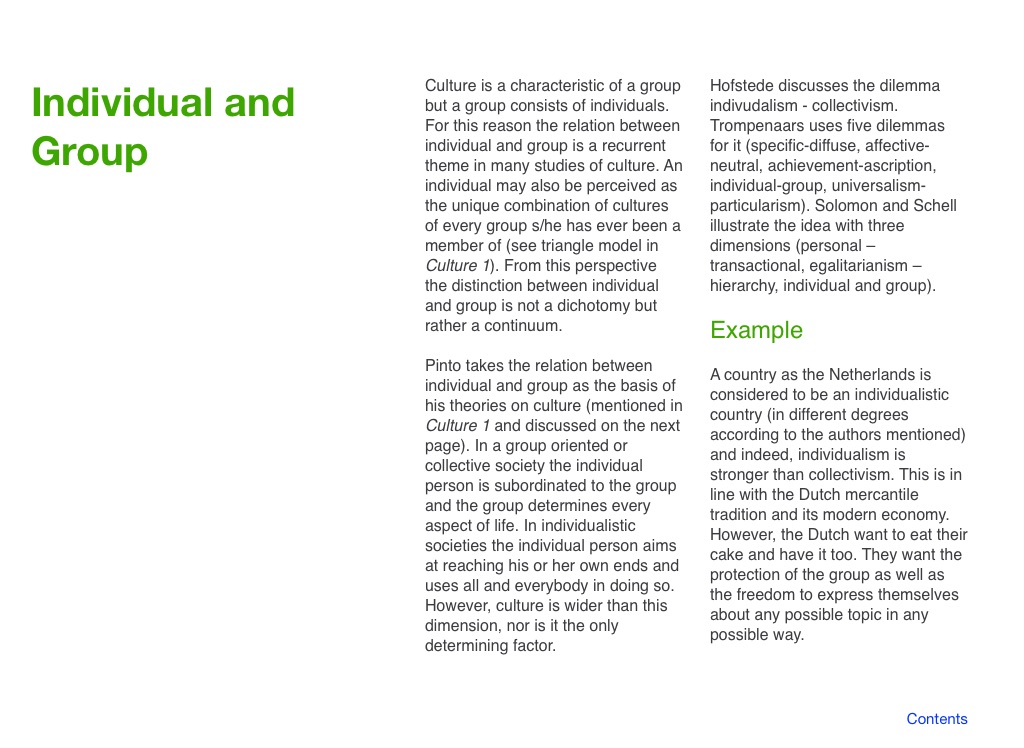
Prof. Pinto uses the terms tight and loose structures for group oriented and individualistic societies respectively. The picture on the top left clarifies this. A tight structure or a small box in the matrix equals a group-oriented culture. In such a culture the focus is on the position of the group in society and the individual person only counts as a member of the group and his/her contribution to the enhancement of the position of that group in society In a somewhat extreme way one may say that the group determines all and everything; what school you are going to, the job you may have, the woman or husband or the house you live in. In such a culture you do not want to do anything on your own, but you try as much as possible to contribute to the performance and position of the group as a whole. The individual has to meet a closely woven set of rules. Correct behaviour is required and you have little choice with regard to your personal contribution. The individual is boxed in, a tight culture, living in the group’s straitjacket.
The loose structure (wide box), representing the individualistic culture, is just the opposite. The individual person has a dream future and s/he uses other people and groups to his/her own ends. You have maximum freedom determining everything. Pinto shows a western or individualistic bias in the thinking about the objectives of people). The illustration on the left below shows the pyramid of Maslow, representing Western thinking about the development of man. In this perception people want to satisfy their primary needs first and then move through phases of uncertainty reduction, acceptance by others, recognition of achievements and self-development. Pinto indicates that the Maslow pyramid only applies to loose structures. Tight structures also start from the fulfilment of primary needs but then continue through pleasing the group , your reputation as a member of that group and the honour of being a member of the group.
Contents
Towards Post-Modern Society
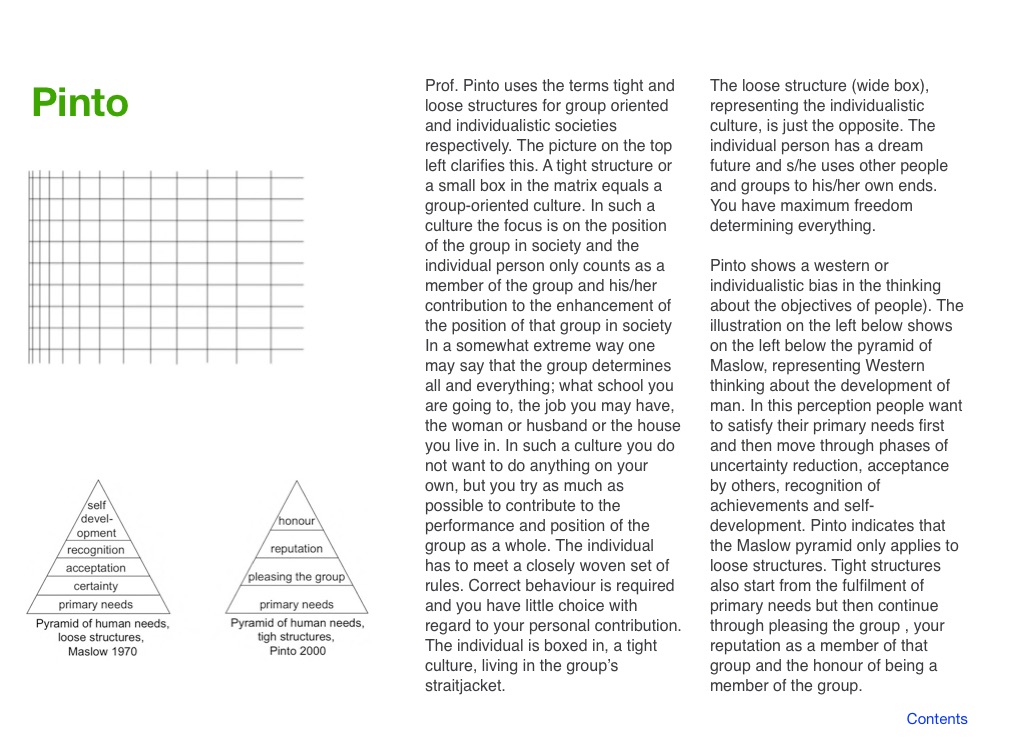
In his book Modernization and Post-modernization (1997) Ronald Inglehart developed on the basis of the World Values Survey a theory on a major shift in society, at present in Western society. As the second image in the stack indicates, mankind has been moving from a society of hunters and gatherers, through agricultural society to modern or industrial society and is now on the brink of post-modern society. Nobody knows yet the nature of this society but it is less about politics and hard work (industrial society) and more about the quality of existence and individual self-expression. Inglehart explains the shift through changes in culture, economics and politics. These are the same starting points for explaining the shift to modern society in the nineteenth century. However, Inglehart states that at present changes occur simultaneously in all three domain, affecting the other two directly.
The starting point may be found in the late sixties when survival ceased to be the prime motivation, due to the availability of retirement funds, unemployment benefits and health insurance. Inglehart plots the values of the 1990 survey on two axes, one from survival to well-being and the other from traditional to secular-rational authority. The values of the four types of societies emerge: left hunters and gatherers society, bottom agricultural society, top industrial society and on the right post-modern society. If you do the same with countries, you see also patterns emerging (but do remember that logistics was down in Central Europe in 1990 and hence, they score close to survival).
Contents
Exercise
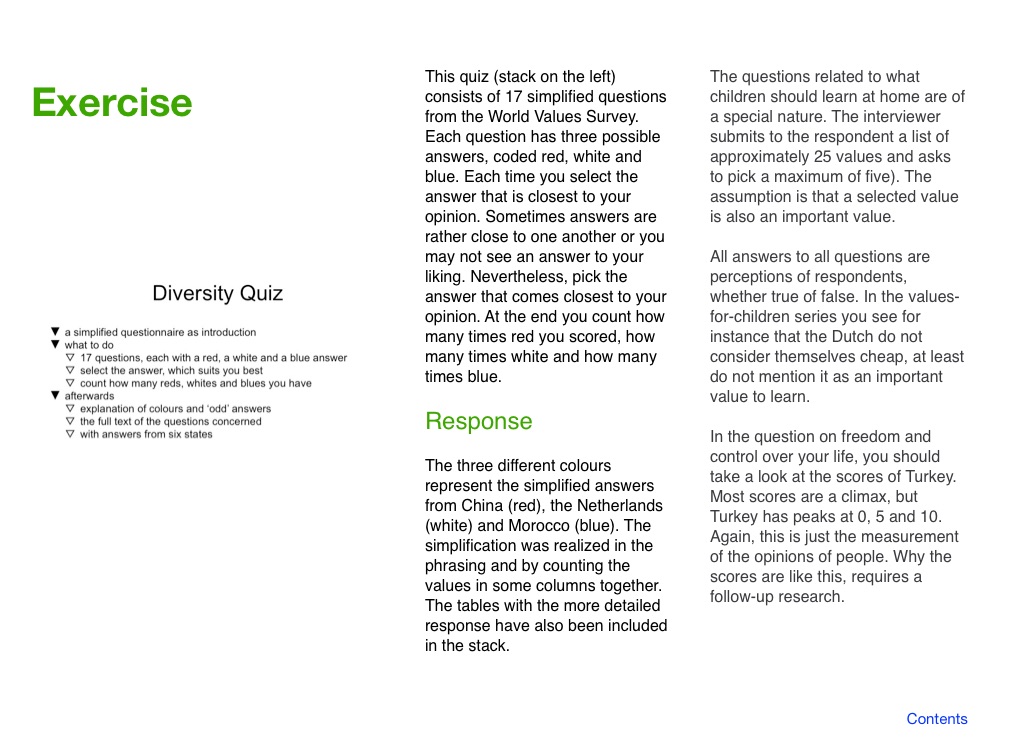
This quiz (stack on the left) consists of 17 simplified questions from the World Values Survey. Each question has three possible answers, coded red, white and blue. Each time you select the answer that is closest to your opinion. Sometimes answers are rather close to one another or you may not see an answer to your liking. Nevertheless, pick the answer that comes closest to your opinion. At the end you count how many times red you scored, how many times white and how many times blue. Response The three different colours represent the simplified answers from China (red), the Netherlands (white) and Morocco (blue). The simplification was realized in the phrasing and by counting the values in some columns together. The tables with the more detailed response have also been included in the stack.
The questions related to what children should learn at home are of a special nature. The interviewer submits to the respondent a list of approximately 25 values and asks to pick a maximum of five). The assumption is that a selected value is also an important value. All answers to all questions are perceptions of respondents, whether true of false. In the values-for-children series you see for instance that the Dutch do not consider themselves cheap, at least do not mention it as an important value to learn. In the question on freedom and control over your life, you should take a look at the scores of Turkey. Most scores are a climax, but Turkey has peaks at 0, 5 and 10. Again, this is just the measurement of the opinions of people. Why the scores are like this, requires a follow-up research.
Contents
Further Reading
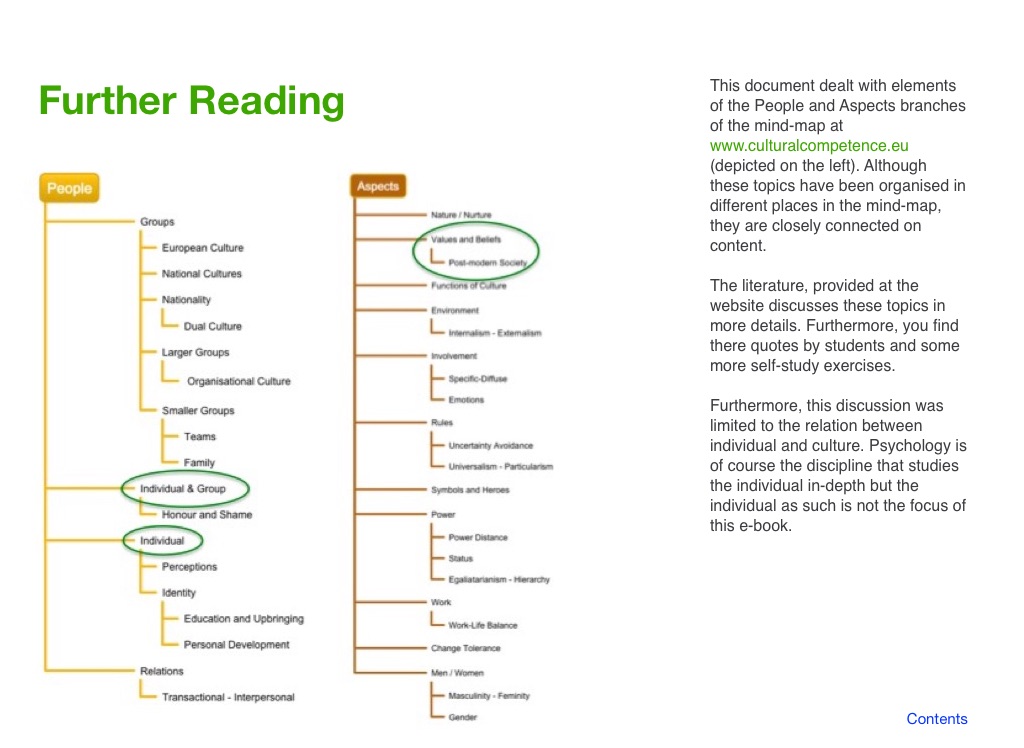
This document dealt with elements of the People and Aspects branches of the mind-map at www.culturalcompetence.eu (depicted on the left). Although these topics have been organised in different places in the mind-map, they are closely connected on content. The literature, provided at the website discusses these topics in more details. Furthermore, you find there quotes by students and some more self-study exercises. Furthermore, this discussion was limited to the relation between individual and culture. Psychology is of course the discipline that studies the individual in-depth but the individual as such is not the focus of this e-book.