







Culture 5 Teams and Projects
Culture 5 Teams and Projects
This document gives an overview of the relations between culture and small groups, in particular teams and families. In addition, a paragraph on culture and projects has been included.
Pieter van Nispen Senior Lecturer and Researcher, retired
February 2018
Table of Contents
page
page
page
page
page
Introduction
Small Groups
Family
Teams in General
Multicultural Teams
page
page
page
page
Richard D. Lewis
Projects
Exercises
Further Reading
Contents
Introduction
In the approach of culture according to the size of groups (see the triangle model in Culture 1), small groups are the third layer. From a business perspective, you may think of teams but culture casts a wider net, e.g. a family, a sports team or some volunteers that take care of flowers in a church. The focus in this e-book is on teams at work (public, private, civil society), either with one or more than one nationality. Nevertheless, in view of the importance of families in enculturation and the development of values, a paragraph on family has been included as well. Many teams work on projects, a specific task that demands dedicated attention from some people, benefitting either the parent organisation or a customer. In that sense, the juxtaposition of teams and project makes sense. On the other hand, culture has a strong influence on projects and deserves its own publication. In view of the limited research in this field, it would provide hardly any answers and raise only questions.
Overview This series of e-books is based on triangle model of culture, which in turn is based on the size of groups. In previous e-books the very large groups (national culture, multicultural society) and the large groups (organisational culture) were discussed. This e-book focuses on the small group. After some general remarks, the best-known small group, i.e. family is discussed. The focus then moves to teams in general and multicultural teams in particular. Projects are discussed in this document as well because they are often realised by teams.
Contents
Small Groups
In a large group the overall intensity of mutual relations is lower than in a small group. If this large group represents an organisation, the focus is on the realisation of the objectives of that organisation. The individual person is not so much seen in terms of a person but rather as the contribution to that realisation of objectives; more or less qualified for a job. Small groups on the other hand allow people to know one another as persons, with all the related good and bad habits, not as a means to an end and primarily realising the objectives of the organisation. Just because of this aspect of being known individually, a small group may have a strong impact on a person. A simple reflection on the family you grew up in and its consequences may serve as an example. In the same vein a team at work may affect the working climate for better or worse and the dissolution of the team may take much of the work motivation with it. People in a small group react to one another and show specific
behaviour. At the interaction level an individual has to clarify his or her questions, points of view, interests and so on, as well as to understand the points of the other. Lewin describes the behaviour of a group as a function of personal factors and the environment. Such interaction results in the small group’s own culture e.g. the use of certain words, specific behaviour, common opinions and the reference to common experiences. Groups may also face an inherent tension between the interests of individuals versus those of the group as a whole. Personal factors include personality traits, status, authority, communication styles and patterns, co-ordination, personal advantage, socialisation, freeloaders and expectations of the members of the team. Environmental factors deal with the organisation as a whole, the place of the team in that larger whole, the expectations of that environment (management, colleagues, customers), the availability of people, organisational and national cultures and management styles.
The closeness between the people does however also forbid any socially unaccepted behaviour.
Usually, culture is shared by a group of people but this does not necessarily mean that each member of the group shares every feature and value of this particular culture group.
Contents
Family
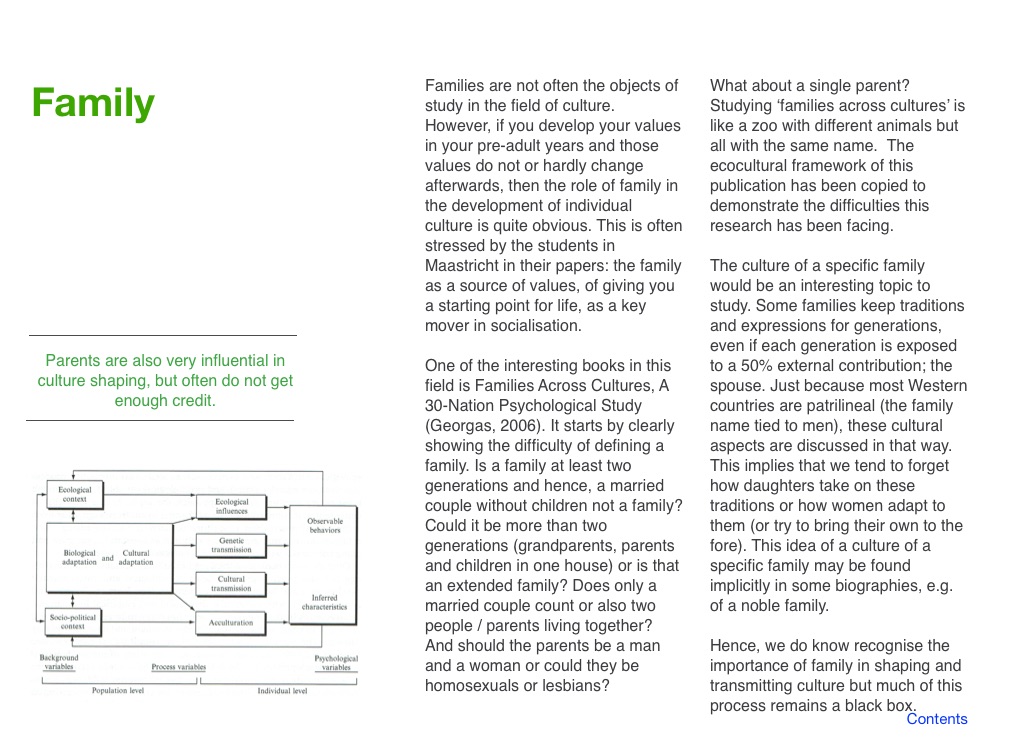
Families are not often the objects of study in the field of culture. However, if you develop your values in your pre-adult years and those values do not or hardly change afterwards, then the role of family in the development of individual culture is quite obvious. This is often stressed by the students in Maastricht in their papers: the family as a source of values, of giving you a starting point for life, as a key mover in socialisation. One of the interesting books in this field is Families Across Cultures, A 30-Nation Psychological Study (Georgas, 2006). It starts by clearly showing the difficulty of defining a family. Is a family at least two generations and hence, a married couple without children not a family? Could it be more than two generations (grandparents, parents and children in one house) or is that an extended family? Does only a married couple count or also two people / parents living together? And should the parents be a man and a woman or could they be homosexuals or lesbians?
What about a single parent? Studying ‘families across cultures’ is like a zoo with different animals but all with the same name. The ecocultural framework of this publication has been copied to demonstrate the difficulties this research has been facing. The culture of a specific family would be an interesting topic to study. Some families keep traditions and expressions for generations, even if each generation is exposed to a 50% external contribution; the spouse. Just because most Western countries are patrilineal (the family name tied to men), these cultural aspects are discussed in that way. This implies that we tend to forget how daughters take on these traditions or how women adapt to them (or try to bring their own to the fore). This idea of a culture of a specific family may be found implicitly in some biographies, e.g. of a noble family. Hence, we do know recognise the importance of family in shaping and transmitting culture but much of this process remains a black box.
Parents are also very influential in culture shaping, but often do not get enough credit.
Contents
Teams in General
A team is a specific way to realise the objectives of an organisation. You may define conditions for the successful use of this approach now and again and it may also be a standard way of doing things. In both cases teams have a relation with organisational and national culture (from opposed to aligned). Teams may be approached from several perspectives: its success or failure in meeting its objectives (not always effective or efficient); its development (e.g. orientation, conflict, norming, performing en dissolving); its functioning (management, decision-making, groupthink, procedures); the interaction between its members (roles); the team’s culture (identity, rules, behaviour, status, co-operation, competition, conflict, communication patterns, commonalities and differences with the organisation as a whole). Furthermore, the study of teams should include its environment with mutual influences (e.g. parent organisation, relations with other groups, internal or external customers, expectations).
In a wider sense some cultures are more suitable for teamwork than others (e.g. in dealing with conflicts, focus on harmony, priority to family or work, influence of religion and morality, preference for hierarchy). As a consequence multicultural teams may be an advantage but could block any progress just as well. This is also a factor in a multicultural society, in particular the degree of integration in the dominant national culture (e.g. preferences for roles within ethnic groups). The decision to start a team is the outcome of a process. A decision sounds so simple but we cannot ignore the temptation to point out the difficulties in reaching that stage. Why would you as a manager, like to start a team? Why cannot the problems in question be solved by the standing organisation? Do you want a permanent or a temporary team? What tasks is the team going to get, which responsibilities, which means? How do you delineate these tasks and what is the interrelationship between the tasks
Contents
and others in the organisation? What disciplines, knowledge, skills and experience need to be available within the team? What type of people do you select and how well should they fit together (personal chemistry)? Easy questions, difficult answers. From different angles research has been done in how people work together in groups (in terms of personality and roles, e.g. Belbin). The outcomes are not always complementary to one another and neither are these outcomes readily available as an instrument for management. In day-to-day reality managers often have a need for a team and only a limited number of people who might be a member of the proposed team. In such a situation the manager does not have the ‘luxury’ to determine whether individuals fit specific criteria for optimal team co-operation or whether all possible positions (on the basis of this or that theory) have been covered. However, with a theory in hand and with hindsight the manager may better understand what went wrong or could have been done better.
The identity of a small group is different than that of other small groups. It has its own nature and its own history although the differences are sometimes hard to pinpoint. The rules, set at the beginning determine a lot of the actual development of the team. A team develops common norms, common interpretations and applications of norms in the day-to-day working environment. These norms form the basis of a team’s culture, separating one team from the other. A team has to agree on its objectives and to make the best of realising them. This struggle is in itself an important source for the team’s culture (and of course the theories may help in sorting things out). A team’s culture is in most cases different from the organisation’s culture, simply because different groups have different ways of thinking and acting. The team’s culture does not need to be aligned with the culture of the parent organisation (fit). Some difference is unavoidable because the team members are not representative for the organisation
the most successful groups … had three characteristics, the really successful teams. First of all, they showed high degrees of social sensitivity to each other. (…)Secondly, the successful groups gave roughly equal time to each other, so that no one voice dominated, but neither were there any passengers. And thirdly, the more successful groups had more women in them. Margaret Heffernan in her Ted-talk
Contents
as a whole; another group of people, another interplay, another culture. Sometime the team’s culture (its way of doing things) may be deliberately at odds with the organisational culture as a whole, for instance when the team has to realise a major change in the co-operation between employees and hence, the organisational culture (deliberate anti-fit). The degree in which the organisational culture and the team’s culture differ from one another and the desirability of the gap need further research attention. The discussion of a team should include the simple fact that the team consist of individuals. If you approach the issue from this angle, other points of attention come to the fore: personal gain (status, career, influence), personal development, the difference between group behaviour and personal behaviour, adaptation, socialisation (learning how to be a good member of the group) and personal space (literally and figuratively). If you feel at ease within a specific small group, you may recognise an overlap between your own identity and that of the
group. Such a situation of identification with the group also implies a personal involvement of the individual person. The groupceases to be only a means to specific end, like earning money. Another aspect of involvement is a concern about the other members of the group. At work a group motivates and stimulates you to give your best. Avoiding uncertainty in the context of the small group may be considered as the other side of the coin of involvement. If you can show the appropriate behaviour (independent of its cultural definition) by adhering to the written and unwritten rules of the small group then you do not need to feel uncertain. The small group functions as a compass for the way to go or rather act. Normal behaviour is the behaviour the group expects from you and if you prefer to behave in a different way, you have to face the music. Dissenting behaviour ultimately results in the termination of your membership of that group or such internal tension that the group ceases to function.
Contents
Multicultural Teams
Multicultural teams consist in different forms, ranging from teams with participants with different nationalities to teams that monitor the international aspects of the company’s environment. Multicultural teams need to deal with cultural differences between countries, e.g. different perceptions of hierarchy, co-operation or time management. These teams also face differences in organisational cultures, e.g. within a joint venture. The research, providing handles for such situations, is still rather limited. You can easily imagine a situation in which one team member takes initiative and self-responsibility as starting points and the other the order given by the boss. They will not be able to deliver results (without further intervention). This mix of national and organisational cultures is one of the major problems expats are facing (conflict on how things are done in the home country and in the host country). And how does the expat fits in the host country?
In his book Mind your Manners John Mole mentions a series of topics of possible conflict within a multicultural team. ▼ Language: for some the chosen language is more of an advantage than for others ▼ Expectations vis-à-vis function and outcome ▼ Preparation: from thorough to hardly at all ▼ Attendance: who will attend, how many, status, seniority, discipline (walking in and out) ▼ Punctuality: start, end, punctuality, deadlines ▼ Agenda: strictly follow the agenda or be flexible ▼ Chair: strict control, flexible, challenging chair or not ▼ Participation: on content, position or process, interruptions, contradicting one another, rational or emotional, formal or flexible, pragmatic / realistic, humour ▼ Consensus: degree of being committed to outcome ▼ Follow-up: focus on implementation of result or spirit of co-operation
Contents
Richard D. Lewis
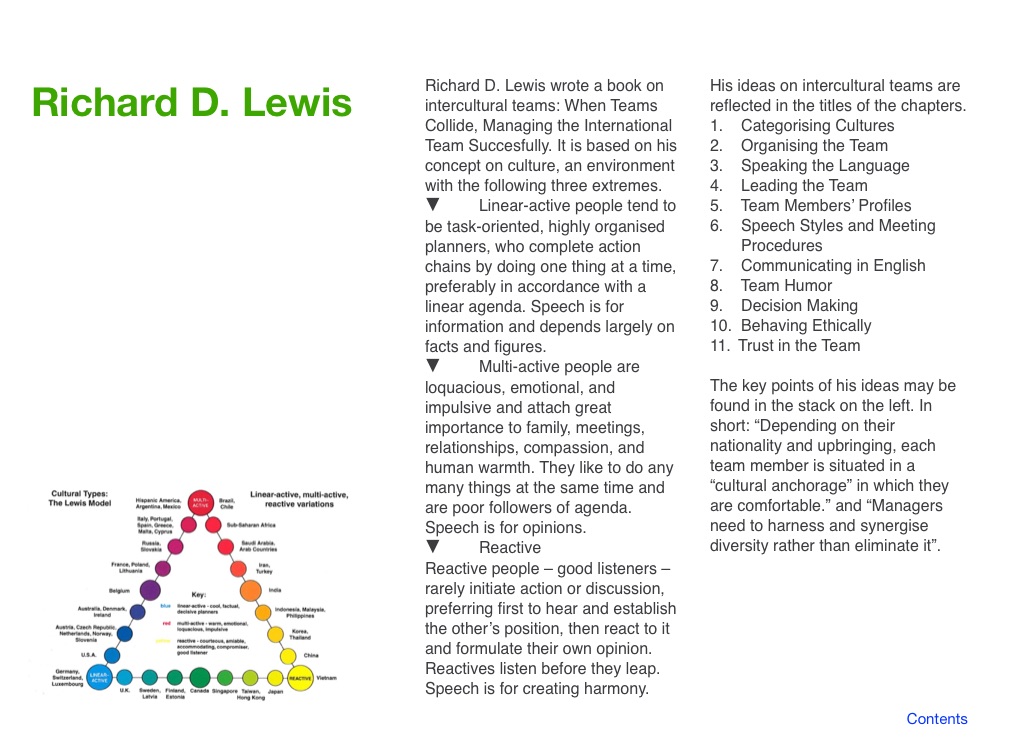
Richard D. Lewis wrote a book on intercultural teams: When Teams Collide, Managing the International Team Succesfully. It is based on his concept on culture, an environment with the following three extremes. ▼ Linear-active people tend to be task-oriented, highly organised planners, who complete action chains by doing one thing at a time, preferably in accordance with a linear agenda. Speech is for information and depends largely on facts and figures. ▼ Multi-active people are loquacious, emotional, and impulsive and attach great importance to family, meetings, relationships, compassion, and human warmth. They like to do any many things at the same time and are poor followers of agenda. Speech is for opinions. ▼ Reactive people – good listeners – rarely initiate action or discussion, preferring first to hear and establish the other’s position, then react to it and formulate their own opinion. Reactives listen before they leap. Speech is for creating harmony.
His ideas on intercultural teams are reflected in the titles of the chapters. 1. Categorising Cultures 2. Organising the Team 3. Speaking the Language 4. Leading the Team 5. Team Members’ Profiles 6. Speech Styles and Meeting Procedures 7. Communicating in English 8. Team Humor 9. Decision Making 10. Behaving Ethically 11. Trust in the Team The key points of his ideas may be found in the stack on the left. In short: “Depending on their nationality and upbringing, each team member is situated in a “cultural anchorage” in which they are comfortable.” and “Managers need to harness and synergise diversity rather than eliminate it”.
Contents
Projects
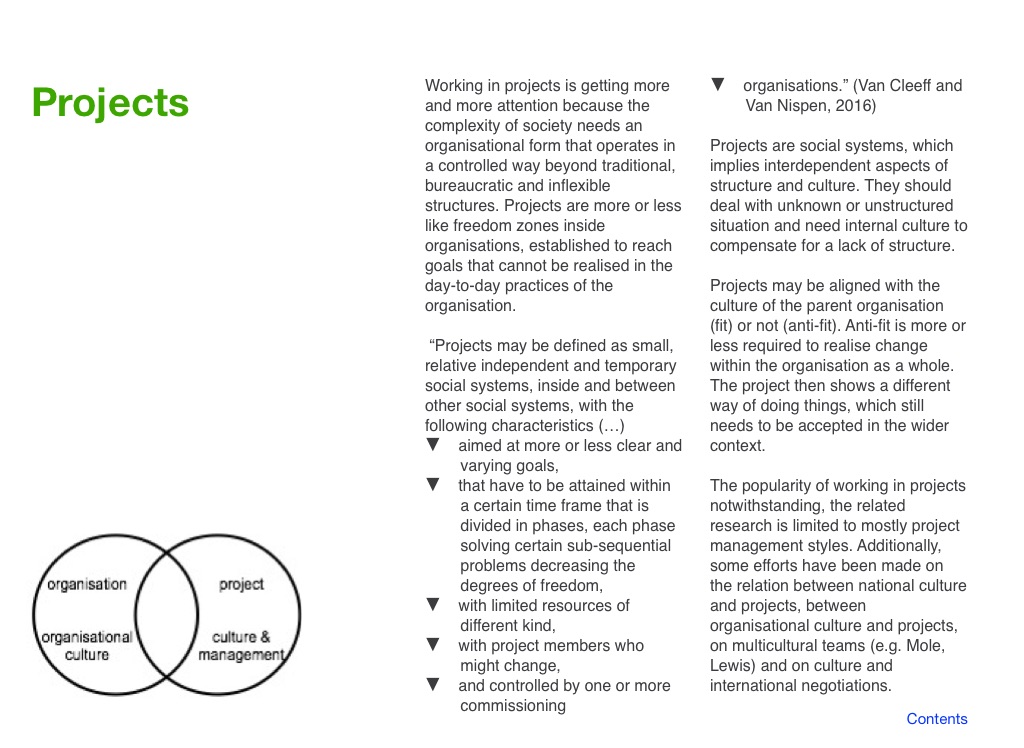
Working in projects is getting more and more attention because the complexity of society needs an organisational form that operates in a controlled way beyond traditional, bureaucratic and inflexible structures. Projects are more or less like freedom zones inside organisations, established to reach goals that cannot be realised in the day-to-day practices of the organisation. “Projects may be defined as small, relative independent and temporary social systems, inside and between other social systems, with the following characteristics (…) ▼ aimed at more or less clear and varying goals, ▼ that have to be attained within a certain time frame that is divided in phases, each phase solving certain sub-sequential problems decreasing the degrees of freedom, ▼ with limited resources of different kind, ▼ with project members who might change, ▼ and controlled by one or more commissioning
▼ organisations.” (Van Cleeff and Van Nispen, 2016) Projects are social systems, which implies interdependent aspects of structure and culture. They should deal with unknown or unstructured situation and need internal culture to compensate for a lack of structure. Projects may be aligned with the culture of the parent organisation (fit) or not (anti-fit). Anti-fit is more or less required to realise change within the organisation as a whole. The project then shows a different way of doing things, which still needs to be accepted in the wider context. The popularity of working in projects notwithstanding, the related research is limited to mostly project management styles. Additionally, some efforts have been made on the relation between national culture and projects, between organisational culture and projects, on multicultural teams (e.g. Mole, Lewis) and on culture and international negotiations.
Contents
In general, the focal points of each project method may on the one hand reflect a structural and cultural weakness of the surrounding system. In this situation people are aware of this weakness and the models reflect this awareness. On the other hand, the focal points of the project method may reflect blind spots, resulting in bias and weaknesses. The lack of research is demonstrated by the following list of project variables and the possible effect of culture on these variables. This list also shows that a more comprehensive theoretical framework for classifying projects, their variables and the effects of culture is required, as well as the ways and means to use them in practice. ▼ Cultural context: economic system, state, region, sector, organisation ▼ Culture type: e.g. Dreimüller, Hofstede Organisational Culture Model
▼ Nature of the project (internal – external, duration, scope, complexity, number of people involved, number of degrees of freedom, research required or not, sub-projects or not, on its own or part of a programme) ▼ Project organisation (management: method, on process or content; organisation: different per phase or not; internal: matrix, co-ordination; external; control; actors and their participation) ▼ Scope / responsibility ▼ Result of the project (product, service, change, other; content: technical, organisation, cultural) ▼ Parent organisation (organisational characteristics; parent and project; sector)
Contents
Exercises
Teams One of the often-quoted theories on team roles is based on the research by Belbin; see http://www.belbin.com/about/belbin-team-roles/. The full questionnaire to determine whether your personality fits better with this or that team role is protected for commercial reasons. However, you might find a few somewhat simplified free versions on the internet. Another way to approach the issue of where you stand in terms of team co-operation is by being honest to yourself. On internet you find lots of information on team roles. You may read a bit of it and recognise where your strengths might well be.
Family A (nucleus) family is a small group of people like a team but in a family more things are at play: (lifelong) relationships, dependency (parent – child), love, 24/7. In short, a family is much more intense and more complex. One student decided to write her paper on culture in the form of a (virtual) letter to her parents. In it she analysed how her youth had been shaping her through all the cultures of all groups she was a member of at the time (and in part still is). Try to do the same, looking back on your past and how it impacts you.
Contents
Further Reading
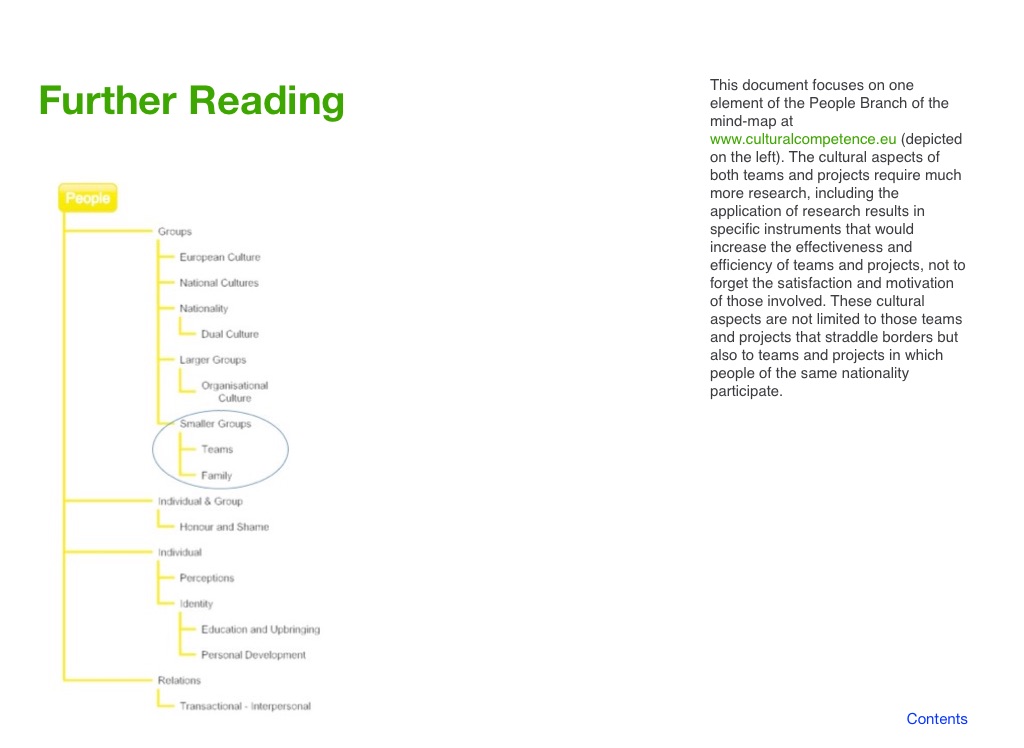
This document focuses on one element of the People Branch of the mind-map at www.culturalcompetence.eu (depicted on the left). The cultural aspects of both teams and projects require much more research, including the application of research results in specific instruments that would increase the effectiveness and efficiency of teams and projects, not to forget the satisfaction and motivation of those involved. These cultural aspects are not limited to those teams and projects that straddle borders but also to teams and projects in which people of the same nationality participate.