







Culture 7 Communication
Culture 7 Communication
This document introduces communication as the flipside of culture; culture exists in its expression. The process of communication is discussed, as well as the effects of differences in (national) cultures on communication.
Pieter van Nispen Senior Lecturer and Researcher, retired
March 2018
Table of Contents
page
page
page
page
page
Introduction and Overview
Communication Model of Communication
Aspects of Communication
Communication across borders Johari Window
Model Revisited
page
page
page
page
page
Aspects Revisited
Hall’s Handles
Direct versus Indirect Communication
Exercises
Further Reading
Contents
Introduction
This document is part of larger project to bring the reality and theory of culture together. At its core it the website www.culturalcompetence.eu. The model used has the size of groups as its starting point, ranging from very large groups through larger and smaller groups to the individual. This idea is summarised in the triangle model of culture (see Culture 1). Communication is the flipside of culture because culture only exists in its communication to others . The study of communication as a process in society is a fairly new discipline and this applies even more so to communication across borders. These borders could national ones as in communication across national cultures but are not limited to them. In line with the triangle model of culture the argument applies to the border of larger and smaller groups as well; e.g. organisational culture and the culture of a family or a team (see Culture 4 and Culture 5). I am using deliberately the term 'communication across cultures',
trying to find a neutral term. More common terms are 'intercultural communication' and 'cross-cultural communication' but both are not correct from a scientific point of view. 'Inter~' in the strict sense refers to differences and 'cross~' points at commonalities. Effective communication across cultures requires the reconciliation of differences and commonalities, a process in which both play their role. Such a situation is formally called transcultural communication. Although the term is not quite common in day-to-day discussions, it hints at the idea of a higher order and hence, indicates the objective of communication across borders. Overview First the process of communication is briefly discussed, just to give you an idea. In the second part the cultural factors of the communication process are introduced. Whatever model of communication you use, every aspects of it is influenced by culture!
I also read this year a meta-study on the different ways of communicating. Logical scientific communication is based on facts and logical reasoning. It appear to me the best way to explain how things are structured in outline. An anecdote is no proof, I want to see hard data. However, in narrative communication it is all about anecdotes and communication from which someone has to derive the bigger picture. Several studies now show that the latter way of communication functions much better. Ionica Smeets, de Volkskrant (Dutch newspaper), December 24th, 2015.
Contents
Communication
Culture would have no effect without communication and at the same time provides the codes for effective communication. This close interrelationship between culture and communication is also visible in the study of communication. Whatever model of communication you take, each aspect of it is influenced by culture. For this reason, dealing with cultural differences is more often than not a question of adjusting ways and means of communication. In one way, we all know what communication is, but a closer look shows a series of complexities. When two people talk to one another, it is communication. The communication partners do not need to be near one another; they do not even have to know one another (e.g. billboard, architecture).
The study of communication may focus on the process as such, aspects of communication, layers of communication, forms of communication and more. A simple model of communication is sufficient to realise that many communication problems may occur. The basic idea is the need for alignment between sender and receiver to get the message across.
Contents
Model of Communication
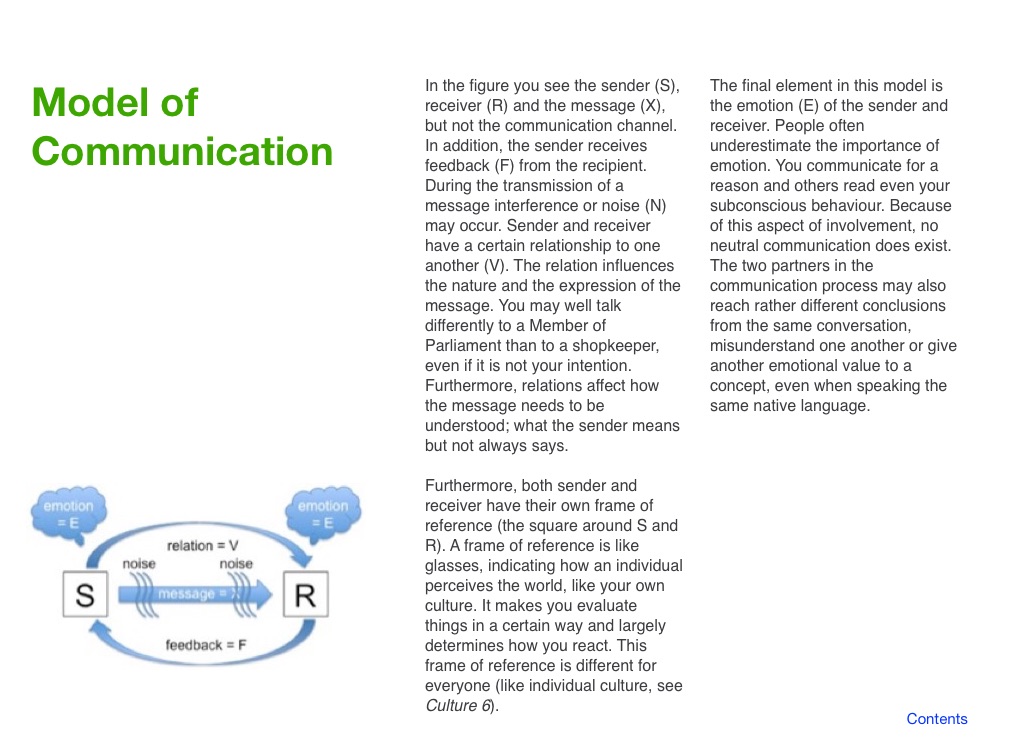
In the figure you see the sender (S), receiver (R) and the message (X), but not the communication channel. In addition, the sender receives feedback (F) from the recipient. During the transmission of a message interference or noise (N) may occur. Sender and receiver have a certain relationship to one another (V). The relation influences the nature and the expression of the message. You may well talk differently to a Member of Parliament than to a shopkeeper, even if it is not your intention. Furthermore, relations affect how the message needs to be understood; what the sender means but not always says. Furthermore, both sender and receiver have their own frame of reference (the square around S and R). A frame of reference is like glasses, indicating how an individual perceives the world, like your own culture. It makes you evaluate things in a certain way and largely determines how you react. This frame of reference is different for everyone (like individual culture, see Culture 6).
The final element in this model is the emotion (E) of the sender and receiver. People often underestimate the importance of emotion. You communicate for a reason and others read even your subconscious behaviour. Because of this aspect of involvement, no neutral communication does exist. The two partners in the communication process may also reach rather different conclusions from the same conversation, misunderstand one another or give another emotional value to a concept, even when speaking the same native language.
Contents
Aspects of Communication
Next to the development of models of communication, aspects of the process have been studied. Communication may for instance be understood in terms of four layers: procedure (such as face-to-face conversation, gestures, telepathy, smoke signals, light signals, signal flags, Morse, telex, letter, telephone, fax, advertising, billboards, e-mail), content, relations and emotion. Our present society has many relatively new forms of communication, becoming more and more common. The question is whether the new communication tools are just that (new) or do they result in different relationships? E-mail has breached hierarchical parts of the government and new forms of coordination have emerged. Communication may also be divided into language, tone of voice and body language. The psychologist Albert Mehrabian demonstrated that (in specific circumstances) a face-to-face conversation consists of only 7% of the content of words, 38% of tone of voice (all sound with the exception of the words itself) and
55% of body language. Whether these percentages are exactly right, is not that important; the division is. Normally you are thinking of what you want to say, the content but that encompasses only 7% of the conversation. Of course, you try to pass on the message as good as possible, including the use of sound and body language. However, the use of the last two is rather subconscious. You are even unable to influence certain aspects of body language and the message of these aspects may even conflict with the conscious message. The division also clarifies why writing a text and getting the message across in that way is so difficult; you depend only on the 7%! This is also true for the right interpretation of such messages. Some gestures are positive in one culture but offensive in another. Part of body language is biological and part of it is learned (cultural body language). Important is always to see body language in the context of the bigger communication picture in order to reach a proper understanding. The interpretation of
Contents
body language is difficult because it may well depend on the culture of the other (what you observe and what it means). The appropriate reading and use of body language takes quite a bit of training and practice. Language As mentioned above language makes up only a small part of communication. However, the power of language should not be underestimated; think for instance about novels that bring people to tears or page-turners, both involving people by calling on their imagination and empathy. Languages also reflect the variety of human beings. The differences between languages should not only be understood in terms of different words and grammar but also by different sounds or the pitch (as in tonal languages like Chinese or Igbo). In total approximately 6,000 languages are spoken. Some of them will probably disappear in the near future due to the very limited number of native speakers. Even if you do not know such a language,
its disappearance is impoverishment ("… any mans death diminishes me, because I am involved in Mankinde …", John Donne). Tone of Voice Tone of voice (voice language, paralinguistic) is probably more subconsciously applied than language but more consciously than body language. You may think of volume, pitch, articulation, voice quality (e.g. hoarse), speed of talking, rhythm, sighing, throat scraping, sniffing, laughing, giggling, weeping, yawning, words without their own meaning (e.g. oh), hesitations, time-out and emphasis. Body Language Body language consists of all movements and postures of the body, or a part of our body, when we talk to others. Some of this is innate, the rest we learn through education and the like. This also implies that we cannot control every part of our
Contents
body. We make quite a few movements whether we like it or not. Especially these subconscious movements are the 'traitors'. If the other they can 'read' them, s/he knows what you feel or think, however you do your best to hide it. Incidentally, many learned gestures seem difficult to influence because they are deeply integrated after many years. In fact, you don't recognise those gestures when looking at yourself. Students often know the fixed gestures of teachers betters than teachers themselves. These gestures usually form the basis for imitating someone. Based on Mehrabian's percentage body language is more important in conveying a message than substance and tone, but most of us do not come much further than a certain facial expression or hand gesture, perhaps a knee under the table. Body language is also getting more and more attention. Some people are better in reading and using body language (encoding and decoding) than others and generally women are better at it than men; nature and
nurture? Reading the body language of older people is generally more difficult than that of younger people, because the muscles of older people function less. The various gestures, movements and postures need to be seen in conjunction and in the context of the conversation. Otherwise, you can quickly make a mistake. Suppose you see someone sitting hunched on a bench on the street. You can think of a defensive posture, but if you see the bus stop and realise that it was a cold day, the attitude is just a reaction to the temperature. In order to prevent miscommunication in a short written text like an e-mail body language may be reflected in communication by using smileys or emoticons. However, be careful when using emoticons across borders, because research has shown that culture affects the use and 'reading' of emoticons.
Contents
Communication across Borders
In view of the discussion of communication, the difficulty of communicating across borders is easy to understand. Probably because of the myriad aspects no comprehensive study in the field is available, leave alone with practical tools. The Johari window (next page) demonstrates some of the difficulties. The study by Edward and Mildred Hall indicates some of the differences in this communication. In addition some specific aspects have been studied, such as direct versus indirect communication. And the study by Hoffman (the TOPOI model) allows us to analyse afterwards what went wrong in the communication (discussed on the website). Communication across cultures involves by definition different ways of thinking, feeling and acting. Some researchers have defined the concept as the situation in which two people do not speak the same native language. If that would apply, British and American people do not have communication differences (and no related cultural differences) between them! The difference is not
in the language but in the process of communication (reference frameworks, ways of sending a message, receiving and understanding a message and not to forget differences in body language and tone of voice). Language differences are an important aspect of communication across borders but they do not define the concept. Communication is not a mere trick. One may approach it as such in exchanging messages but this will not result in real and authentic mutual contact. Communicating in that way is close to manipulation and once the other actor gets that impression more harm is done than gains achieved. Communication is a prime factor in coping with cultural diversity and requires a higher level of communication which both reconciles differences and commonalities (trans-cultural communication). Because cultural (de)coding presupposes cultural sophistication, communication across borders requires cultural competence.
Contents
Johari Window
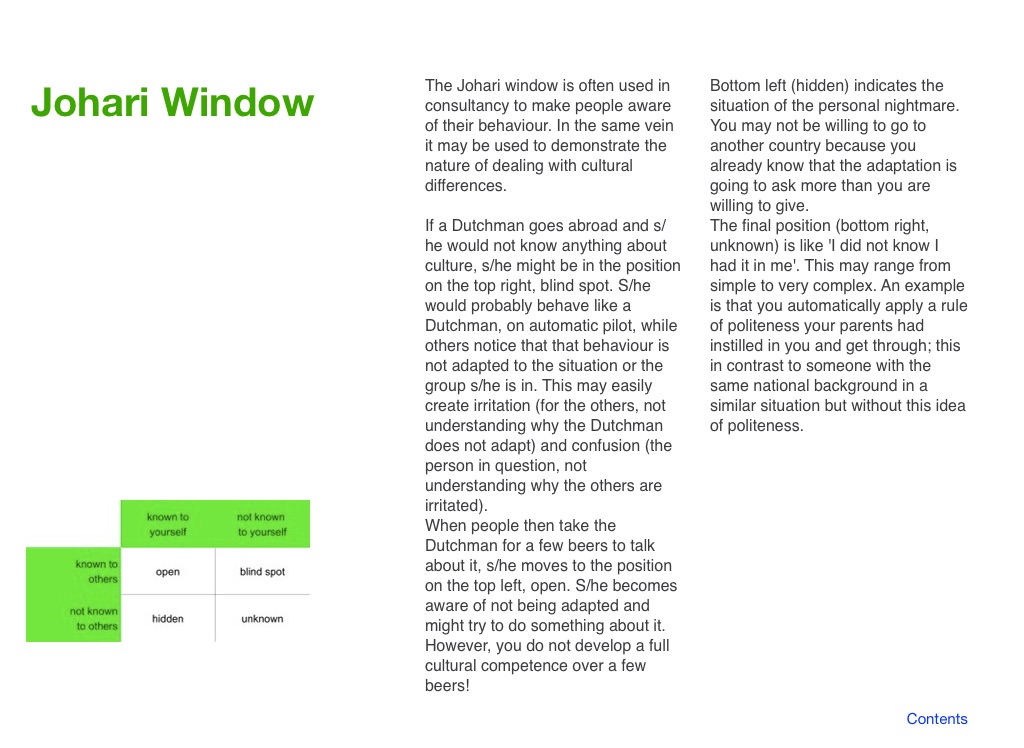
The Johari window is often used in consultancy to make people aware of their behaviour. In the same vein it may be used to demonstrate the nature of dealing with cultural differences. If a Dutchman goes abroad and s/he would not know anything about culture, s/he might be in the position on the top right, blind spot. S/he would probably behave like a Dutchman, on automatic pilot, while others notice that that behaviour is not adapted to the situation or the group s/he is in. This may easily create irritation (for the others, not understanding why the Dutchman does not adapt) and confusion (the person in question, not understanding why the others are irritated). When people then take the Dutchman for a few beers to talk about it, s/he moves to the position on the top left, open. S/he becomes aware of not being adapted and might try to do something about it. However, you do not develop a full cultural competence over a few beers!
Bottom left (hidden) indicates the situation of the personal nightmare. You may not be willing to go to another country because you already know that the adaptation is going to ask more than you are willing to give. The final position (bottom right, unknown) is like 'I did not know I had it in me'. This may range from simple to very complex. An example is that you automatically apply a rule of politeness your parents had instilled in you and get through; this in contrast to someone with the same national background in a similar situation but without this idea of politeness.
Contents
Model Revisited
Cultural aspects are reflected in each communication model. For example, transmitter and receiver each have their own culture (triangle model). This is most apparent in everyone's reference frame, the way the sender encrypts the message and the receiver decodes the message. The intent of the sender does not automatically come across to the recipient. The message itself is often a cultural issue because not every message is important in every culture. And not all cultures use the same channels. Furthermore, the degree of suitability of a certain channel for a certain message differs per culture. Can you dismiss someone from a job via a text message? Yes, in the U.S., no in the Netherlands. Feedback is a message in itself with the cultural aspects of the framework. Cultural differences often create more noise because the partners are less aligned, like a radio that is not properly tuned. The relationship of transmitter and receiver relative to each other can have different meanings in different cultures (a teacher has more status in Finland than in the Netherlands;
the use of levels of Javanese depend on social position). The same applies to the concept of context. Emotions also have a cultural aspect, because the values of feeling differ by culture.
Contents
Aspects Revisited
Language In terms of dealing with cultural differences language is often considered the gate to the other culture. Normally people in the host country appreciate the modest effort of greeting or thanking in their language, because it shows good intentions and an interest in the other. Within the domain of culture language is a necessary part of communication, in particular on the national level. In an organisation one may use a different language than is common in the host country (e.g. English in an international firm). Some families have specific words of phrases and an individual often uses language in his or her own way. A language can have words for concepts that in other languages hardly exist. Not only is language important in terms of the influence of culture on the content of concepts, but also how people think about a particular concept.
Tone of Voice Tone of voice differs per culture, sometimes overlapping, sometimes different. If someone scrapes his throat before saying something, it may imply that he asks for attention or that he has something difficult to say. An important cultural difference may be found in the use of silence in the conversation. People in Eastern Asia appreciate periods of silence in a conversation but people in Western Europe and North America easily feel uncomfortable. Think for instance of a detective movie in which the detective uses silence to get the suspect talking.A specific element of tone of voice is a word that has the same sound but quite a different meaning in another language. If people toast one another in a pub in the Netherlands they may say Proost! With the same pronunciation it means You stupid in Romanian. Tone of voice across borders is difficult because of its subconscious
Contents
nature. Of course, we all try to bring an awful message across in a friendly way, but we rarely take voice lessons to get everything out of our voice. And it is still the question what may be used deliberately or not (biologically determined or not). What in one language may sound friendly, doesn't need to sound friendly in another language. Sometimes people say that a particular language sounds friendly or sounds sharp, while they do not speak the language. Body Language Body language, the number of its aspects and their meaning is studied in more and more detail. All in all, it is way too much to consider when you are just talking to someone from another culture but the awareness of some of these points may already help. Much of body language is on a subconscious level, resulting in misunderstanding and even insult in communicating across cultures
without any intent to do so. Lots of books and websites show for instance identical gestures with completely different meanings in different cultures. External appearance have both biological and cultural aspects. The biological aspects may in turn also get a cultural meaning. Examples are skin colour and the 'scary, dark man'; male or female and (sub)domination and subordination; height as a characteristic of power; age and the wise old man; effects of diseases. The face is a mixture of biological and cultural aspects as well. If we are happy, we laugh, but how we laugh is another story. Culture has a strong impact on body language. Major domains include proxemics and territoriality (mostly the preferred distance between people); kinesics, movement and posture; gestures; greeting; facial expression; chronemics (aspects of time); haptics (touching); clothing and physical appearance; olfactics (smell and its influence). More details may be found on the website.
Contents
Hall’s Handles
In their book Understanding cultural differences (1990) Edward and Mildred Hall looked at nine aspects of communication across borders. ▽▽ fast and slow messages: sending messages with a different speed, depending on whether or not a message can be quickly understood and responded to. ▽ high and low context: the degree of common background of parties concerned; discussed below in some more detail ▽ space: territoriality, personal space, the multi-sensory spatial experience, unconscious reactions to spatial differences ▽ mono-chronic and poly-chronic time perception, the relation between time and space, poly- chronic time and information, past- and future-oriented countries; whether people do one thing at the time, step-by- step (similar to Lewis' concept of linear cultures) or are involved in more than one thing at a time (like Lewis' multi-active) ▽ time as communication: tempo, rhythm, and synchrony; scheduling and lead time; the importance of proper timing; appointments ¸
▽ awareness of fast and slow information flow ▽ awareness of a chain of actions as necessary steps to an objective. An action chain is the sequence of events in which people work together to achieve a goal. When a step in the sequence is omitted, rushed, or delayed (e.g. as the result of a cultural difference), the goal is unattainable. ▽ interfacing: creating the proper fit ▽ releasing the right responses High and low context probably received most attention. Context is strongly related to culture and includes historical background, relationship, status, mood, time of day and the place where the communication takes place. Low context cultures are those in which people do not have much information about one another and nearly everything needs to be spelled out in detail. Its opposite is high context cultures.
Contents
Direct versus Indirect Communication
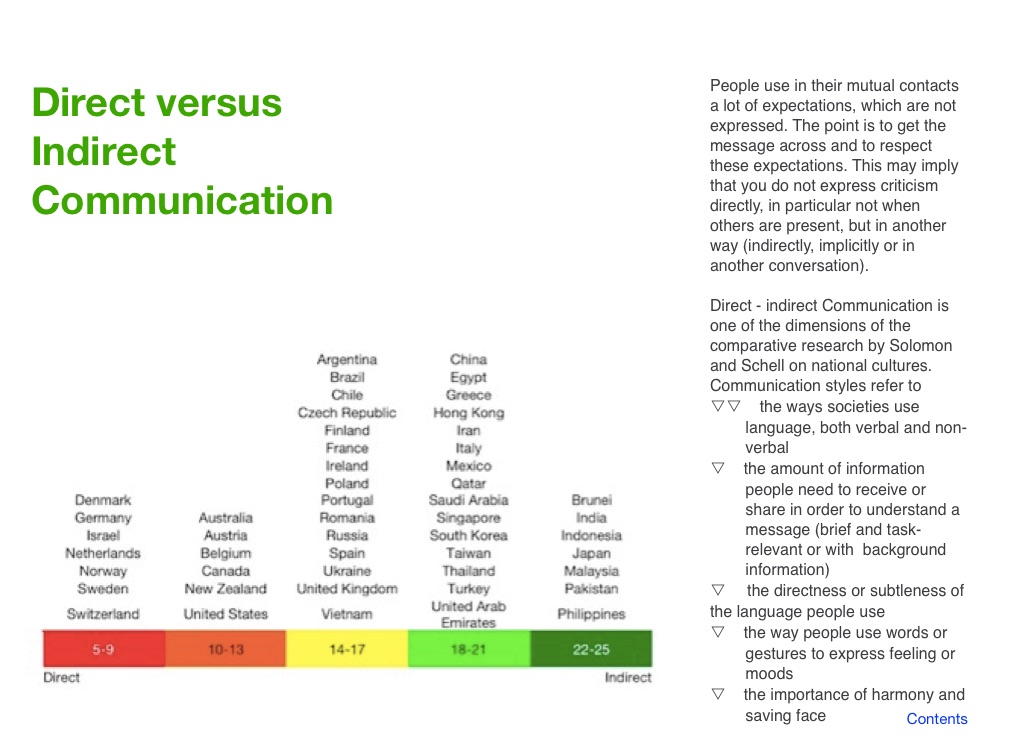
People use in their mutual contacts a lot of expectations, which are not expressed. The point is to get the message across and to respect these expectations. This may imply that you do not express criticism directly, in particular not when others are present, but in another way (indirectly, implicitly or in another conversation). Direct - indirect Communication is one of the dimensions of the comparative research by Solomon and Schell on national cultures. Communication styles refer to ▽▽ the ways societies use language, both verbal and non- verbal ▽ the amount of information people need to receive or share in order to understand a message (brief and task- relevant or with background information) ▽ the directness or subtleness of the language people use ▽ the way people use words or gestures to express feeling or moods ▽ the importance of harmony and saving face
Contents
Exercises
Communication Styles On internet you may find the test on communication styles, developed by Thomas Kilmann. The formal term 'conflict mode questionnaire' may be a bit off-putting. However, when communication faces difficulties, the situation may be understood as cultural conflict. Response The outcome shows strongest communication style. However, in terms of dealing with cultural differences, you should be able to deal with all five styles with equal competence, depending the situation. Nobody will fit this ideal picture. Nevertheless, the test shows where your strong suit is and what might be a point of attention. At the same time you should be aware of the pitfall of automatically following your preferred style of communication.
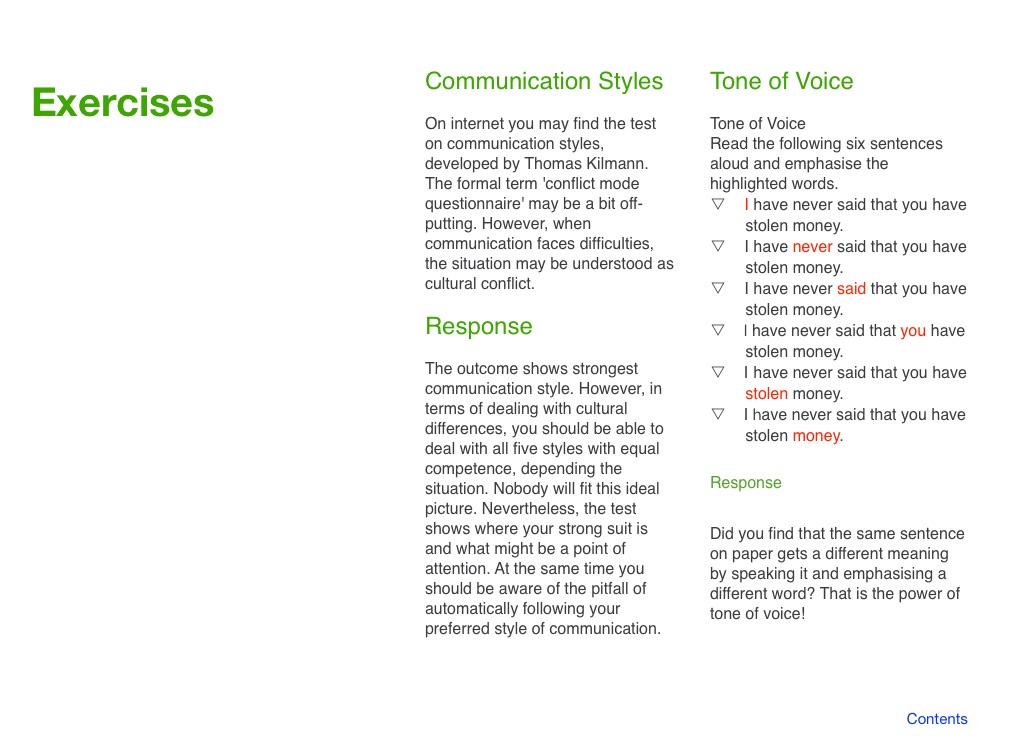
Tone of Voice Tone of Voice Read the following six sentences aloud and emphasise the highlighted words. ▽ I have never said that you have stolen money. ▽ I have never said that you have stolen money. ▽ I have never said that you have stolen money. ▽ I have never said that you have stolen money. ▽ I have never said that you have stolen money. ▽ I have never said that you have stolen money. Response Did you find that the same sentence on paper gets a different meaning by speaking it and emphasising a different word? That is the power of tone of voice!
Contents
Further Reading
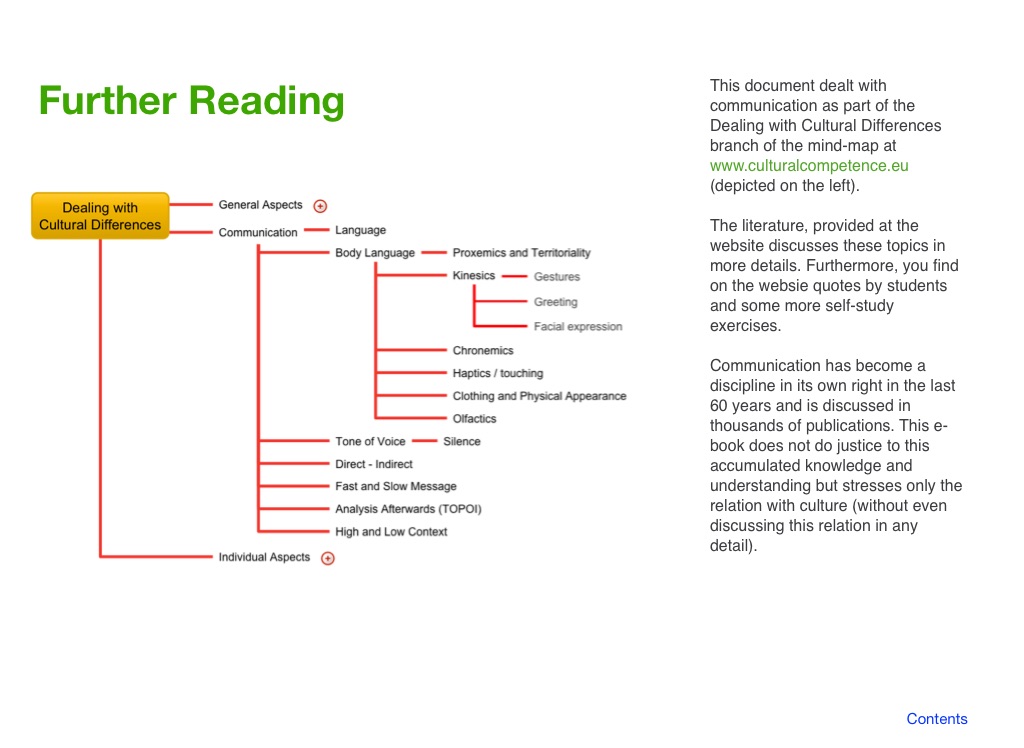
This document dealt with communication as part of the Dealing with Cultural Differences branch of the mind-map at www.culturalcompetence.eu (depicted on the left). The literature, provided at the website discusses these topics in more details. Furthermore, you find on the websie quotes by students and some more self-study exercises. Communication has become a discipline in its own right in the last 60 years and is discussed in thousands of publications. This e-book does not do justice to this accumulated knowledge and understanding but stresses only the relation with culture (without even discussing this relation in any detail).