







Culture 10 Cultural Competence
Culture 10 Cultural Competence
A distinction in the duration of a visit to another country (duty trip, exchange, expat, living abroad) results in different requirements regarding culture.
Pieter van Nispen Senior Lecturer and Researcher, retired
April 2018
Table of Contents
page
page
page
page
page
Introduction and Overview
Cultural Competence: the Concept
Cultural Competence: Knowledge
Cultural Competence: Skills
Cultural Competence: Attitudes
page
page
page
page
page
Acquiring Cultural Competence
Handling Differences
Exercise Cultural Competence
Response to Exercise Cultural Competence
Further Reading
Contents
Introduction
This document is part of larger project to bring the reality and theory of culture together. At its core it the website www.culturalcompetence.eu, based on the mind-map and the triangle model of culture. The triangle model has the size of groups as its starting point, ranging from very large groups through larger and smaller groups to the individual. Cultural competence draws the lines of this series of e-books together. This concept indicates how each of us may deal with culture. Each of us deals with culture in every contact, albeit at the subconscious level. Moving it up to conscious level, helps you in understanding yourself (individual culture), clarifies aspects of job, sport or hobby (organisational culture, team culture), highlights the difficulties of the multicultural society and indicates the differences between states (national cultures).
However, this learning process is not a simple one, like reading a book or following training. The focus is on the continuous process itself; the goal is clear but you also know that you will never reach it – like life itself. Just because a human being is not perfect, you can only improve your cultural competence but not mastering it. Having a good level of cultural sophistication, cultural preparations will be more efficient (one knows what to look for) and more effective (one knows why). Overview This e-book consist of three parts. ▼ the idea of cultural competence by illustrating its three main components, knowledge, skills and attitudes ▼ acquiring cultural competence ▼ dealing with cultural differences.
Contents
The Concept
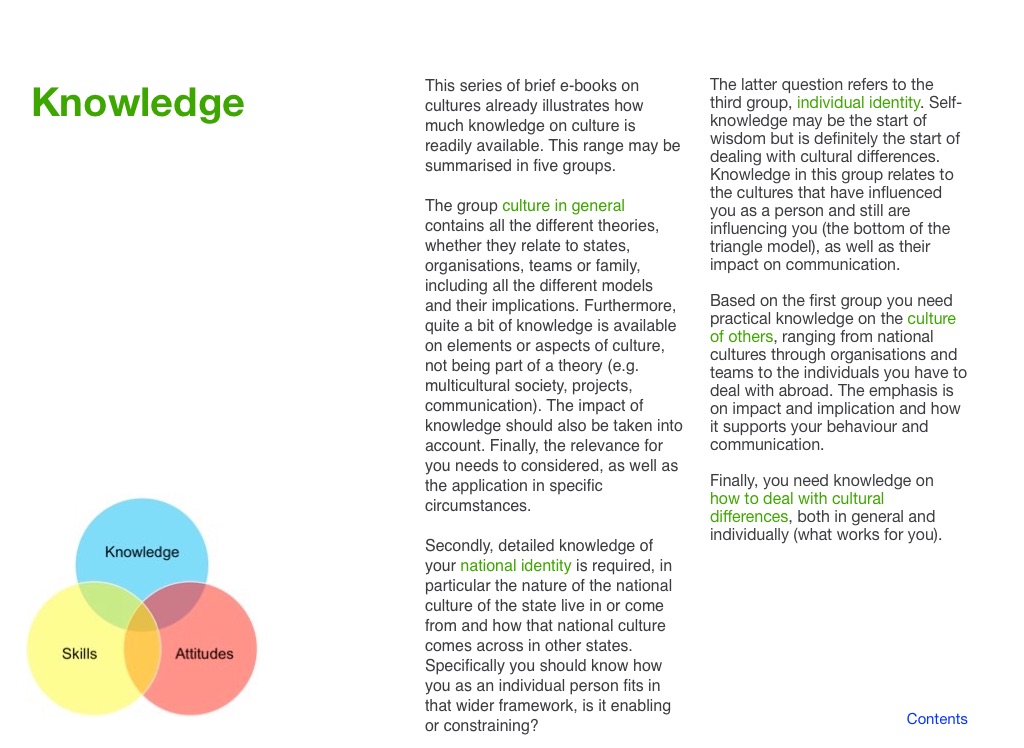
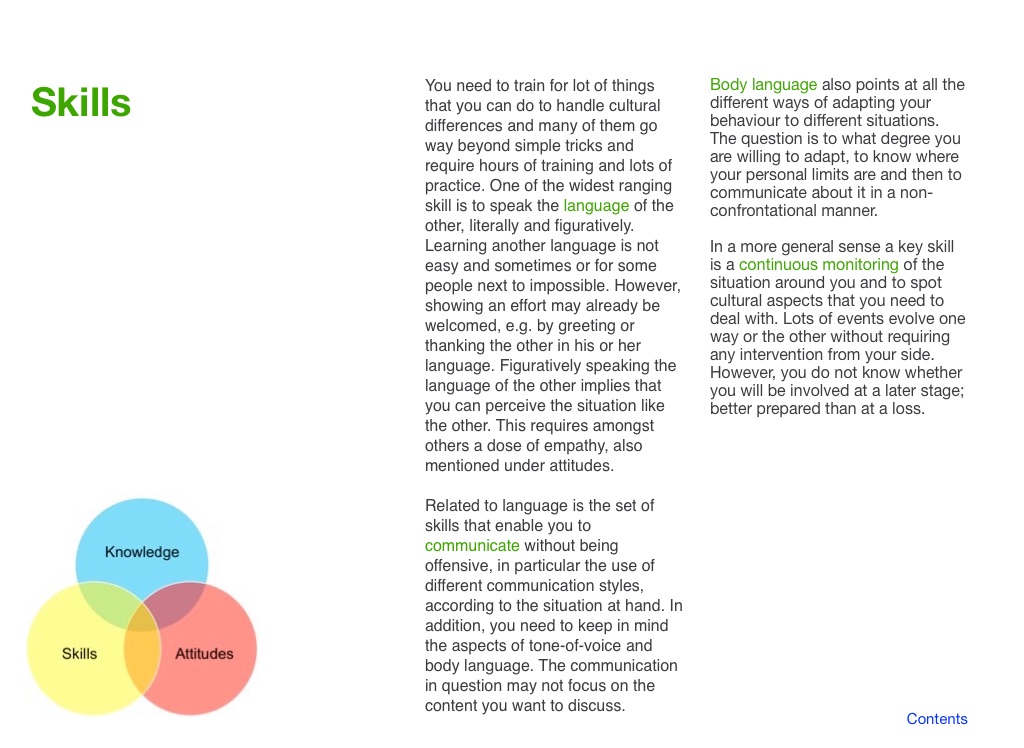
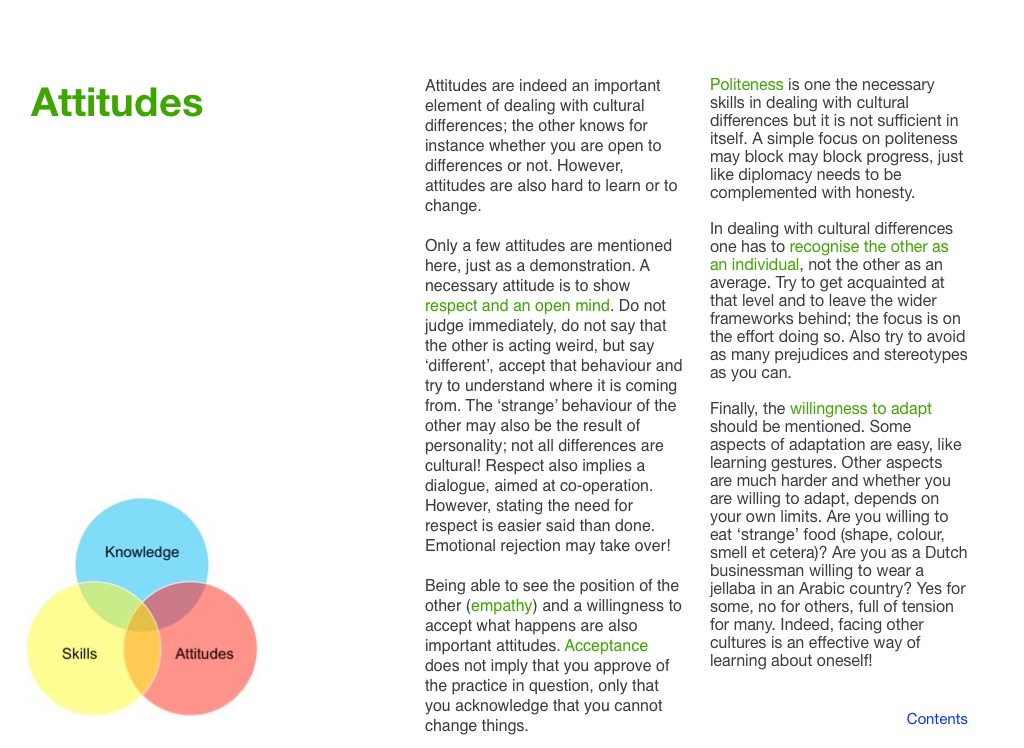
In Dutch educational theory a competence is an integral combination of knowledge, skills and attitudes. Approximately ten competences define a specific job. Cultural competence is then a set of knowledge, skills and attitudes and their interaction in relation to culture. At first glance it resembles the idea of Cultural Intelligence or CQ of Thomas and Inkson, an integral combination of knowledge, behavioural skills (instead of skills) and mindfulness (just one of the range of necessary attitudes). The interrelationship of the three elements is manifold but may be summarised as follows. Knowledge works through skills, and attitudes enable successful implementation; experience then feeds into knowledge again and different circumstances shed new light on lessons learnt earlier. Preparations for dealing with another culture become over time more effective and efficient.
The concept of cultural competence is more like a helicopter view than the tricks-of-the-trade of intercultural or cross-cultural communication. It does not offer any standard solution but enables you to find a proper solution in every situation in which culture appears to be a stumbling block. Many authors have drafted lists of points of attention for dealing with cultural differences and internet contains dozens of them (with different qualities of course). The point is that you may them learn by heart but to apply them on the spot is quite a different thing. Furthermore, what works for the one, does not work for the other; do not bluff if you do not have a poker face.
Contents
Knowledge
This series of brief e-books on cultures already illustrates how much knowledge on culture is readily available. This range may be summarised in five groups. The group culture in general contains all the different theories, whether they relate to states, organisations, teams or family, including all the different models and their implications. Furthermore, quite a bit of knowledge is available on elements or aspects of culture, not being part of a theory (e.g. multicultural society, projects, communication). The impact of knowledge should also be taken into account. Finally, the relevance for you needs to considered, as well as the application in specific circumstances. Secondly, detailed knowledge of your national identity is required, in particular the nature of the national culture of the state live in or come from and how that national culture comes across in other states. Specifically you should know how you as an individual person fits in that wider framework, is it enabling or constraining?
The latter question refers to the third group, individual identity. Self-knowledge may be the start of wisdom but is definitely the start of dealing with cultural differences. Knowledge in this group relates to the cultures that have influenced you as a person and still are influencing you (the bottom of the triangle model), as well as their impact on communication. Based on the first group you need practical knowledge on the culture of others, ranging from national cultures through organisations and teams to the individuals you have to deal with abroad. The emphasis is on impact and implication and how it supports your behaviour and communication. Finally, you need knowledge on how to deal with cultural differences, both in general and individually (what works for you).
Contents
Skills
You need to train for lot of things that you can do to handle cultural differences and many of them go way beyond simple tricks and require hours of training and lots of practice. One of the widest ranging skill is to speak the language of the other, literally and figuratively. Learning another language is not easy and sometimes or for some people next to impossible. However, showing an effort may already be welcomed, e.g. by greeting or thanking the other in his or her language. Figuratively speaking the language of the other implies that you can perceive the situation like the other. This requires amongst others a dose of empathy, also mentioned under attitudes. Related to language is the set of skills that enable you to communicate without being offensive, in particular the use of different communication styles, according to the situation at hand. In addition, you need to keep in mind the aspects of tone-of-voice and body language. The communication in question may not focus on the content you want to discuss.
Body language also points at all the different ways of adapting your behaviour to different situations. The question is to what degree you are willing to adapt, to know where your personal limits are and then to communicate about it in a non-confrontational manner. In a more general sense a key skill is a continuous monitoring of the situation around you and to spot cultural aspects that you need to deal with. Lots of events evolve one way or the other without requiring any intervention from your side. However, you do not know whether you will be involved at a later stage; better prepared than at a loss.
Contents
Attitudes
Attitudes are indeed an important element of dealing with cultural differences; the other knows for instance whether you are open to differences or not. However, attitudes are also hard to learn or to change. Only a few attitudes are mentioned here, just as a demonstration. A necessary attitude is to show respect and an open mind. Do not judge immediately, do not say that the other is acting weird, but say ‘different’, accept that behaviour and try to understand where it is coming from. The ‘strange’ behaviour of the other may also be the result of personality; not all differences are cultural! Respect also implies a dialogue, aimed at co-operation. However, stating the need for respect is easier said than done. Emotional rejection may take over! Being able to see the position of the other (empathy) and a willingness to accept what happens are also important attitudes. Acceptance does not imply that you approve of the practice in question, only that you acknowledge that you cannot change things.
Politeness is one the necessary skills in dealing with cultural differences but it is not sufficient in itself. A simple focus on politeness may block may block progress, just like diplomacy needs to be complemented with honesty. In dealing with cultural differences one has to recognise the other as an individual, not the other as an average. Try to get acquainted at that level and to leave the wider frameworks behind; the focus is on the effort doing so. Also try to avoid as many prejudices and stereotypes as you can. Finally, the willingness to adapt should be mentioned. Some aspects of adaptation are easy, like learning gestures. Other aspects are much harder and whether you are willing to adapt, depends on your own limits. Are you willing to eat ‘strange’ food (shape, colour, smell et cetera)? Are you as a Dutch businessman willing to wear a jellaba in an Arabic country? Yes for some, no for others, full of tension for many. Indeed, facing other cultures is an effective way of learning about oneself!
Contents
Acquiring
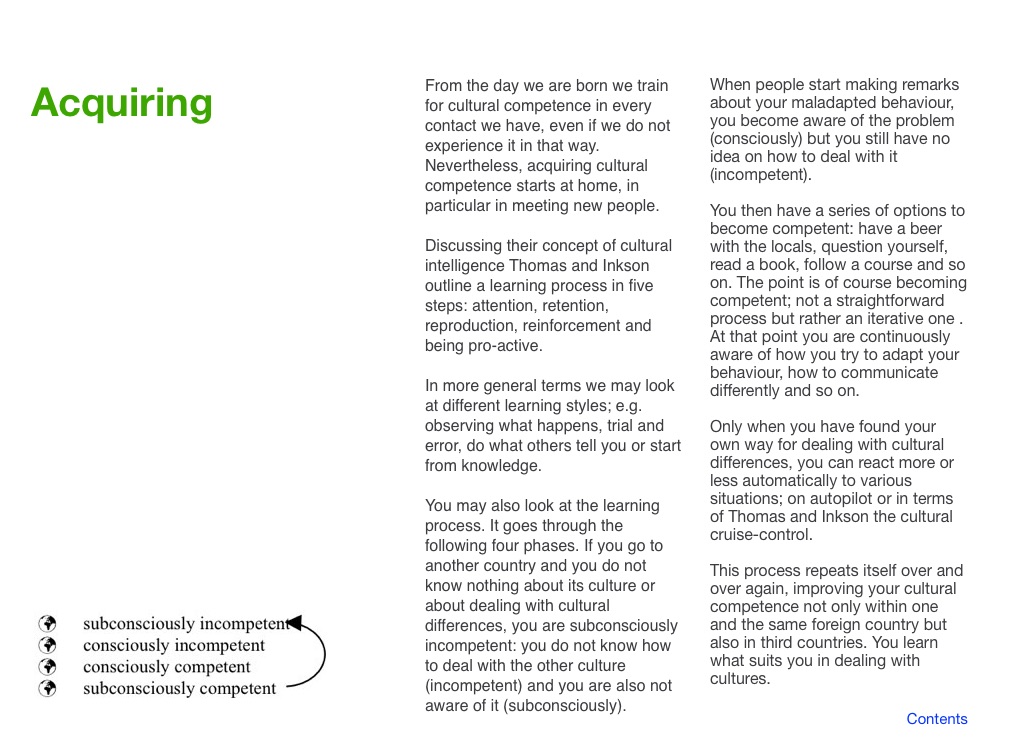
From the day we are born we train for cultural competence in every contact we have, even if we do not experience it in that way. Nevertheless, acquiring cultural competence starts at home, in particular in meeting new people. Discussing their concept of cultural intelligence Thomas and Inkson outline a learning process in five steps: attention, retention, reproduction, reinforcement and being pro-active. In more general terms we may look at different learning styles; e.g. observing what happens, trial and error, do what others tell you or start from knowledge. You may also look at the learning process. It goes through the following four phases. If you go to another country and you do not know nothing about its culture or about dealing with cultural differences, you are subconsciously incompetent: you do not know how to deal with the other culture (incompetent) and you are also not aware of it (subconsciously).
When people start making remarks about your maladapted behaviour, you become aware of the problem (consciously) but you still have no idea on how to deal with it (incompetent). You then have a series of options to become competent: have a beer with the locals, question yourself, read a book, follow a course and so on. The point is of course becoming competent; not a straightforward process but rather an iterative one . At that point you are continuously aware of how you try to adapt your behaviour, how to communicate differently and so on. Only when you have found your own way for dealing with cultural differences, you can react more or less automatically to various situations; on autopilot or in terms of Thomas and Inkson the cultural cruise-control. This process repeats itself over and over again, improving your cultural competence not only within one and the same foreign country but also in third countries. You learn what suits you in dealing with cultures.
Contents
Handling Differences
You have two good reasons to bridge cultural differences: to minimise their negative consequences and to benefit from their positive aspects. The strongest example of the positive side is your own development. Time and time again people emphasise what they have learned from the confrontation with another culture and especially how they have come to know themselves better. However, dealing with cultural difference ultimately boils down to you as an individual; what works for the one, does not do so for the other. As part of your cultural competence, you make your own choices and experience shows the way to success. The e-book on definitions and concepts of culture (Culture 1) outlines the difficulties in studying culture and they apply to dealing with cultural differences just as well. They are: you are part of culture, lack of a common definition, focus on differences, approach by averages and stereotypes and prejudices. In the same vein some
requirements need to be met: a willingness to learn and to adapt and a capability of spotting the differences and to recognise ways and means of dealing with them. As in security studies, preventing (cultural) conflict trumps engaging in (cultural) conflict. This is why the cultural competence is so important, as well as a thorough preparation (see Culture 8). The question is what you can actually do when you perceive tension due to cultural differences in a meeting with another person. At that moment you cannot brush up your cultural competence or revise your preparation. The literature on how to handle cultural differences may be divided in the following groups. ▼ ‘Recipes’: rules of behaviour, often without background or only loosely related elements. Yet, these books quickly give a first idea. ▼ Knowledge and understanding of the concept of culture, two necessary but too general conditions. They are insufficient for solving issues.
Contents
▼ Country-specific knowledge: useful but not indicate how you as a foreigner should adapt. It does not mention the cultural differences with your national culture and focuses on averages. ▼ Comparative research of national cultures; relatively superficial (Culture 2). ▼ The experiences of others, who have been on a similar bridge between cultures; e.g. a novel on growing up in two cultures. ▼ Core values (USA) or practices (continental Europe) of organisations; needs to be adapted to the organisation in question. ▼ Group dynamics and team culture; needs again to be adapted ▼ The psychological characteristics of the individual. A relevant aspect but do you know your own psychological profile and that of the other? ▼ Be like me (term of Thomas and Inkson, 2004; not the approach they favour); does not work. ▼ Living in another country (from novel to cultural anthropology). ▼ Impact of living abroad on children; may be traumatic!
In general you may deal with cultural differences in three ways: do nothing (not sensible), emphasise common issues (insufficient) and to deal with the differences. You can also try to evade the question of cultural differences by naming them in another way. There is no one-size-fits-all approach to dealing with cultural differences; see also Culture 8. Bridging the cultural gap depends on individual persons with their personal characteristics in a unique situation. Partners in a conversation should create their own reality in which the differences and commonalities are reconciled (transcultural communication). Ultimately, the best thing is to uncover the three to five key aspects for you as an individual and to translate them in as many catchwords. They represent your own stumbling blocks and function as signal flags of possible danger. This requires of course experience and reflection, but that is the nature of the game, building up over time.
Contents
Exercise Cultural Competence
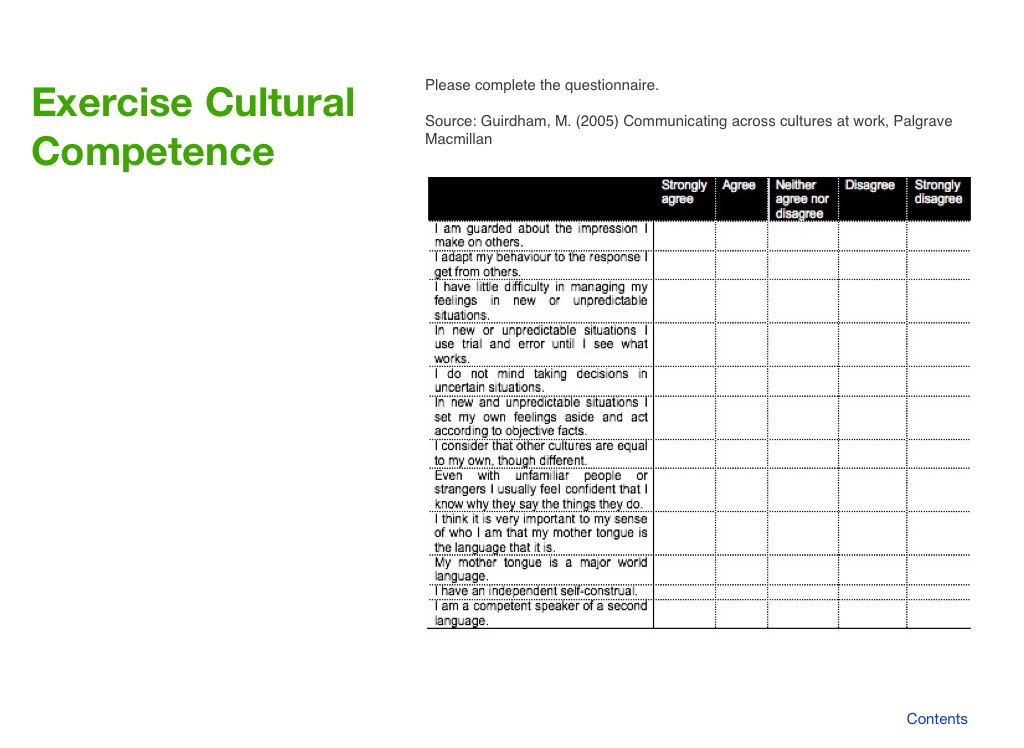
Please complete the questionnaire. Source: Guirdham, M. (2005) Communicating across cultures at work, Palgrave Macmillan
Contents
Response
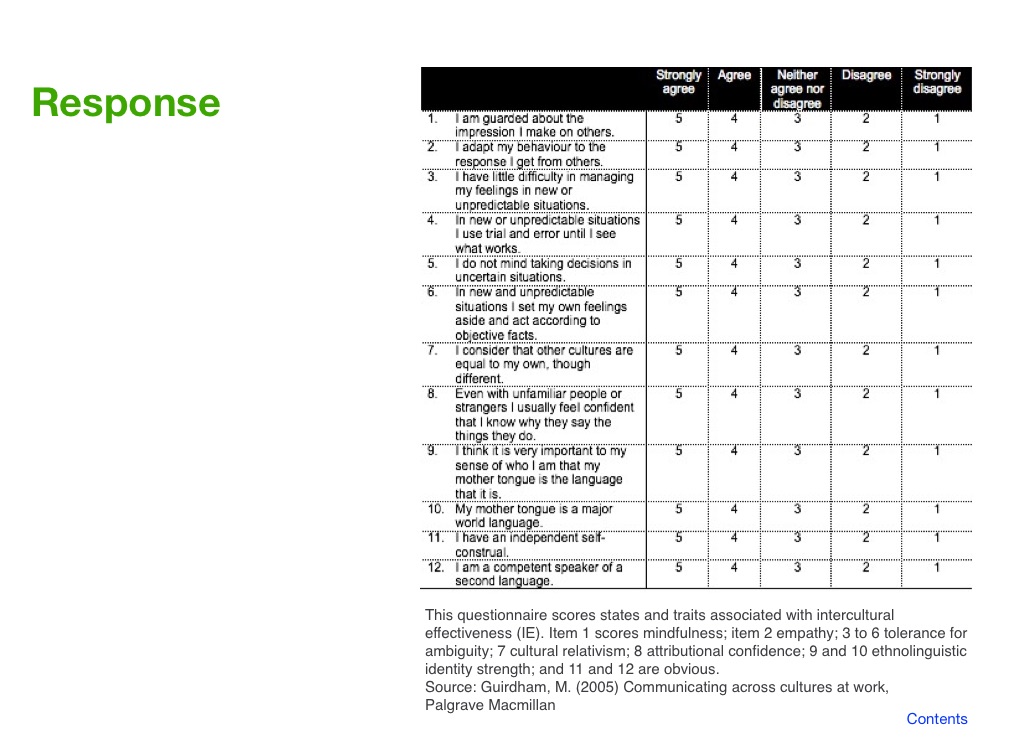
This questionnaire scores states and traits associated with intercultural effectiveness (IE). Item 1 scores mindfulness; item 2 empathy; 3 to 6 tolerance for ambiguity; 7 cultural relativism; 8 attributional confidence; 9 and 10 ethnolinguistic identity strength; and 11 and 12 are obvious. Source: Guirdham, M. (2005) Communicating across cultures at work, Palgrave Macmillan
Contents
Further Reading
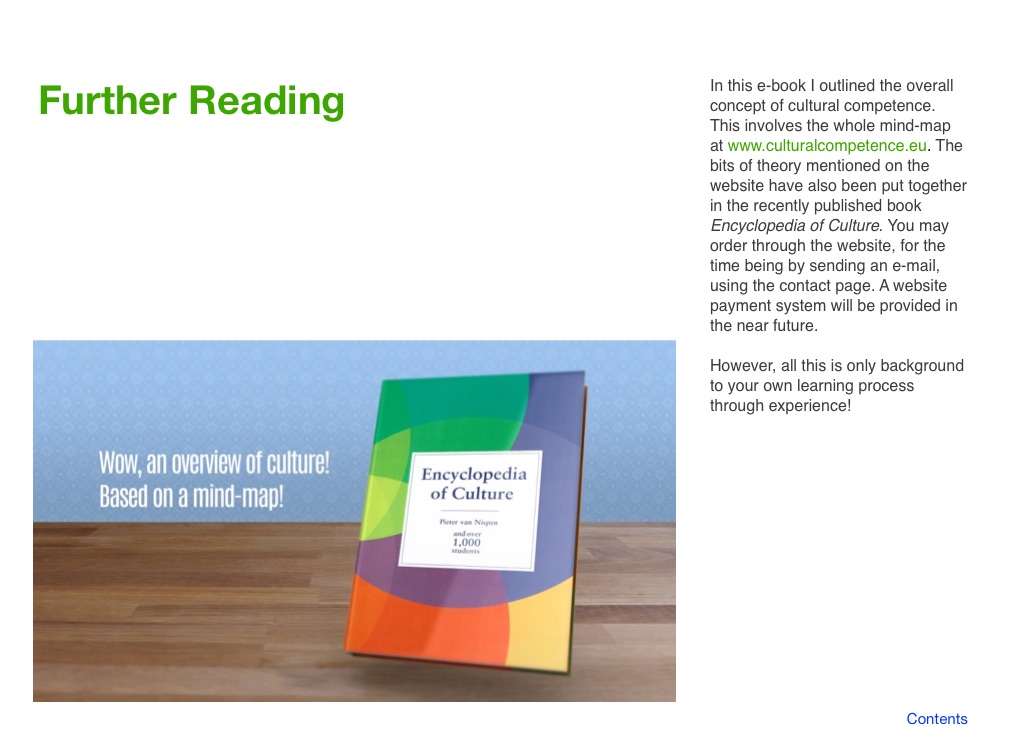
In this e-book I outlined the overall concept of cultural competence. This involves the whole mind-map at www.culturalcompetence.eu. The bits of theory mentioned on the website have also been put together in the recently published book Encyclopedia of Culture. You may order through the website, for the time being by sending an e-mail, using the contact page. A website payment system will be provided in the near future. However, all this is only background to your own learning process through experience!