Sign up for FlowVella
Sign up with FacebookAlready have an account? Sign in now
By registering you are agreeing to our
Terms of Service
Loading Flow

Downloading Image /

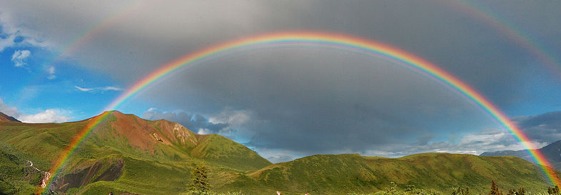
What are rainbows ?
A rainbow is an arch of colours visible in the sky, caused by the refraction and dispersion of the sun's light by rain or other water droplets in the atmosphere.
How is light reflected to create rainbows?
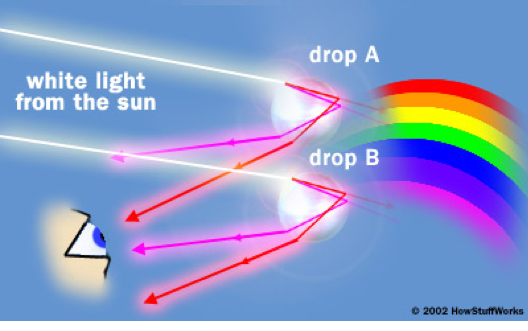
As light enters a water droplet, the different wavelength colors bend at slightly separate angles. Some of this light reflects off the back of the droplet and is bent a second time as the droplet emerges from the light beam. Drops at different angles send distinctively different colors to the eye.
If light is hitting raindrops at a proper angle, a secondary, larger rainbow will appear outside of the main rainbow. This secondary rainbow is fainter in color than the main one because the light has been reflected twice by each raindrop. This double reflection also reverses the colors in the secondary rainbow.
To see a rainbow, an observer must have her back to the sun and rain must be falling in some part of the sky. Since each raindrop is lit by the white light of the sun, a spectrum of colors is produced.
No two observers will ever witness exactly the same rainbow because each will view a different set of drops at a slightly different angle. Also, each color seen is from different raindrops.
As light enters a water droplet, the different wavelength colors bend at separate angles. Some of this light reflects off the back of the droplet and is bent a second time as the droplet emerges from the light beam. Drops at different angles send different colors to the eye.
If light is hitting raindrops at a proper angle, a secondary, larger rainbow will appear outside of the main rainbow. This secondary rainbow is fainter in color than the main one because the light has been reflected twice by each raindrop. This double reflection also reverses the colors in the secondary rainbow.
How is light reflected to create a rainbow?
Downloading Image /
Downloading Image /
Downloading Image /
Downloading Image /



FlowVella, Previously Known As Flowboard
© 2025 FlowVella
 FlowVella