Sign up for FlowVella
Sign up with FacebookAlready have an account? Sign in now
By registering you are agreeing to our
Terms of Service
Loading Flow

Downloading Image /
Downloading Image /
Downloading Image /
Downloading Image /
The Lambda name is derived from the Greek letter “L” which is the physics symbol for angular momentum; the Newtonian principle that keeps a top from falling over. I'm not a physicist, but I did stay at a Holiday Inn Express at some point during college. Here we go:
ANGULAR MOMENTUM (L) = RADIUS (MASS x VELOCITY)
This equation is all you need to know about tops. For a given top, the size (radius) and weight (mass) are fixed, so your only variable is velocity. If you want more spin, you need more speed. How fast can you spin it?
The (major) factors that reduce spin time are friction and the geometry between the top’s “contact point” and the target surface. You get to pick the surface, but I get to pick the contact point :)
POLAR MOMENT OF INERTIA (Ip) = p(r)r^2dV
Don’t sweat the details. That just means a unique feature of the Lambda is the use of 2 different materials in the design. It looks awesome and it increases performance.
6061 aluminum is used for the spindle to decrease the polar moment of inertia … in other words, reducing the amount of force it takes to get the top up to a given velocity. If you remember, the more velocity the more angular momentum … and a longer spin time.
Solid brass is heavy, really heavy. It also machines beautifully. If you recall, mass is another important component to angular momentum, making brass an ideal material for the outer ring.


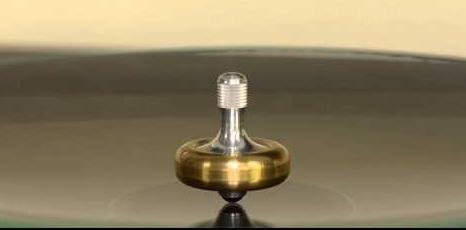
Let's agree to call it a cone. A cone isn’t a very good shape for the contact point because you are always on one side of the point … or the other. This means the top will have a hard time balancing upright, wasting energy during the early spin, and then falling over early during the late spin when the top is losing RPM. It's inherently imprecise.
The perfect sphere means there is always a perfect point of contact with the surface, wasting less energy and spinning longer. It also means the Lambda is better able to spin along its axis; therefore, it does not exhibit the large amount of precession (angular wobble) that you see in a traditional top.
How long will the Lambda spin? It depends … on a lot of different factors. How long “will” it spin is entirely up to you. How long “can” it spin is entirely unknown. My personal record (unofficial) is over 12 minutes. Check out the video below for a “bar-setting” unedited 10 minute spin.
Can you beat me? It's gotta be on video! Submit your “video response” to my 10 min spin on the YouTube page!

Downloading Image /
Downloading Image /
Downloading Image /


FlowVella, Previously Known As Flowboard
© 2025 FlowVella
 FlowVella