








Plants Nutrition
Plant Nutrition
by Daniel Juan
Unit 3 (part 2)
Photosynthesis
Plants and animals both feed on organic matter. However, plants are different to animals because they make their own organic matter and turn it into food. They do this through a process called photosynthesis. Photosynthesis is the process that allows plants to make food from water, carbon dioxide and sunlight. It occurs in the green cells of the plant’s leaves. Sunlight is an essential part of the process of photosynthesis as it provides the plant with energy. The sunlight is processed by a green substance, called chlorophyll, found in the chloroplasts of the green cells. During this process, the plant also releases oxygen. This gas is important because it is needed by all living things, including plants, for respiration.
How algae and mosses make their food
Algae and mosses make food through the process of photosyntesis. These plants live in or near water, and absorb water and carbon dioxide dissolved in water directly into their cells. They do not need to transport food as it passes directly from one cell to the next.
How more complex plants make and transport food
Spermatophytes and ferns have green cells in their leaves. They get carbon dioxide from the air through their leaves, but absorb the water and minerals they need from the ground through their roots.
Raw sap and elaborated sap
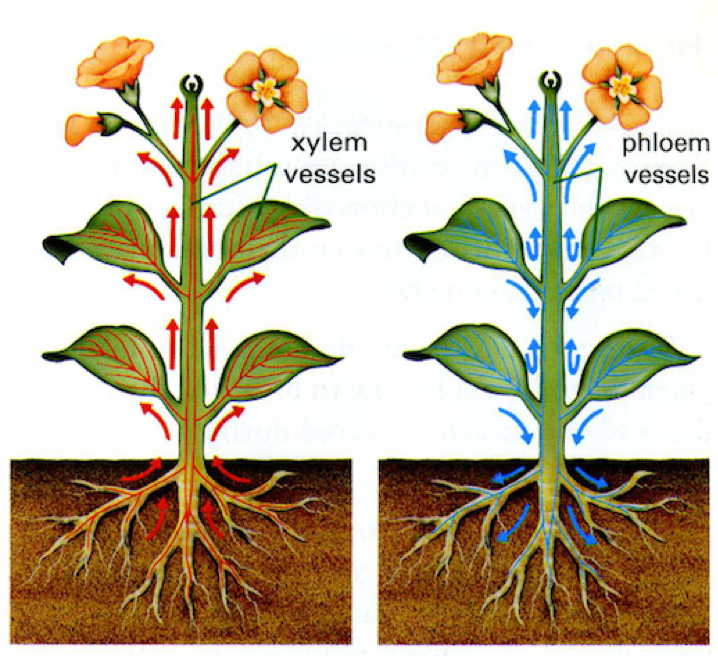
The mixture of water and minerals from the roots is called raw sap. It travels up the stem of the plant to the leaves in thin tubes called xylem vessels. During photosynthesis, the raw sap mixes with carbon dioxide to produce elaborated sap. The elaborated sap produced in the leaves travels back to other parts of the plant in phloem vessels. Like the xylem vessels, these are the thin tubes. The xylem and phloem vessels are always found together. In addition to transporting sap, they provide a support structure for the plant.