








Human Reproduction, 5th level (Part 2)
Human Reproduction (part 2)
Unit 4, 5th level
by Daniel Juan Santigosa
table of contents
The reproductive system (Male)
………………
…………………….
……………………………..
The reproductive system
The male reproductive system
The male reproductive system has two main functions: to produce sperm and to deposit them inside the female reproductive system. The most important organs of the male reproductive system are the testicles and the penis. Both are situated in the lower abdomen and are external.
Front view
Front view
* The testicles are two small round organs covered with skin that are located under the penis. Each testicle is connected to the penis by a tube through which the sperm travel. When a boy reaches puberty, the testicles start to produce millions of sperm. * The penis is cylindrical in shape, and contains a tube called the urethra. Both the sperm and urine leave the body through the urethra in the penis. There is a valve where the bladder and the urethra meet that prevents the urine and sperm from mixing.
Side view
Pregnancy and birth
The start of the pregnancy
During sexual intercourse, a man deposits millions of sperm into a woman’s vagina. The sperm have tails, which help them to move. They travel from the vagina to the uterus and then up to the fallopian tubes. Fertilisation occurs when an ovum and a sperm meet and unite in the fallopian tubes. This union creates a new cell called a zygote. Pregnancy starts at the moment of fertilisation and finishes with the birth of a baby.
The formation of the embryo
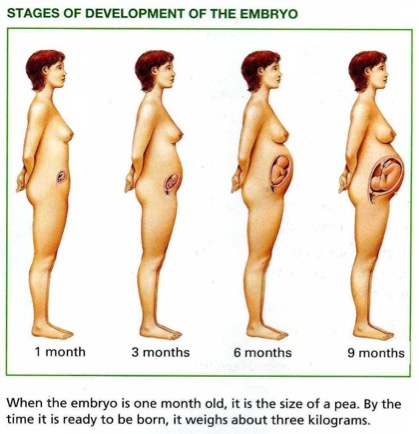
The zygote travels down the fallopian tubes to the uterus. The zygote attaches to the lining of the uterus which has thickened to receive it. The zygote then starts to divide into many cells and grow into an embryo. As it grows, the embryo moves away from the uterus lining, but is still attached to it by an umbilical cord.
The umbilical cord connects the mother and the embryo. The embryo receives the food and oxygen it needs through the umbilical cord. The embryo stays in the uterus during the nine months of pregnancy.
Menstruation or a period
Every month, one of the ovaries releases an ovum, and the lining of the uterus thickens in order to receive the future zygote. If the releases ovum is not fertilised, it dies after a few days. It leaves the body through the vagina, with blood from the lining of the uterus. This is called menstruation, or a period, as it occurs approximately every month.
The development of the fetus
After two months of pregnancy, the embryo starts to look like a baby. From this stage, it is called a fetus. During pregnancy the mother’s uterus gets bigger as the fetus grows. After nine months of pregnancy, the fetus is fully developed and is ready to be born.
The birth
Birth happens at the end of pregnancy. The fully developed fetus leaves the uterus and comes out of the mother’s body through the vagina. After the baby is born, the umbilical cord is cut. The end of the cord dries and falls off, leaving a scar on the stomach of the baby. This is the navel. Sometimes doctors need to perform an operation called a caesarean section. This involves cutting open the mother’s uterus to remove the baby.
end of
human reproduction
part 2