


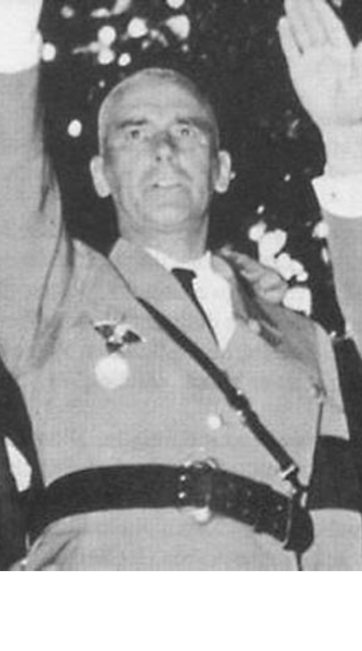





Wilhelm Frick
Wilhelm Frick
Background
- Frick was born in the Palatinate municipality of Alsenz -He attended the gymnasium in Kaiserslautern, passing his Abitur exams in 1896. He went on studying philology at the University of Munich, but soon after turned to study law in Heidelberg and Berlin.
Background cont.
- He joined the Bavarian civil service in 1903, working as an attorney at the Munich Police Department. -Rejected as unfit, Frick did not serve in World War I. -He was promoted to the official rank of a Regierungsassessor and he re-assumed his post at the Munich Police Department by 1917.
How Frick Got Involved
-Chief of Police Ernst Pöhner introduced him to Adolf Hitler, whom he helped willingly with obtaining permissions to hold political rallies and demonstrations. - He participated in Hitlers failed Beer Hall Putsch. -He tried to stop police oppression and that got him charged with high treason. -After several months in custody, he was given a suspended sentence of 15 months' imprisonment and was dismissed from his police job. -In the aftermath of the Putsch, Wilhelm Frick was elected a member of the German Reichstag parliament in the federal election of May 1924.
How He Made His Name
-On September 1st, 1925, Frick joined the re-established Nazi Party. He associated himself with the radical Gregor Strasser. - He made his name by aggressive anti-democratic and antisemitic Reichstag speeches, so he climbed to the post of the Nazi parliamentary group leader. -On January 23rd, 1930 Wilhelm Frick was appointed State Minister of the Interior and of Education in the government of Thuringia, which made him the first Nazi to hold any ministerial-level post in pre-Nazi Germany.
Nazi Career Cont.
-When Reich president Paul von Hindenburg appointed Hitler chancellor on January 30th, 1933, Frick joined his government as Reich Minister of the Interior. -Together with Reichstag Speaker Hermann Göring, he was one of only two Nazi Reich Ministers in the original Hitler Cabinet. -Though Frick held a key position, especially in organizing the federal elections of March 1933, he initially had far less power than his counterparts in the rest of Europe. Notably, he had no authority over the police. -In May 1934, he was appointed Prussian State Minister of the Interior under Minister-President Göring, which gave him control over the police in Prussia. By 1935, he also had near-total control over local government.
-Frick was instrumental in the racial policy of Nazi Germany drafting laws against Jewish citizens, like the "Law for the Restoration of the Professional Civil Service" and the notorious Nuremberg Laws. -Frick also took a leading part in Germany's re-armament in violation of the 1919 Versailles Treaty. -In the summer 1938 Frick was named the patron of the Deutsches Turn- und Sportfest in Breslau, a patriotic sports festival attended by Hitler and much of the Nazi leadership. -From the mid-to-late 1930s Frick lost favour irreversibly within the Nazi Party after a power struggle involving attempts to resolve the lack of coordination within the Reich government.
Relation with Hitler
-Frick's replacement as Reich Minister of Interior did not reduce the growing administrative chaos and infighting between party and state agencies. -Frick was then appointed as Protector of Bohemia and Moravia, making him Hitler's personal representative in the Czech Lands.
What Happened To Him
-Frick was arrested and tried before the International Military Tribunal at Nuremberg, where he was the only defendant besides Rudolf Hess who refused to testify on his own behalf. -Frick was convicted of planning, initiating and waging wars of aggression, war crimes and crimes against humanity. -Frick was also accused of being one of the highest persons responsible for the existence of the concentration camps. -Wilhelm Frick was sentenced to death on October 1st, 1946, and was hanged on October 16th. -His body, as those of the other nine executed men and the corpse of Hermann Göring, was cremated at Ostfriedhof and the ashes were scattered in the river Isar.