






Culture 8 Abroad
Culture 8 Abroad
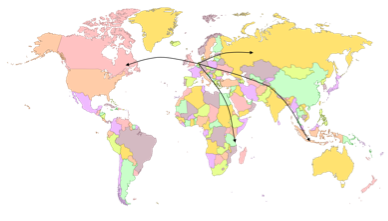
A distinction in the duration of a visit to another country (duty trip, exchange, expat, living abroad) results in different requirements regarding culture.
Pieter van Nispen Senior Lecturer and Researcher, retired
April 2018
Table of Contents
page
page
page
page
page
Introduction and Overview
Duty Trip
Student Exchange
Expat
Living Abroad
page
page
page
page
page
Preparations and Practical Details
Culture Shock
Dealing with Differences, Points of Attention, History, Experience
Exercise
Further Reading
Contents
Introduction
This document is part of larger project to bring the reality and theory of culture together. At its core it the website www.culturalcompetence.eu. The model used has the size of groups as its starting point, ranging from very large groups through larger and smaller groups to the individual. The focus of this e-book is on the individual confrontation with another national culture. This is discussed on the basis of the time spent abroad: duty trip, (student) exchange and expat assignment. Such a division coincides with the increasing requirements for dealing with the experienced differences. Other reasons for travelling, such as holidays are not mentioned. A wider discussion of dealing with cultural differences may be found in the e-book on cultural competence (Culture 10). It discusses more than national cultures, it outlines the learning processes and highlights the integration of knowledge, skills and attitudes.
Overview The first part discusses the three different forms of staying abroad, mentioned above (duty trip, exchange and expat assignment) and in addition the idea of living abroad (possibly permanent). Some aspects are then discussed in some more detail: preparation, culture shock, dealing with cultural differences, the impact of history and the role of experience in handling situations in the guest country.
Contents
Duty Trip
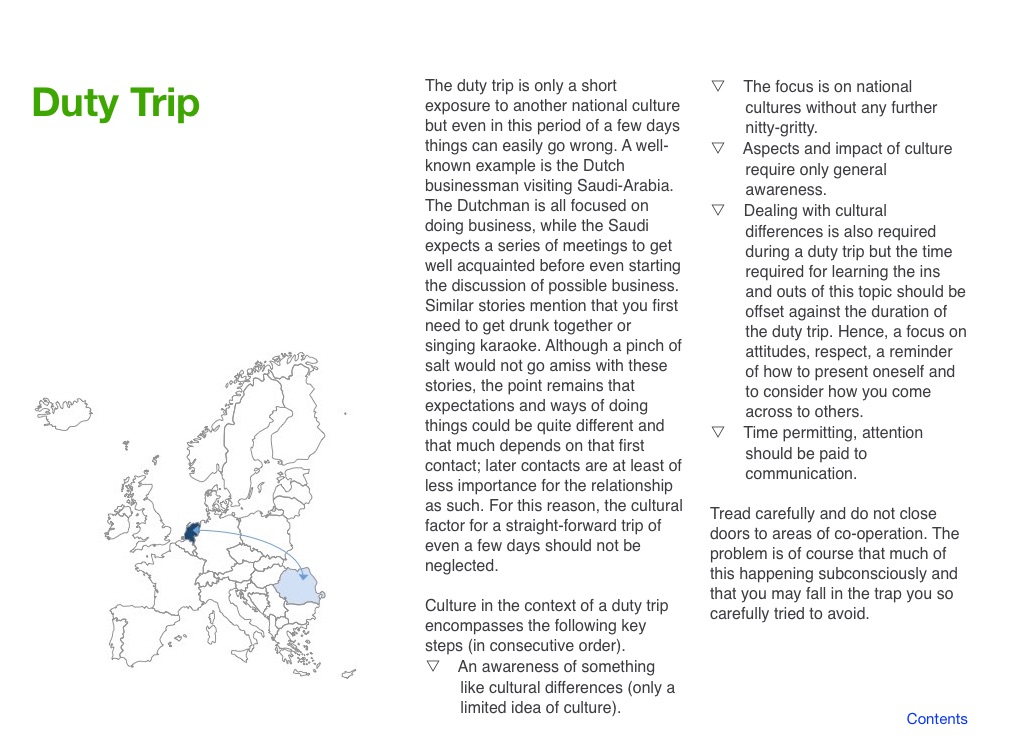
The duty trip is only a short exposure to another national culture but even in this period of a few days things can easily go wrong. A well-known example is the Dutch businessman visiting Saudi-Arabia. The Dutchman is all focused on doing business, while the Saudi expects a series of meetings to get well acquainted before even starting the discussion of possible business. Similar stories mention that you first need to get drunk together or singing karaoke. Although a pinch of salt would not go amiss with these stories, the point remains that expectations and ways of doing things could be quite different and that much depends on that first contact; later contacts are at least of less importance for the relationship as such. For this reason, the cultural factor for a straight-forward trip of even a few days should not be neglected. Culture in the context of a duty trip encompasses the following key steps (in consecutive order). ▽ An awareness of something like cultural differences (only a limited idea of culture).
▽ The focus is on national cultures without any further nitty-gritty. ▽ Aspects and impact of culture require only general awareness. ▽ Dealing with cultural differences is also required during a duty trip but the time required for learning the ins and outs of this topic should be offset against the duration of the duty trip. Hence, a focus on attitudes, respect, a reminder of how to present oneself and to consider how you come across to others. ▽ Time permitting, attention should be paid to communication. Tread carefully and do not close doors to areas of co-operation. The problem is of course that much of this happening subconsciously and that you may fall in the trap you so carefully tried to avoid.
Contents
Exchange
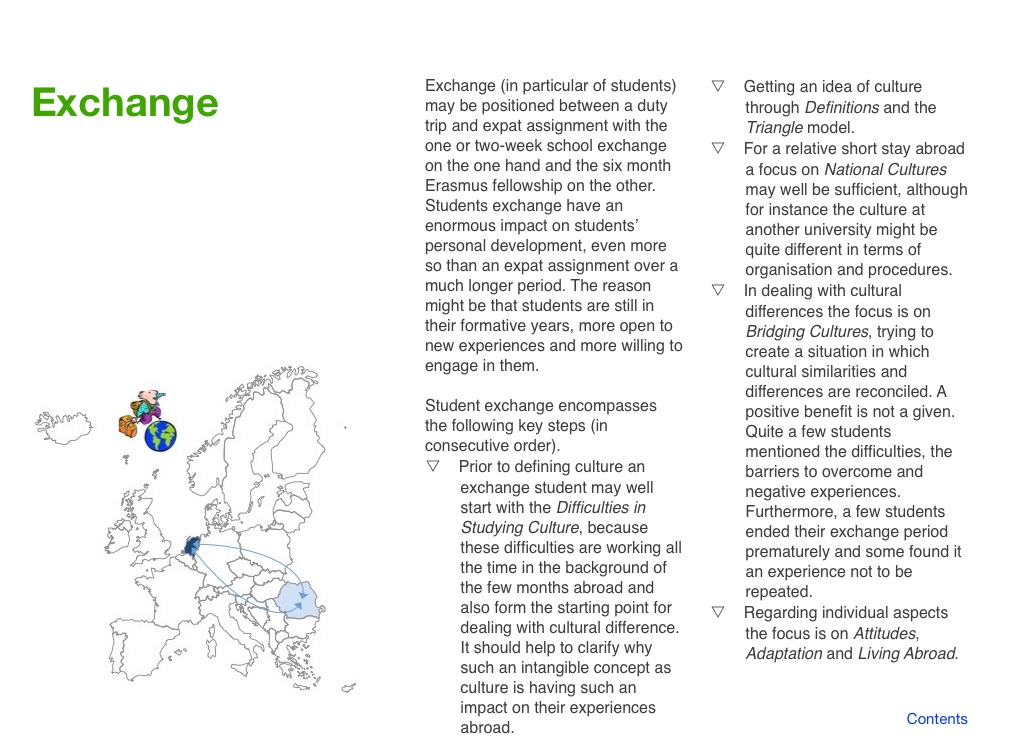
Exchange (in particular of students) may be positioned between a duty trip and expat assignment with the one or two-week school exchange on the one hand and the six month Erasmus fellowship on the other. Students exchange have an enormous impact on students’ personal development, even more so than an expat assignment over a much longer period. The reason might be that students are still in their formative years, more open to new experiences and more willing to engage in them. Student exchange encompasses the following key steps (in consecutive order). ▽ Prior to defining culture an exchange student may well start with the Difficulties in Studying Culture, because these difficulties are working all the time in the background of the few months abroad and also form the starting point for dealing with cultural difference. It should help to clarify why such an intangible concept as culture is having such an impact on their experiences abroad.
▽ Getting an idea of culture through Definitions and the Triangle model. ▽ For a relative short stay abroad a focus on National Cultures may well be sufficient, although for instance the culture at another university might be quite different in terms of organisation and procedures. ▽ In dealing with cultural differences the focus is on Bridging Cultures, trying to create a situation in which cultural similarities and differences are reconciled. A positive benefit is not a given. Quite a few students mentioned the difficulties, the barriers to overcome and negative experiences. Furthermore, a few students ended their exchange period prematurely and some found it an experience not to be repeated. ▽ Regarding individual aspects the focus is on Attitudes, Adaptation and Living Abroad.
Contents
Expat
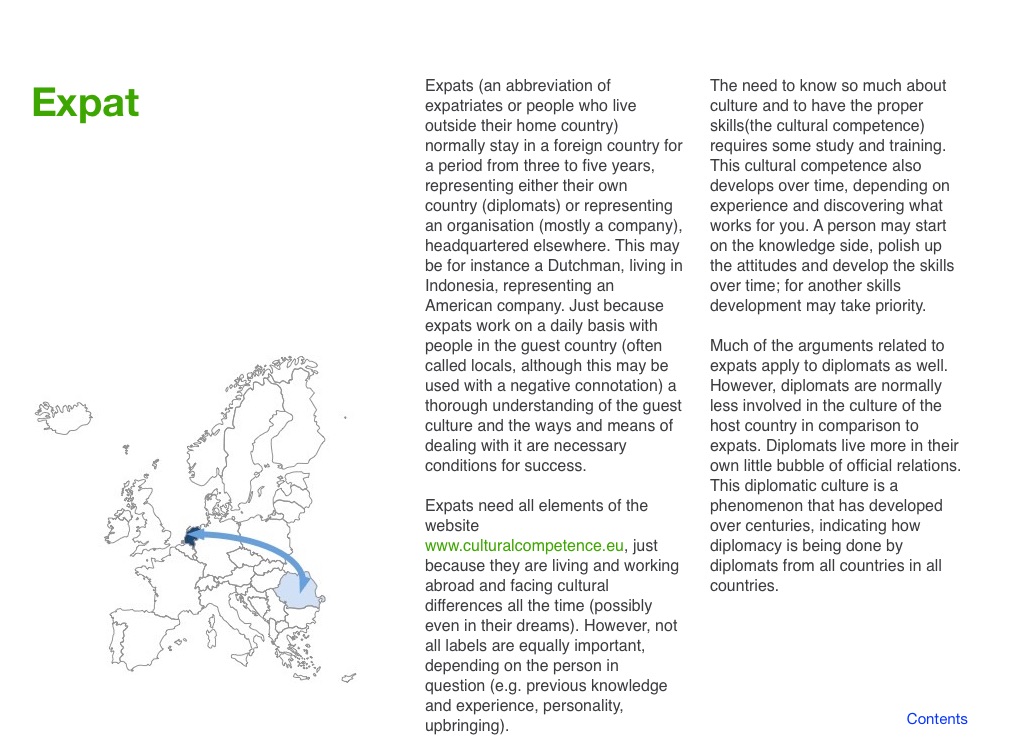
Expats (an abbreviation of expatriates or people who live outside their home country) normally stay in a foreign country for a period from three to five years, representing either their own country (diplomats) or representing an organisation (mostly a company), headquartered elsewhere. This may be for instance a Dutchman, living in Indonesia, representing an American company. Just because expats work on a daily basis with people in the guest country (often called locals, although this may be used with a negative connotation) a thorough understanding of the guest culture and the ways and means of dealing with it are necessary conditions for success. Expats need all elements of the website www.culturalcompetence.eu, just because they are living and working abroad and facing cultural differences all the time (possibly even in their dreams). However, not all labels are equally important, depending on the person in question (e.g. previous knowledge and experience, personality, upbringing).
The need to know so much about culture and to have the proper skills(the cultural competence) requires some study and training. This cultural competence also develops over time, depending on experience and discovering what works for you. A person may start on the knowledge side, polish up the attitudes and develop the skills over time; for another skills development may take priority. Much of the arguments related to expats apply to diplomats as well. However, diplomats are normally less involved in the culture of the host country in comparison to expats. Diplomats live more in their own little bubble of official relations. This diplomatic culture is a phenomenon that has developed over centuries, indicating how diplomacy is being done by diplomats from all countries in all countries.
Contents
Living Abroad
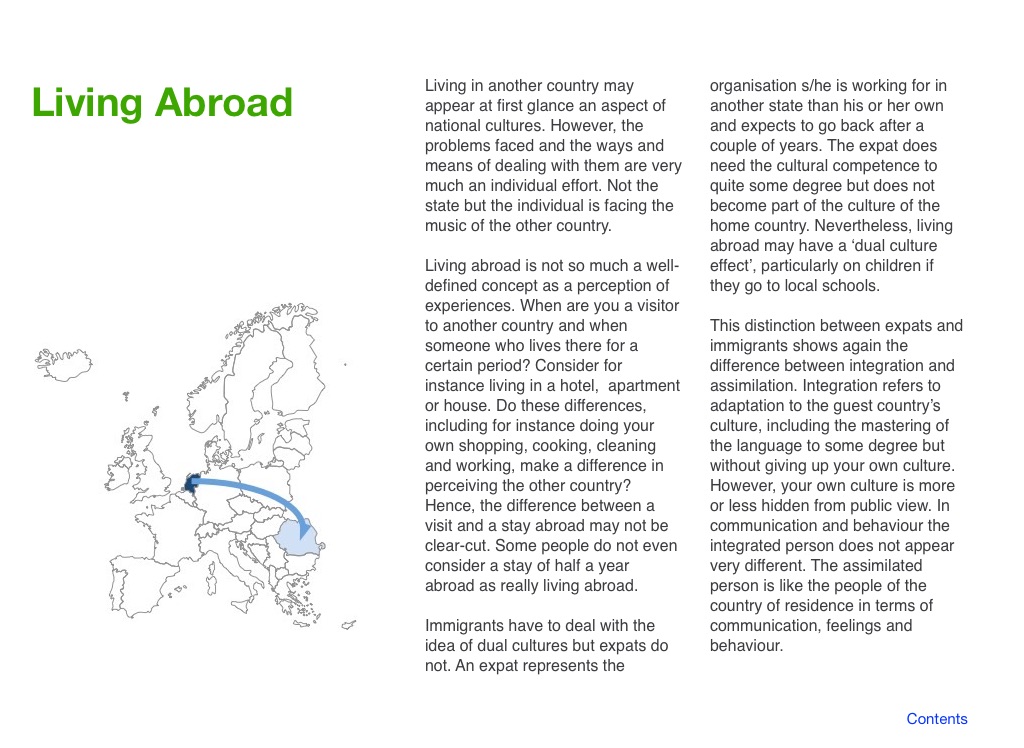
Living in another country may appear at first glance an aspect of national cultures. However, the problems faced and the ways and means of dealing with them are very much an individual effort. Not the state but the individual is facing the music of the other country. Living abroad is not so much a well-defined concept as a perception of experiences. When are you a visitor to another country and when someone who lives there for a certain period? Consider for instance living in a hotel, apartment or house. Do these differences, including for instance doing your own shopping, cooking, cleaning and working, make a difference in perceiving the other country? Hence, the difference between a visit and a stay abroad may not be clear-cut. Some people do not even consider a stay of half a year abroad as really living abroad. Immigrants have to deal with the idea of dual cultures but expats do not. An expat represents the
organisation s/he is working for in another state than his or her own and expects to go back after a couple of years. The expat does need the cultural competence to quite some degree but does not become part of the culture of the home country. Nevertheless, living abroad may have a ‘dual culture effect’, particularly on children if they go to local schools. This distinction between expats and immigrants shows again the difference between integration and assimilation. Integration refers to adaptation to the guest country’s culture, including the mastering of the language to some degree but without giving up your own culture. However, your own culture is more or less hidden from public view. In communication and behaviour the integrated person does not appear very different. The assimilated person is like the people of the country of residence in terms of communication, feelings and behaviour.
Contents
Preparations
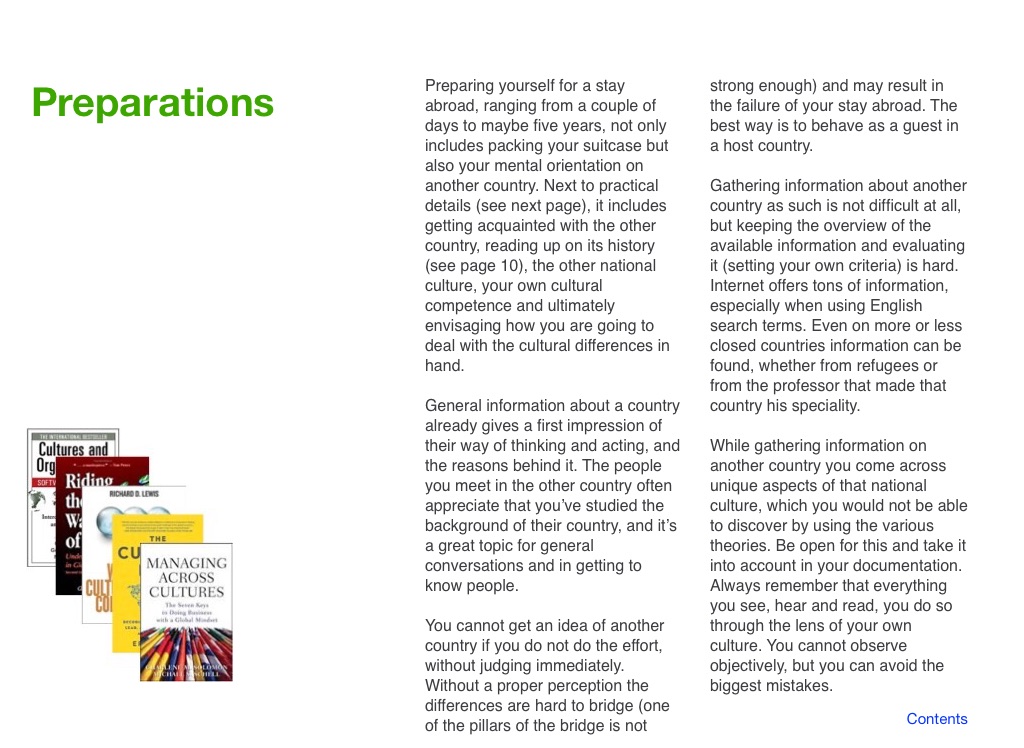
Preparing yourself for a stay abroad, ranging from a couple of days to maybe five years, not only includes packing your suitcase but also your mental orientation on another country. Next to practical details (see next page), it includes getting acquainted with the other country, reading up on its history (see page 10), the other national culture, your own cultural competence and ultimately envisaging how you are going to deal with the cultural differences in hand. General information about a country already gives a first impression of their way of thinking and acting, and the reasons behind it. The people you meet in the other country often appreciate that you’ve studied the background of their country, and it’s a great topic for general conversations and in getting to know people. You cannot get an idea of another country if you do not do the effort, without judging immediately. Without a proper perception the differences are hard to bridge (one of the pillars of the bridge is not
strong enough) and may result in the failure of your stay abroad. The best way is to behave as a guest in a host country. Gathering information about another country as such is not difficult at all, but keeping the overview of the available information and evaluating it (setting your own criteria) is hard. Internet offers tons of information, especially when using English search terms. Even on more or less closed countries information can be found, whether from refugees or from the professor that made that country his speciality. While gathering information on another country you come across unique aspects of that national culture, which you would not be able to discover by using the various theories. Be open for this and take it into account in your documentation. Always remember that everything you see, hear and read, you do so through the lens of your own culture. You cannot observe objectively, but you can avoid the biggest mistakes.
Contents
Practical Details
The longer your stay abroad, the more important the practical ‘details’ may be (in terms of being properly organised). It includes general information on the host country, as well as passports, insurances, health, vaccinations, visas, transport, communication, accommodation, money, emergency telephone numbers, removal, schools for children and so on! The general information includes the history of the country (see next page), the main data (country size, population, political system, language, education, religion, legal system), economics (balance, focus on agriculture, industry or services, trade relations, income of the population) and the arts. This list is far from complete, and every aspect of the list can again be further developed. Reliable, brief but rather complete factual information per country may be found in the CIA World Fact-book. On culture internet may be the best source (e.g. culture guides, expatriate guides, management
guides; e.g. www.culturalcompetence.eu). The value patterns of nearly 100 countries may be found at www.worldvaluessurvey.org. Preparations may include meeting people from the country of destination or with experience in that country. The gathered information should be cut to oneself. The literature may well describe a characteristic of another culture that is hard to deal with in general but it might be something you as an individual do not need to worry about because you can relate to it. That frequently occurring problem is then not a problem for you. If a culture is for instance described as rather strong on status and you know of yourself that you have been raised with respect for hierarchy, you may trust your normal politeness to avoid the worst mistakes.
Contents
Culture Shock
The initial experience of cultural differences while living abroad is often referred to as culture shock. Culture shock is a strong emotion of not being able to deal with the cultural differences at hand while living abroad, often linked with a strong desire to go back home. Some people do return home but many find their own ways and means of dealing with it, e.g. by questioning one’s own assumptions in looking at the host culture. Culture shock is for instance mentioned in student exchanges, albeit to different degrees (depending mainly on cultural distance and personality characteristics). Even if these exchanges are normally not more than half a year, the cultural difference may become quite a burden. However, most students evaluate the differences and their effects as something positive. Recurring themes are ‘the confrontation with yourself’, ‘own responsibility’ and ‘not everything
can be done on automatic pilot’. In addition specific learning experiences are also mentioned; e.g. differences in the perception of work in life. Returning Home Important to note is that people often also experience culture shock on returning ‘home’ after a longer stay abroad. Although often unexpected, the phenomenon is a logical result of having changed by being in another country and at the same time not being fully involved in developments in one’s own country. People in the home country may for instance be involved in some major event (from disaster to a television series) that mostly escaped the attention of the expat, receiving much less attention. The path through life of an expat has deviated from the highway of the people in the home country and to join the traffic on the highway proves more difficult than expected.
Contents
Dealing with Differences
Although a lot has been written on the importance and ways and means of dealing with cultural differences, as well as the negative consequences of failing to do so, it fails in helping you out in day-to-day reality (e.g. applicability of theories or specific tips, importance of home country, adaptation to individual). What you need, is cultural competence (see Culture 10). Ultimately dealing with another (national) culture comes down to the individual level, not the construct of averages but a person with likes and dislikes and never fully fitting those averages. It is not just blah-blah but something you can work on (cultural competence). It is not just politeness, but that does help. It is juggling paradigms but it is definitely not about arguing or shouting your opinion across.
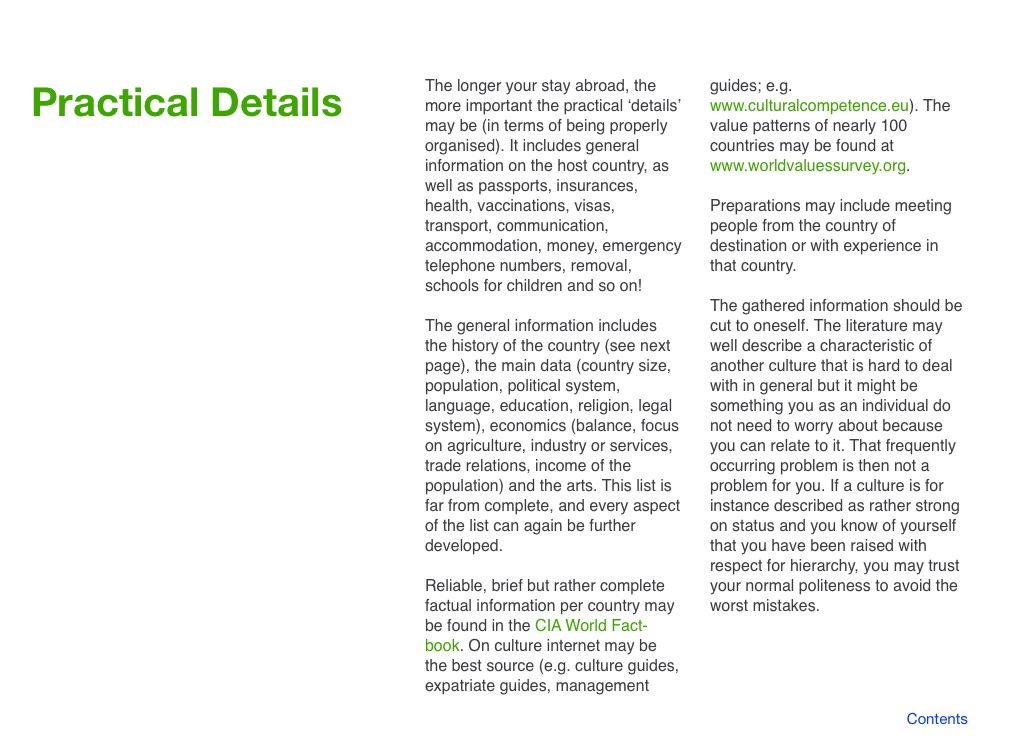
The idea of dealing with cultural differences may be depicted as a bridge between your own culture and the culture of the other party you are dealing with. Such a bridge is founded on respect for the other as a fundamental condition, based on the equality of people. Do not say that the other is behaving in an odd way, just accept the way s/he is behaving and try to understand where this behaviour is coming from. Furthermore, common interests need to be recognised. The figure also draws attention to the necessity of knowing your own culture (from individual to country), the culture of the other (the importance of trying to understand the culture of the other) as well as realising how your own culture comes across to your discussion partner.
Contents
Points of Attention
The literature and the stories from practice show hundreds if not thousands points of attention in dealing with cultural differences between states and lower levels. However, even a superficial reading of these points would result in quite some confusion. What works for the one, might not work for the other; what is nice in theory, might not work in practice and so on. Ultimately you need to build up your own list, bottom-up from experience; what works for you! This list needs to be simple (three to five catchwords), enabling an appropriate reaction in any situation of cultural conflict. On the website www.culturalcompetence.eu dozens of points from research are mentioned. Smith and Bond (1988) for instance investigated the application of social psychology in different cultures. The first point of attention is gathering information on the other. In a next step people try to learn more about one another through passive means (observation: external appearances, way of speaking, behaviour), active
means (interaction with the environment but not with the stranger) and interactive means (direct interaction). The key points of communication across cultures may be summarised in the list below. However, they are still rather general and need to be adapted to you as a person and the situation you are in. ▼ Know yourself! ▼ Try to know the other. ▼ Show respect, in particular by not judging different behaviour immediately and to see it just being different. ▼ Equality as human beings. ▼ Empathy ▼ Dialogue! ▼ Study background, history et cetera
Contents
History
The preparation for visiting another country should include reading about the history of the home country and in particular about its effects on the prevailing mentality. Books on the linkage between history and mentality are not always easy to find and if finding one its academic nature and purpose may obscure the consequences in day-to-day life. A positive exception, for instance, on the Netherlands is Under a Low Sky by Han van der Horst (2001). This book was written as an introduction to Dutch society for foreign students, showing the effects of Dutch history on the Dutch mentality. Another (easy) approach is reading an historical novel on that country. Several researchers have shown how important the effect of the history of a state may be on the nature of a culture and how decades-old (or even older) value patterns of work through on a culture.
Inglehart (1997) argues that cultural differences can be explained of 51% on the basis of history and old patterns. However, you have to assure that the boundaries of that country are not substantially altered (e.g. Poland, Germany; think also about all the artificial borders, drawn by colonial powers). In addition, the difference between a state and nation are to be addressed as well. History helps in decreasing prejudices and stereotypes.
Contents
Experience
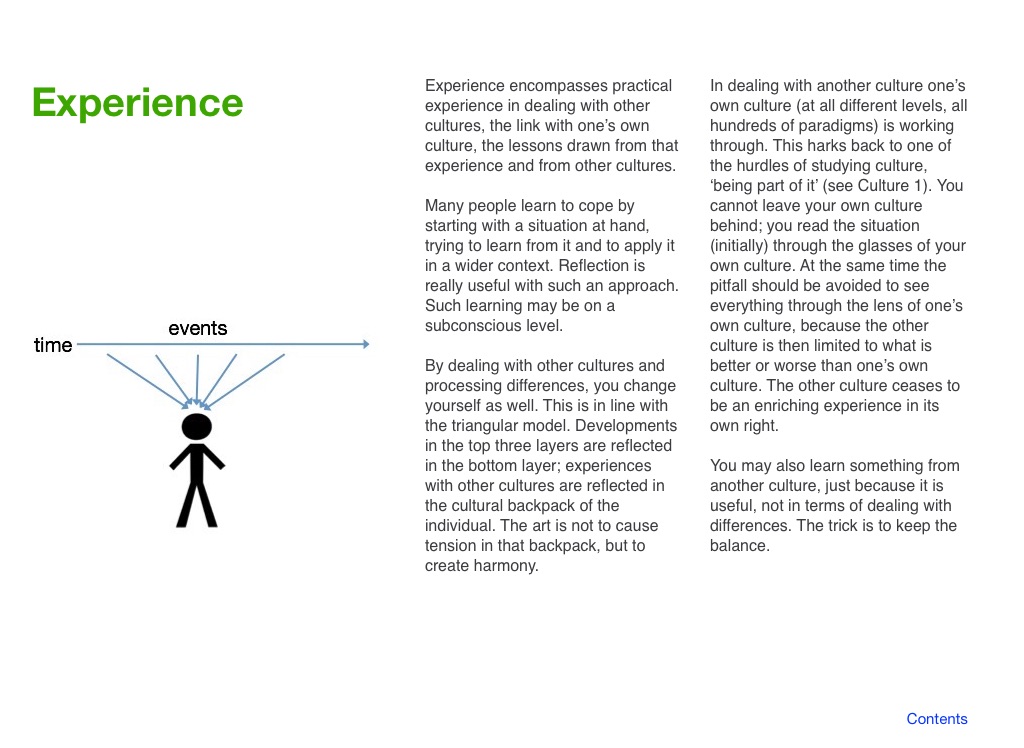
Experience encompasses practical experience in dealing with other cultures, the link with one’s own culture, the lessons drawn from that experience and from other cultures. Many people learn to cope by starting with a situation at hand, trying to learn from it and to apply it in a wider context. Reflection is really useful with such an approach. Such learning may be on a subconscious level. By dealing with other cultures and processing differences, you change yourself as well. This is in line with the triangular model. Developments in the top three layers are reflected in the bottom layer; experiences with other cultures are reflected in the cultural backpack of the individual. The art is not to cause tension in that backpack, but to create harmony.
In dealing with another culture one’s own culture (at all different levels, all hundreds of paradigms) is working through. This harks back to one of the hurdles of studying culture, ‘being part of it’ (see Culture 1). You cannot leave your own culture behind; you read the situation (initially) through the glasses of your own culture. At the same time the pitfall should be avoided to see everything through the lens of one’s own culture, because the other culture is then limited to what is better or worse than one’s own culture. The other culture ceases to be an enriching experience in its own right. You may also learn something from another culture, just because it is useful, not in terms of dealing with differences. The trick is to keep the balance.
Contents
Exercises
The most important exercise is to get a better knowledge of oneself. What aspects of behaviour and communication do you find difficult? Where are your personal limits? Is that in certain types of food (colour, smell and so on) or clothing. You do not need to pay attention to things that you do more or less automatically right but you should rather focus of overcoming barriers of psychological resistance. Dealing with Cultural Differences Dealing with different cultures is an individual question because culture ultimately means something different to all and everybody. Please indicate how you how you would like to do that (dealing with (national) cultural differences). Just because the topic is so wide, it does not really matter where you start.
The following YouTube videos may serve for inspiration. ▼ youtu.be/a5bpaTl0ELM It has the title Bridging race and culture - the story of Busboys & Poets and tells how may create an environment in which you reconcile cultural differences and commonalities in one environment (formally: transcultural). ▼ youtu.be/aDfoudegLn8 This video shows that internationalisation starts at home: talk to people with different (national) cultural backgrounds and you get already a pretty good idea (although you will not be immersed in another culture and surrounded by people who speak a language you do not understand). ▼ youtu.be/ZDvLk7e2Irc Here you get four tips for helping you along. You may stretch them (by adding interpretations) in such a way that you only need additional specific information.
Contents
Further Reading
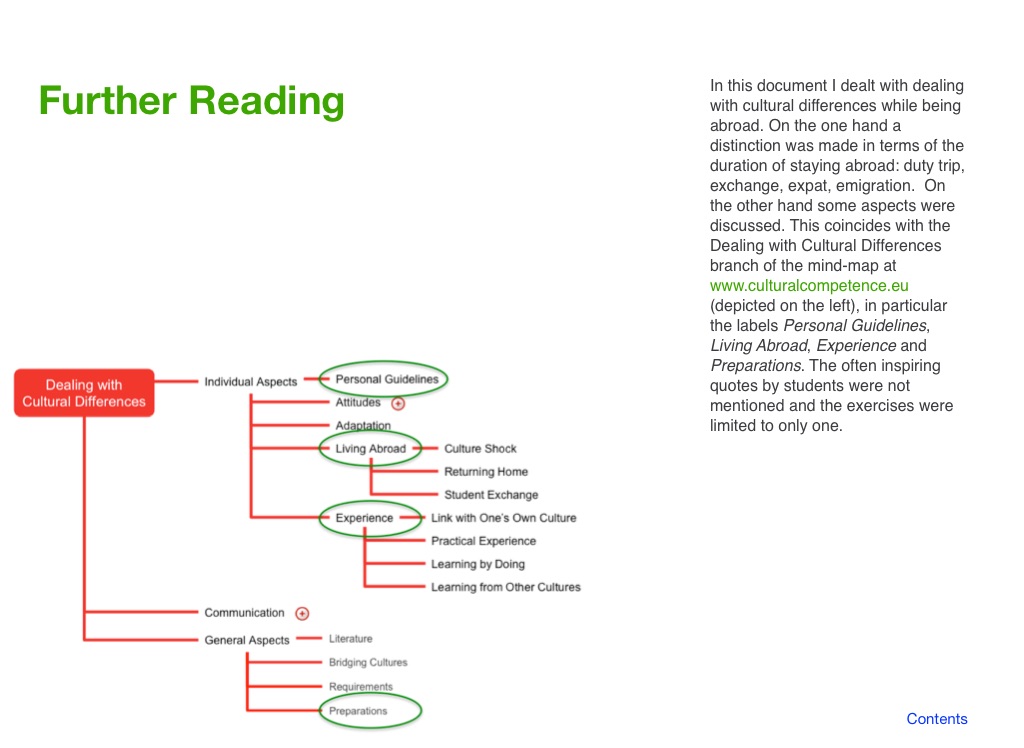
In this document I dealt with dealing with cultural differences while being abroad. On the one hand a distinction was made in terms of the duration of staying abroad: duty trip, exchange, expat, emigration. On the other hand some aspects were discussed. This coincides with the Dealing with Cultural Differences branch of the mind-map at www.culturalcompetence.eu (depicted on the left), in particular the labels Personal Guidelines, Living Abroad, Experience and Preparations. The often inspiring quotes by students were not mentioned and the exercises were limited to only one.