







PRIMES_vs_NO-PRIMES
PRIMES vs NO-PRIMES
Gather the NO-PRIMES 6yx+-y Remains are the PRIMES
Reginald Brooks
©2019, Reginald Brooks. All rights reserved.
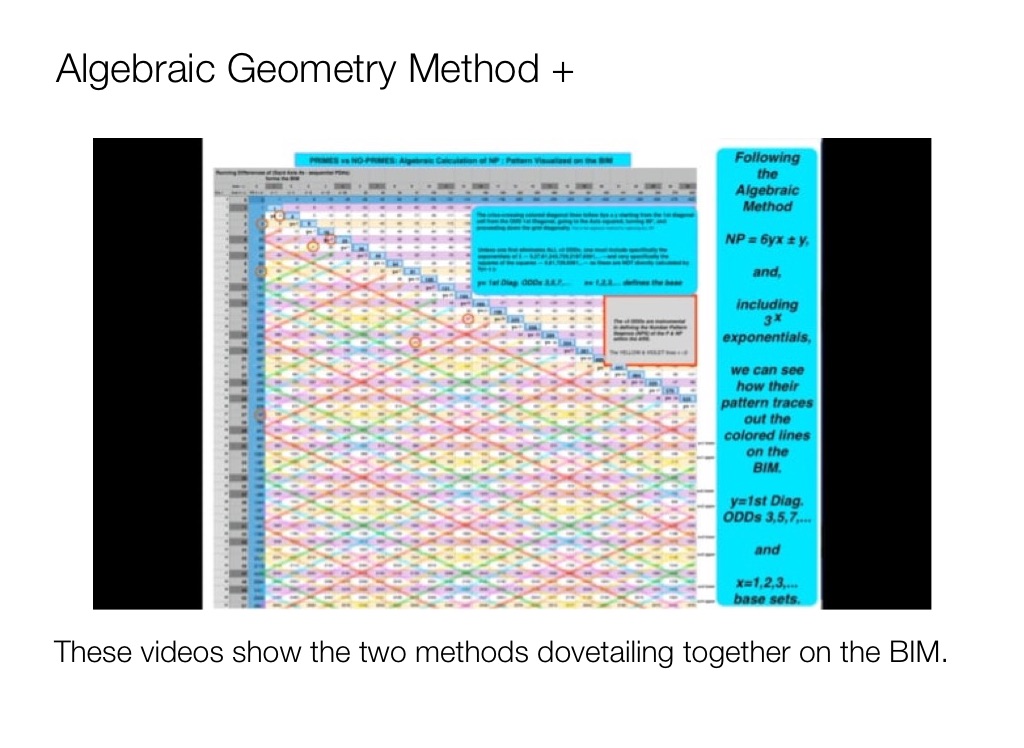
Abstract: Amongst a list of all the ODD numbers (≥3), one may reveal ALL the PRIMES (P) simply be identifying ALL the NO-PRIMES (NP). Two new methods: 1.) algebraic; 2.) algebraic geometry; —identify ALL the NP from any list of sequential ODD numbers. 1.) *NP = 6yx ± y (let x = 1, 2, 3,..., and y = ODD number) is the pure algebraic method. It was derived from and is easily visualized within the 2.) algebraic geometry method. (*The exponentials of 3, as 3^x, must be added to the algebraic method.) The latter method is built into the matrix grid depicting the Inverse Square Law, known as the BBS–ISL Matrix or BIM for short. The enclosed geometry on one part of the BIM identifies ALL the NP numbers. When eliminated from the remaining Inner Grid geometry, ALL the PRIMES (≥3) are revealed. Both methods produce identical results. Given enough CPU cycles, ALL PRIMES can potentially be identified, including those larger than—and between—the Mersenne Primes.
Introduction Identifying the PRIMES (P) from the NO-PRIMES (NP) from the pool of ODD numbers is a matter of separation, as one defines the other. Two new methods have been found: 1.) the algebraic method; and, 2.) the algebraic geometry method. Both methods capture ALL the NP and visually come together in the geometry. While they process slightly different, they dovetail nicely into a very visual Number Pattern Sequence (NPS) on the BIM (BBS-ISL Matrix of the Inverse Square Law). They both give identical NP results.
Background How can a deceptively simple matrix grid square give us: 1. Inverse Square Law (ISL); 2. Pythagorean Triples (PTs); 3. Primes (P) vs. No-Primes (NP)? The BIM (BBS-ISL Matrix) does that! What started as the invention/discovery of the ISL matrix—a simple grid of natural Whole Integer Numbers (WIN)—has led to an unforeseen connection between the ISL–PPTs–PRIMES. The BIM is an infinitely expanding matrix where every cell within the grid is uniquely occupied by a WIN that is itself simply the difference between its horizontal and vertical intersection values of the main, Prime Diagonal (PD). The PD mirror divides the grid into symmetrical halves. The PD is key as it consists solely of the squares of the Axis numbers (1,2,3,...).
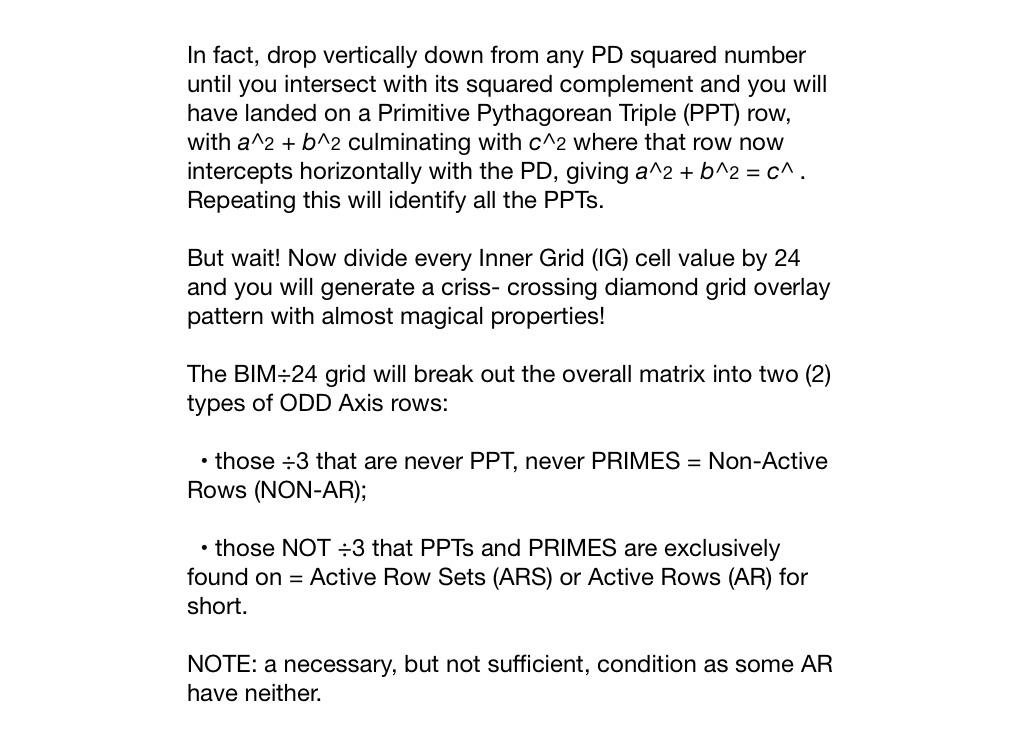
In fact, drop vertically down from any PD squared number until you intersect with its squared complement and you will have landed on a Primitive Pythagorean Triple (PPT) row, with a^2 + b^2 culminating with c^2 where that row now intercepts horizontally with the PD, giving a^2 + b^2 = c^ . Repeating this will identify all the PPTs. But wait! Now divide every Inner Grid (IG) cell value by 24 and you will generate a criss- crossing diamond grid overlay pattern with almost magical properties! The BIM÷24 grid will break out the overall matrix into two (2) types of ODD Axis rows: • those ÷3 that are never PPT, never PRIMES = Non-Active Rows (NON-AR); • those NOT ÷3 that PPTs and PRIMES are exclusively found on = Active Row Sets (ARS) or Active Rows (AR) for short. NOTE: a necessary, but not sufficient, condition as some AR have neither.
Algebraic Method The algebraic method was derived from the exploration of the intimate relationship found between the Inverse Square Law (as depicted on the BIM), the Pythagorean Triples and the PRIMES. Below is a short summary of the key elements. See also the HTML white paper versions of the forthcoming "TPISC IV: Details" ~ The Pythagorean—Inverse Square Connection and PRIMES ebook at: http://www.brooksdesign-ps.net/Reginald_Brooks/Code/Html/MSST/MSST-TPISC_resources/MSST-TPISC_resources.html
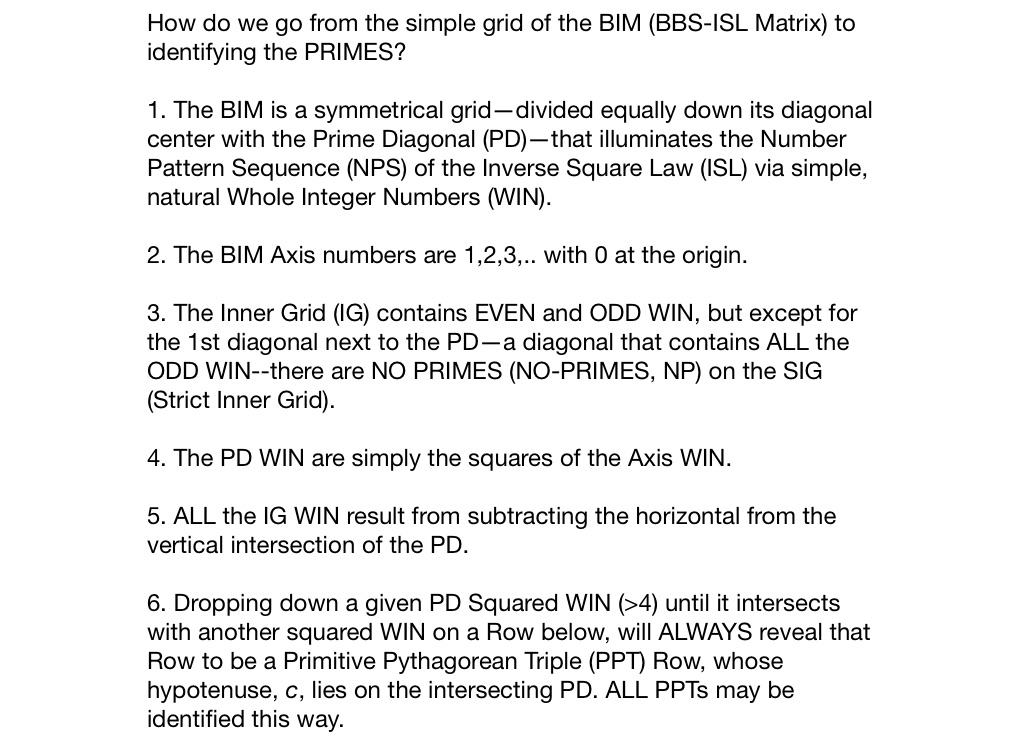
How do we go from the simple grid of the BIM (BBS-ISL Matrix) to identifying the PRIMES? 1. The BIM is a symmetrical grid—divided equally down its diagonal center with the Prime Diagonal (PD)—that illuminates the Number Pattern Sequence (NPS) of the Inverse Square Law (ISL) via simple, natural Whole Integer Numbers (WIN). 2. The BIM Axis numbers are 1,2,3,.. with 0 at the origin. 3. The Inner Grid (IG) contains EVEN and ODD WIN, but except for the 1st diagonal next to the PD—a diagonal that contains ALL the ODD WIN—there are NO PRIMES (NO-PRIMES, NP) on the SIG (Strict Inner Grid). 4. The PD WIN are simply the squares of the Axis WIN. 5. ALL the IG WIN result from subtracting the horizontal from the vertical intersection of the PD. 6. Dropping down a given PD Squared WIN (>4) until it intersects with another squared WIN on a Row below, will ALWAYS reveal that Row to be a Primitive Pythagorean Triple (PPT) Row, whose hypotenuse, c, lies on the intersecting PD. ALL PPTs may be identified this way.
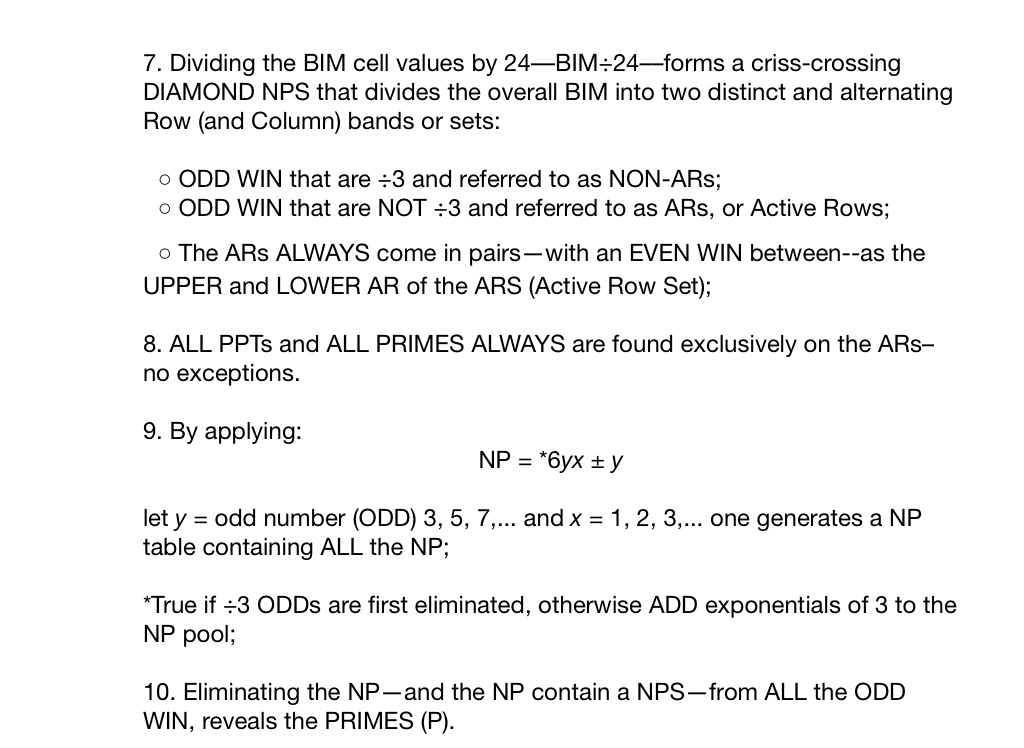
7. Dividing the BIM cell values by 24––BIM÷24––forms a criss-crossing DIAMOND NPS that divides the overall BIM into two distinct and alternating Row (and Column) bands or sets: ◦ ODD WIN that are ÷3 and referred to as NON-ARs; ◦ ODD WIN that are NOT ÷3 and referred to as ARs, or Active Rows; ◦ The ARs ALWAYS come in pairs—with an EVEN WIN between—as the UPPER and LOWER AR of the ARS (Active Row Set); 8. ALL PPTs and ALL PRIMES ALWAYS are found exclusively on the ARs– no exceptions. 9. By applying: NP = *6yx ± y let y = odd number (ODD) 3, 5, 7,... and x = 1, 2, 3,... one generates a NP table containing ALL the NP; *True if ÷3 ODDs are first eliminated, otherwise ADD exponentials of 3 to the NP pool; 10. Eliminating the NP—and the NP contain a NPS—from ALL the ODD WIN, reveals the PRIMES (P).
Algebraic Geometry Method +
These videos show the two methods dovetailing together on the BIM.
Algebraic Geometry Method +
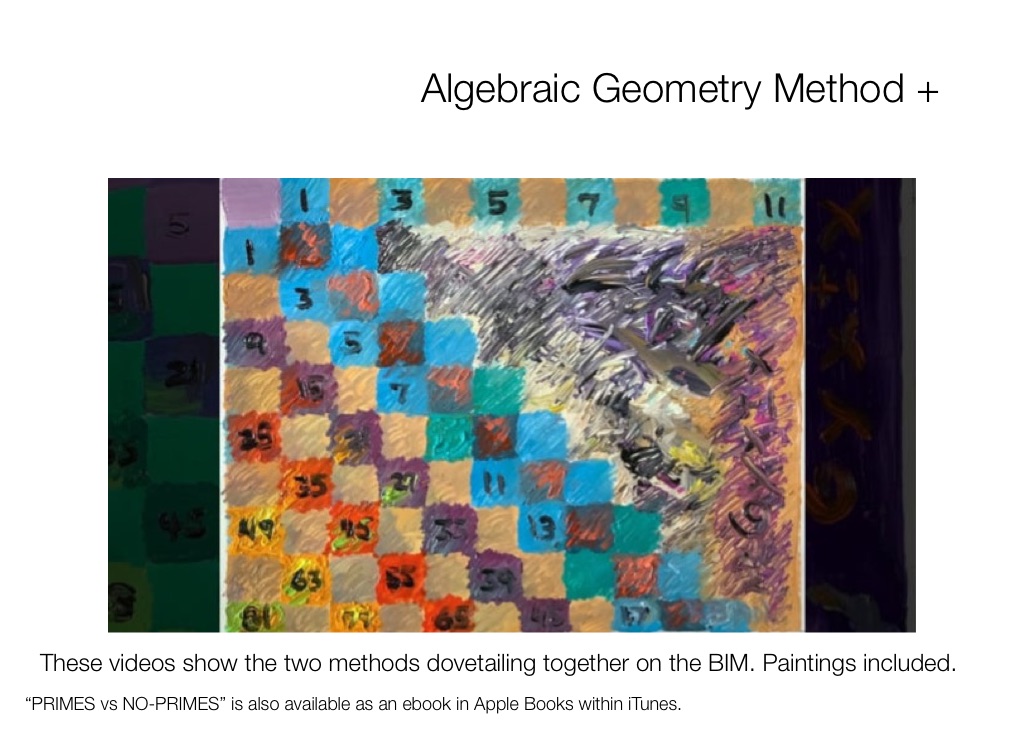
These videos show the two methods dovetailing together on the BIM. Paintings included.
“PRIMES vs NO-PRIMES” is also available as an ebook in Apple Books within iTunes.