







Culture 3 Multicultural Society
Culture 3 Multicultural Society
This document gives an overview of the difficulties of multicultural society and indicates directions of solving them.
Pieter van Nispen Senior Lecturer and Researcher, retired
January 2018
Table of Contents
page
page
page
page
page
Introduction
Concepts of Culture
Problems, including generations, migration, nationalism and minorities
Perceptions
Solutions
page
page
Exercises
Further Reading
Introduction
This series of documents on culture is part of a wider project, enhancing the understanding of culture and learning how to deal with it. The core of this project is the website http://www.culturalcompetence.eu. The website consists of a mind-map with some 100 labels on culture. Each label contains three icons, one with quotes on the topic in question, one with a summary of the literature and one with a self-study exercise. This document gives an overview of the difficulties of multicultural society and indicates directions of solving them. The picture on the front gives already an indication: not people but their backgrounds differ. Multicultural society is a strange phenomenon in the sense that it already exists for centuries and at the same time is often considered as one of the major current problems. All states have a population consisting of different ethnic groups with their own cultural characteristics, even if these differences seem to have disappeared below the surface.
After the fall if the Berlin Wall in 1989 some Central and Eastern European countries appeared rather mono-cultural and even xenophobic but once the socialist framework of unity was removed, the groups showed themselves again; my favourite example are the Gagauz. The question of the identity of ethnic groups is even one of the paradoxes of the European Union: the more you integrate, the more you may express your own identity (because of a less urgent need for national unity). The question is why this centuries old reality ‘all of sudden’ has become a problem. The short answer is that in many states lots of people arrived from other countries within a relatively short period of time and with rather large cultural differences with the host society. This migration changed the composition of a population in terms of ethnic groups but the real problem resulted from the differences in culture and in particular the underlying value patterns.
Contents
Introduction
In addition differences in socio-economic conditions play an important role, whether they are the result of cultural differences or not. A key question for all parties involved is how to keep one’s own identity. The difficulty in this domain is illustrated by the stories of lots of second and third generations of immigrants who are treated as foreigners – even urged to ‘return home’ – while they are born and raised in the country in question and have its nationality as well. The problems range from specific issues (employment, education, housing) through legal issues (recognition as refugee for instance) to individual attitudes (integration and acceptance). The even bigger question is how the resulting problems may be solved. Although they are rather substantial, proven solutions do not exist. Multi-faceted problems demand multi-faceted solutions and hence, creativity, adaptation and learning in practice (stumbling on), even at huge human costs.
Ultimately the solution to multicultural society comes down to the individual person and his or her attitudes, something you cannot guide or control. What you can do is to be open about it, to discuss the positive and negative aspects, to show unfounded assumptions and to get rid of empty rhetoric. The whole society from individual through organisations to government is involved, whether you like it or not. Overview This document discusses 1. the relevant concept of culture 2. the problems 3. some perceptions 4. directions for solutions
Contents
Concepts of Culture
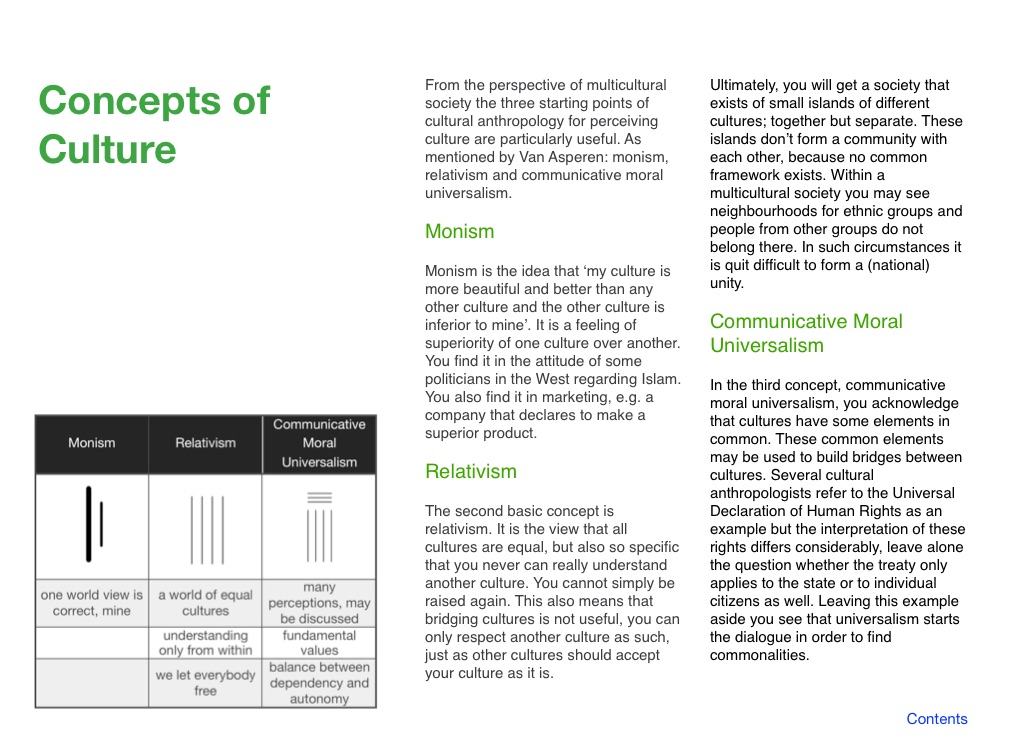
From the perspective of multicultural society the three starting points of cultural anthropology for perceiving culture are particularly useful. As mentioned by Van Asperen: monism, relativism and communicative moral universalism. Monism Monism is the idea that ‘my culture is more beautiful and better than any other culture and the other culture is inferior to mine’. It is a feeling of superiority of one culture over another. You find it in the attitude of some politicians in the West regarding Islam. You also find it in marketing, e.g. a company that declares to make a superior product. Relativism The second basic concept is relativism. It is the view that all cultures are equal, but also so specific that you never can really understand another culture. You cannot simply be raised again. This also means that bridging cultures is not useful, you can only respect another culture as such, just as other cultures should accept your culture as it is.
Ultimately, you will get a society that exists of small islands of different cultures; together but separate. These islands don’t form a community with each other, because no common framework exists. Within a multicultural society you may see neighbourhoods for ethnic groups and people from other groups do not belong there. In such circumstances it is quit difficult to form a (national) unity. Communicative Moral Universalism In the third concept, communicative moral universalism, you acknowledge that cultures have some elements in common. These common elements may be used to build bridges between cultures. Several cultural anthropologists refer to the Universal Declaration of Human Rights as an example but the interpretation of these rights differs considerably, leave alone the question whether the treaty only applies to the state or to individual citizens as well. Leaving this example aside you see that universalism starts the dialogue in order to find commonalities.
Contents
Problems at the level of society
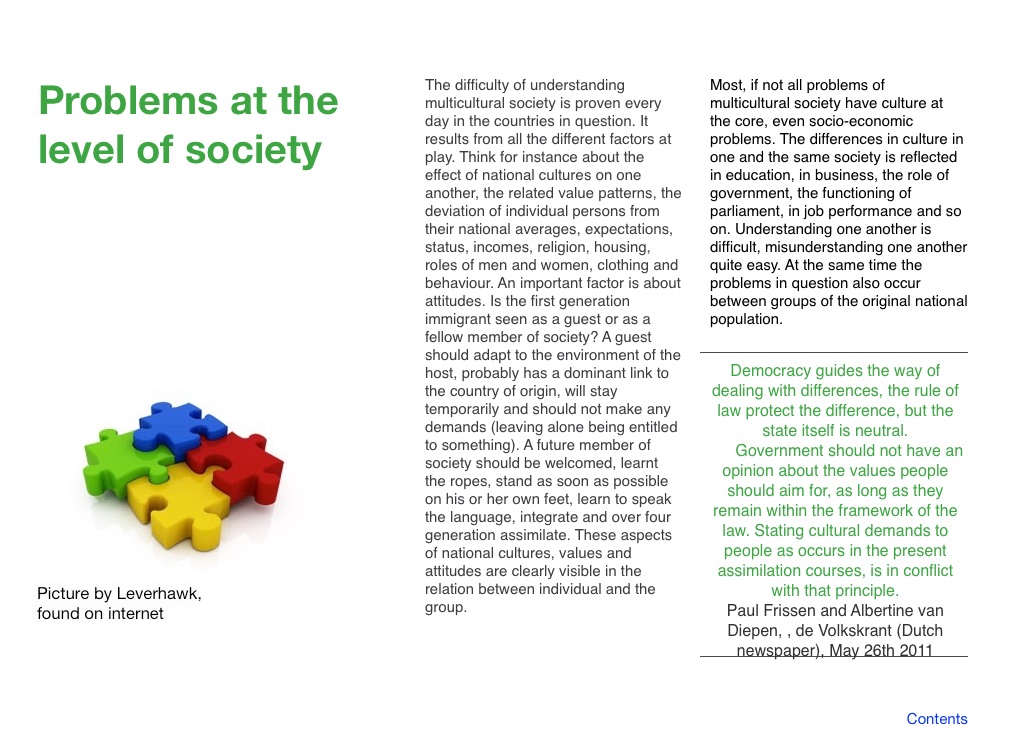
The difficulty of understanding multicultural society is proven every day in the countries in question. It results from all the different factors at play. Think for instance about the effect of national cultures on one another, the related value patterns, the deviation of individual persons from their national averages, expectations, status, incomes, religion, housing, roles of men and women, clothing and behaviour. An important factor is about attitudes. Is the first generation immigrant seen as a guest or as a fellow member of society? A guest should adapt to the environment of the host, probably has a dominant link to the country of origin, will stay temporarily and should not make any demands (leaving alone being entitled to something). A future member of society should be welcomed, learnt the ropes, stand as soon as possible on his or her own feet, learn to speak the language, integrate and over four generation assimilate. These aspects of national cultures, values and attitudes are clearly visible in the relation between individual and the group.
Most, if not all problems of multicultural society have culture at the core, even socio-economic problems. The differences in culture in one and the same society is reflected in education, in business, the role of government, the functioning of parliament, in job performance and so on. Understanding one another is difficult, misunderstanding one another quite easy. At the same time the problems in question also occur between groups of the original national population.
Democracy guides the way of dealing with differences, the rule of law protect the difference, but the state itself is neutral. Government should not have an opinion about the values people should aim for, as long as they remain within the framework of the law. Stating cultural demands to people as occurs in the present assimilation courses, is in conflict with that principle. Paul Frissen and Albertine van Diepen, , de Volkskrant (Dutch newspaper), May 26th 2011
Contents
Problems at the level of society
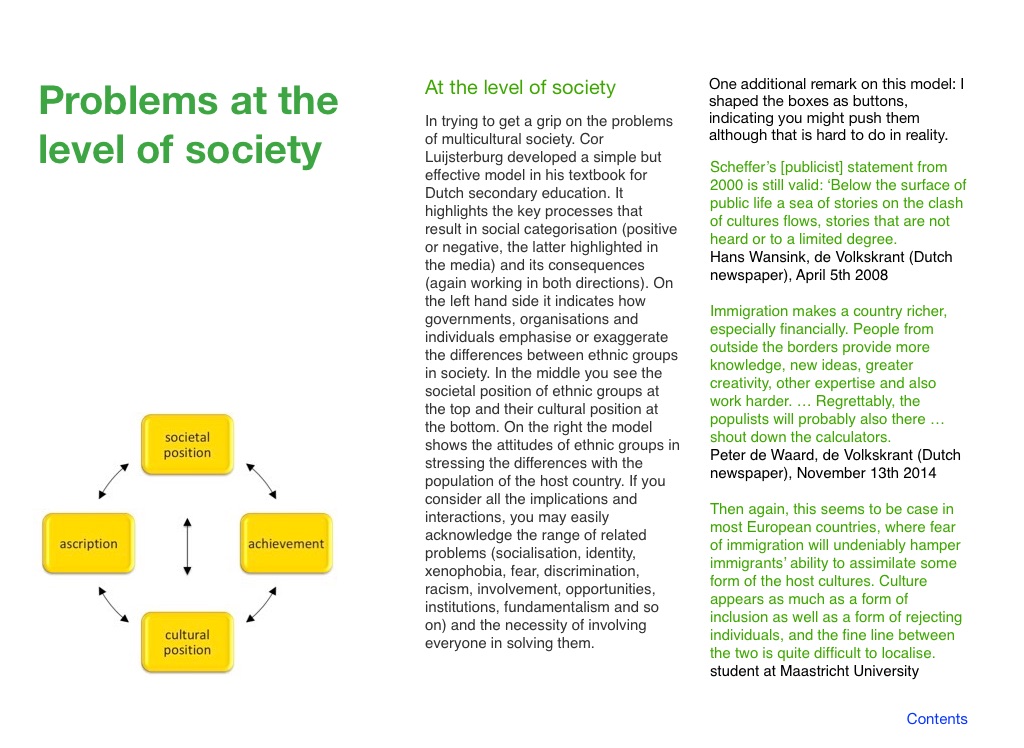
In trying to get a grip on the problems of multicultural society. Cor Luijsterburg developed a simple but effective model in his textbook for Dutch secondary education. It highlights the key processes that result in social categorisation (positive or negative, the latter highlighted in the media) and its consequences (again working in both directions). On the left hand side it indicates how governments, organisations and individuals emphasise or exaggerate the differences between ethnic groups in society. In the middle you see the societal position of ethnic groups at the top and their cultural position at the bottom. On the right the model shows the attitudes of ethnic groups in stressing the differences with the population of the host country. If you consider all the implications and interactions, you may easily acknowledge the range of related problems (socialisation, identity, xenophobia, fear, discrimination, racism, involvement, opportunities, institutions, fundamentalism and so on) and the necessity of involving everyone in solving them.
At the level of society
One additional remark on this model: I shaped the boxes as buttons, indicating you might push them although that is hard to do in reality.
Scheffer’s [publicist] statement from 2000 is still valid: ‘Below the surface of public life a sea of stories on the clash of cultures flows, stories that are not heard or to a limited degree. Hans Wansink, de Volkskrant (Dutch newspaper), April 5th 2008 Immigration makes a country richer, especially financially. People from outside the borders provide more knowledge, new ideas, greater creativity, other expertise and also work harder. … Regrettably, the populists will probably also there … shout down the calculators. Peter de Waard, de Volkskrant (Dutch newspaper), November 13th 2014 Then again, this seems to be case in most European countries, where fear of immigration will undeniably hamper immigrants’ ability to assimilate some form of the host cultures. Culture appears as much as a form of inclusion as well as a form of rejecting individuals, and the fine line between the two is quite difficult to localise. student at Maastricht University
Contents
Problems; Generations
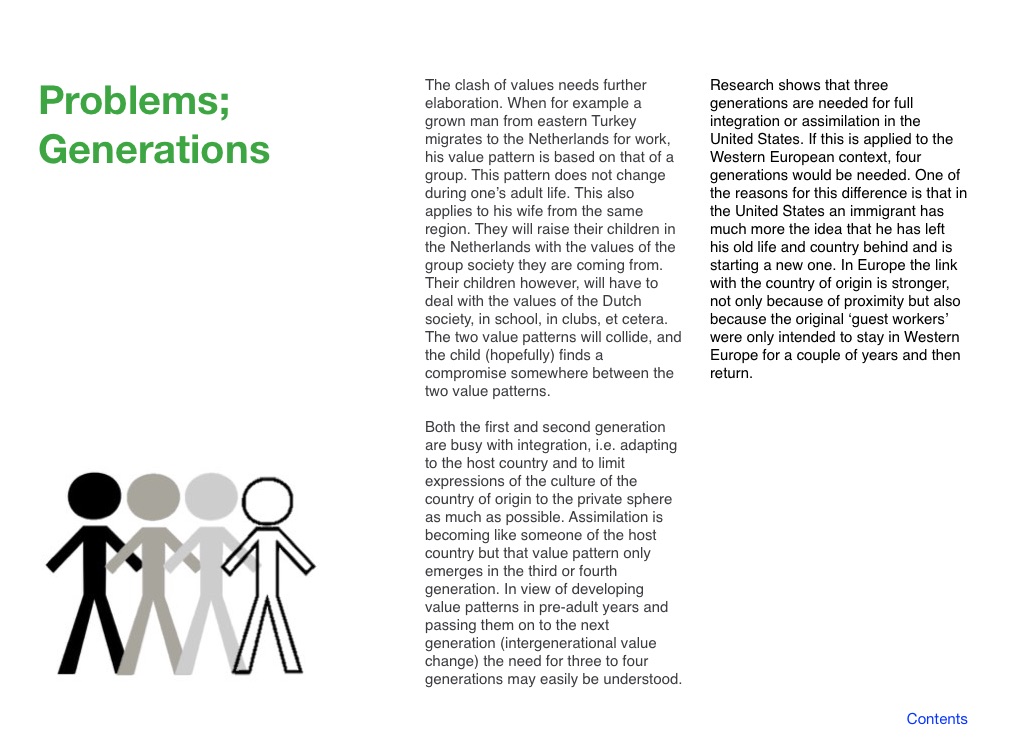
The clash of values needs further elaboration. When for example a grown man from eastern Turkey migrates to the Netherlands for work, his value pattern is based on that of a group. This pattern does not change during one’s adult life. This also applies to his wife from the same region. They will raise their children in the Netherlands with the values of the group society they are coming from. Their children however, will have to deal with the values of the Dutch society, in school, in clubs, et cetera. The two value patterns will collide, and the child (hopefully) finds a compromise somewhere between the two value patterns. Both the first and second generation are busy with integration, i.e. adapting to the host country and to limit expressions of the culture of the country of origin to the private sphere as much as possible. Assimilation is becoming like someone of the host country but that value pattern only emerges in the third or fourth generation. In view of developing value patterns in pre-adult years and passing them on to the next generation (intergenerational value change) the need for three to four generations may easily be understood.
Research shows that three generations are needed for full integration or assimilation in the United States. If this is applied to the Western European context, four generations would be needed. One of the reasons for this difference is that in the United States an immigrant has much more the idea that he has left his old life and country behind and is starting a new one. In Europe the link with the country of origin is stronger, not only because of proximity but also because the original ‘guest workers’ were only intended to stay in Western Europe for a couple of years and then return.
Contents
Problems; Migration
As mentioned before the existence of different ethnic groups with their own cultures is a condition of every state, even if its origin goes back for centuries. Most of the time patterns of co-existence have been developed. One of the major changes in Western countries in the sixties of the last century was the invitation to foreigners to come to work (the guest labourers). They were expected to return after a couple of years and hence, could do with modest housing and did not need to learn the local language. However, they did not return and opted for family reunion in the host country; family reunion is now a major reason for migration. This development changed the rules of the game. In the last few decades three other development reinforced one another in the sense of the number of foreigners arriving in mostly Western countries: asylum seekers (refugees in the strict sense), people fleeing from war and disaster and people who see an opportunity to make more money. In addition more and more people migrate as a result of climate change, as well as the earlier mentioned family reunion.
The first category (asylum seekers) is relatively small in numbers and consists of those who have their fundamental human rights violated (e.g. freedom of expression, religion or sexual orientation). The second group (fleeing war and disasters) wants to return in the end, even if that might take a few years. The third group (‘economic refugees’) is the major problem because they are not entitled to employment in the host country. They may well become illegal inhabitants, hard to track or to send back to the country of origin. This document will not discuss the ins and outs of the permission or not of residing in a given country. Next to a series of international agreements, states have their own rules and regulations. Furthermore, implementation practices differ, possibly within one and the same state. In addition, countries of origin differ in the degree of preventing ‘economic refugees’ to take the road and in the willingness to welcome back their nationals (whatever international law says). These and other factors influence the migration flows (from prevention to stimulation).
Contents
Problems; Nationalism
The idea of nationality is linked to that of the state; a world without states would not have nationalities (the present or modern state only originates from the Treaties of Westphalia of 1648). Although obtaining a nationality is an important element in the discussion on multicultural society, how it may be granted varies too much from state to state to be discussed here. However, nationalism is another issue because is has a cultural rather than a technical or legal nature. Nationalism is a means to an end, used by groups with their own interests. Nationalism may be a positive force as well (e.g. national sports teams) but is often used in a more negative way (e.g. resisting European integration). In its edition of December 23rd 2017 The Economist included a background article on nationalism. A few quotes highlight the major points. The importance of the topic is clear: “Wherever you look, nationalism is rising. Sometimes it takes the form of self-declared nations demanding the right to determine their future … More often it is a lurch to the populist and reactionary right.”
The article mentions that nationalism is a legacy of Enlightenment, which introduced three major new perceptions: (1) legitimacy surges up from the people (2) government is a statement of the nation’s general will and (3) each nation is different. Nationalism uses any of these concepts to its own advantage. “Today’s nations are, in a sense, products of nationalism, rather than, as nationalists might claim, it is of them.” “A lot of movements … have aimed to surpass the nation. None has succeeded.” At the same time the importance of values within a state and between states is decreasing, resulting in an emphasis on own interests. This contrast with the lessons learnt since the World Wars. “The impotence and insecurity felt by large numbers in developed countries shows that an important lesson has been forgotten”, i.e. growing economies benefitting all participants with safety nets for those who could not participate. Nationalists resist the loss of sovereignty (e.g. Brexit). Modern nationalism ranges from a ‘manipulation of history and culture’ to ‘a civic sort of nationalism, comfortable with themselves [Canadians] and the world around them’.
Contents
Problems; Minorities
In a world of approximately 200 states (depending on definition) and 6000 nations (a group belonging together on the basis of ethnicity, history, language and so on; e.g. the Kurds) one cannot avoid the existence of (many) minorities on an ethnic basis in any given country. Minorities may also be based on another denominator, such as religion, increasing the number of minorities in a given state. The key question is how people in a given society live together (in a democracy the majority cares for the minority). If every group lives in its own corner (see ‘relativism’ in the concept of Van Asperen), we may wonder whether we can still speak of a society with a shared vision of reality, common objectives, involving all and everybody. The term multicultural society may then look like an optimistic misnomer. However, please do not forget that not all differences are cultural differences.
At the level of large groups
The question is to what degree a minority (ethnic or otherwise) is willing to adapt to the (national) society as a whole. Integration may result in assimilation (just being like anybody else in society) in three to four generations. The identity of a minority may be of such importance that any integration is rejected, whatever the costs. Famous examples range from the Amish to the Kurds. The former established their own territory and the latter are trying to establish their own state; just one of the many differences between them but showing how hard common measures may be considered for dealing with minorities.
Some of history's most victimised peoples are obliterated; others eventually achieve statehood. Why? … Critical mass; plausible borders; sympathy abroad; a story; a diaspora; fragile overlords: where might these conditions next be met? The Economist June 20th 2015
Contents
Problems at the level of small groups
In a multicultural society you meet people with different backgrounds all the time. The question is, whether it is a problem and if so, how to co-operate. People have different attitudes, expectations, assumptions and so on and all of them might be influenced by culture (as mentioned in Culture 1: ultimately at the level of every individual person). In working together for instance one person may wait for orders while others take the initiative; flexible or strict in using time; working alone or in groups; focus on the job or in persons; status or achievement; and the list goes on. Such differences may create tensions even if the intentions are the best to be desired. Sometimes tensions may run high and a manager has to intervene. How is s/he going to do that if lacking in cultural competence?
However, the problems at the level of smaller groups are not limited to work and may occur in all kinds of day-to-day situations, like shopping. An example in public transport involved an older woman who decided to wait for the next bus because the one in front of her had too many passengers with a migration background. In the same vein people refuse repairpersons with a migration background into their houses (and even change providers for that reason) or do not accept medical care from someone with a migration background (although the cleaning lady may be all colours of the rainbow, particularly if paid in cash). Working together in teams with different cultural backgrounds, whether as a result of multicultural society or the demands of an international company, faces its own problems and will be dealt with in Culture 5: Teams and Projects.
Contents
Problems at the individual level
And before you start to protest: I am often blamed of blindness for the backwardness of my own culture, me, the fruit of the present Europe and living proof of the history that has been inititiated by Europe itself. Or sometimes I am kindly requested to the country of origin if I clearly do not like it here. Needless to say that this is my home country and that this culture is mine. In addition I do my share, thank you so much. But why should I earn my voice?
Nazmiye Oral , de Volkskrant (Dutch newspaper), June 6th 2011 Nazmiye Oral, de Volkskrant (Dutch newspaper), September 20th 2010
However, the values and norms with which he has grown up, will not change. They will be stretched, but not changed. I do not know anyone who started to think in a completely different way once his norms and values had been established as an adult.
Contents
Perceptions
The difference between problems and perceptions is not always clear because of a lack of sufficient research results. A problem may turn out to be only a perceptions and a perception may be proven to be a problem. In this chapter on perceptions a series of quotes illustrate a series of relevant perceptions (without any claim to be even close to the whole variety of perceptions). At the level of society In Belgium for instance … the integration question is still perceived as a socio-economic question, not at all related to religion, leave alone Islam. Hans Wansink , de Volkskrant (Dutch newspaper), April 5th 2008 The multicultural society has to be a marriage of convenience. Ahmed Aboutaleb NRC (Dutch newspaper), October 4th 2001 Also, we can consider different cultures in a society as a mosaic. We should never forget that this elaborate mosaic is reflecting the richness of the society although it is very fragile. student at Maastricht University
For that reason the challenge is multiculturalism … to realise that cultural processes are dynamic and situational. Halleh Gorashi, de Volkskrant (Dutch newspaper), July 24th 2010. ,,, but the thesis that inequality and segregation are persistent phenomena of the multicultural change has not been denied. Paul Scheffer, NRC (Dutch newspaper), March 25th 2000 A society that offers little space to talented migrants will pay a price. Paul Scheffer, Not proximity and touch are undesirable but distance and avoidance. Paul Scheffer, NRC (Dutch newspaper), March 25th 2000
Contents
Perceptions
At the level of larger groups Although immigration featured heavily in the Brexit campaign, areas with the most migrants … were among those most likely to vote Remain … Mint-tea sipping metropolitans may find it absurd that people in areas with comparatively few foreigners should be so keen to curb migration. But consider the change in numbers, rather than the total headcount, and the opposite pattern emerges … Where foreign-born populations increased by more than 200% between 2001 and 2014, a Leave vote followed in 94% of cases. The proportion of migrants may be relatively low in Leave strongholds … but it has soared in a short period of time. High numbers of migrants don’t bother Britons; high rates of change do. The Economist July 16th 2016 I knew that those new seedlings are in-stable, because the new generation is weakened by loyalty. If the history of the parents dies out, then in principle they have never arrived here and they do not live on. They die out. Nazmiye Oral, de Volkskrant (Dutch newspaper), November 29th 2010
Hearing that the group you belong to, is reprehensible, is not without consequences for the day-to-day life of someone. Feeling that you belong to a group that is not desired, of which everone has more than enough, really does not make your life any rosier. Being put away as a group of dangerous simpletons is something nobody has to comply with. Nazmiye Oral, de Volkskrant (Dutch newspaper), October 18th 2010 We are used to look for the extremes of the spectrum of contemporary problems. You are in favour or against and hence, you are always opposite one another. The outliers are so focused on enforcing their right that the problems rather serve as ammunition than as barriers that need to be taken and that may be thought through in a clear way. The centre is absent, a huge grey area, a whole. Nazmiye Oral, de Volkskrant (Dutch newspaper), October 18th 2010
Contents
Perceptions
At the level of the individual Cultural roots are a moral, social and psychological anchor. Harriet Duurvoort, de Volkskrant (Dutch newspaper), October 12th, 2015 … only someone who knows his own borders, may look beyond them. Paul Scheffer, NRC (Dutch newspaper), March 25th 2000 That is also essential for another reason because one who knows to be cut off from his own history, cannot penetrate in other cultures. Paul Scheffer, NRC (Dutch newspaper), March 25th 2000 Multiculturalsim is in its core just a form of positive thinking, a way of living which I try to learn, fumbling … Harriet Duurvoort , de Volkskrant (Dutch newspaper), March 26th 2012
Contents
Solutions; at the level of society
A necessary condition for finding a solution is to recognise the nature of the problem. However, the nature of multicultural society is only known to a limited degree. Insufficient reliable research results contrast with a flood of opinions that are not always helpful in solving the issues at hand. Closing borders for instance, is not a realistic option. In general terms the following problems need to be tackled: an increase of understanding the phenomenon (research), dealing with cultural differences (involving minorities in society, preventing discrimination) and solving issues of socio-economic inequality. At the same time at least three conditions have to be kept in mind: knowing what you want to achieve, one-size-fits-all solutions do not exist and the role of government is necessary but not sufficient. The first condition mentioned is to define the objective, what kind of society are you aiming for. Is it segregation (apartheid), a multicultural society (plural identities, limited commonality, equal opportunities), assimilation with the dominant culture (full integration after some generations), a melting-pot (creating a new national identity for everyone), a mosaic or …?
The processes may be quite different. On the one hand you may have assimilation by use of force after military victory and on the other Zeus, the God of ancient Greece, sleeping with the goddesses of the religions of conquered people, incorporating their religion in the Greek pantheon. The second condition refers the role of government, whether government should be involved or not. If multicultural society does not pose any problem, government has no role to play (although it might have done so to realise that situation). However, if problems do arise, then they probable touch on the two key tasks of a state, security and the well-being of its citizens (both tasks with an internal and external dimension, within the state itself or in relation to other states). Examples include public unrest, maintaining order, riots, fighting, terrorism, equal opportunities, trust in government, political dispute, relations with countries of origin, treaties and their implementation, border control, money transfers, human rights and even fake news and propaganda; specifically housing, employment and education. On the other hand a government cannot oblige individuals to change their values and attit...
They have a mosaic, not a melting pot. They have found a way to celebrate cultural differences and wrap them in a bundle of all-enveloping tolerance. It is not a choice between cultural exceptionalism and moral universalism, but a benign mix of both. The Economist, December 23rd, 2017
Contents
Solutions
Solving the cultural problems requires a willingness to listen to one another and to co-operate (no monism, no relativism), more specifically acculturation (adaptation to as well as changes of the dominant culture), socialisation (of groups and individuals) and internalisation (from values to practices). The process has to work both ways, not only to prevent resentment but also realise the enriching contribution at all levels, from society to individual (if we are open to it). At the same time socio-economic problems need to be addressed, particularly in fields like education, housing and the labour market. They may be the result of subconscious biases (from perception through stereotypes to discrimination and racism) but are very real and harmful in everyday life. In countries in which the rule of law applies citizens are equal in the eye of the law and should have the same rights, opportunities and entitlements. This includes social mobility.
If the Netherlands now says to be an ‘immigration country’, then it has to do what every migration country does, i.e. to emphasise the transfer of language, historical understanding and the legal culture. In the times of pillarization exactly those sources of cohesion prevented the degeneration of cultural differences into conflicts. Paul Scheffer, NRC (Dutch newspaper), March 25th 2000 This does not mean that cultures should convergence; on the contrary, everyone can keep their habits and traditions, but why not maybe develop common rules and standards? (…) This would be something like the lingua franca but a cultura franca and we would have to learn only these rules rather than trying to accommodate all different cultures and in the end acquire mild forms of schizophrenia. We will be just us communicating to the others, as if we were naked. Let us put all cultures in a melting pot and melt them to a culture of “naked people” - a new culture of equals, of persons, individuals who are in the centre of communication, and not their “clothes” - cultures. student at Maastricht Univeristy
Contents
Solutions
At the level of larger groups In the end emancipation has to be fought for by the involved groups themselves but it makes a difference whether the majority dissociates itself from it or wishes to open itself. Paul Scheffer, NRC (Dutch newspaper), March 25th 2000 Nevertheless, pluralism is promoted by those who strongly express the interest of their own interest group but at the same time when necessary critically evaluate their own community … Paul Scheffer, NRC (Dutch newspaper), March 25th 2000 One has to realise that tolerance in the end is a gesture that may be withdrawn if so desired. Hence, in dealing with minorities ultimately not tolerance has to preval but equality. It is about full citizenship. Paul Scheffer, NRC (Dutch newspaper), March 25th 2000
At the level of the individual Solutions on the individual level may only result from a willingness to change. A change values, norms and attitudes cannot be forced if it is possible to do so at all. Over the years I have learned to recognise a probable personality structure that is ideal for migrants … practical, a sunny nature, easy going, a solid base, no questions of identity, open, down-to-earth and having a sense of humour. What I have experienced … is the enormous importance of immediate involvement in society, whether someone is ready for it or not. That is in my opinion the only efficient way to make a good start here … [through a] buddy system. Nazmiye Oral, de Volkskrant (Dutch newspaper), July 18th 2011 A multiculturalist for this reason continuously focuses on how it does succeed, on the spots of light, how it is also possible, just because it has to. Direct the spot on the commonality, the centre, on what we share, the moderate because people find one another in that area. Harriet Duurvoort, de Volkskrant (Dutch newspaper), March 26th 2012
Contents
Contents
Exercises
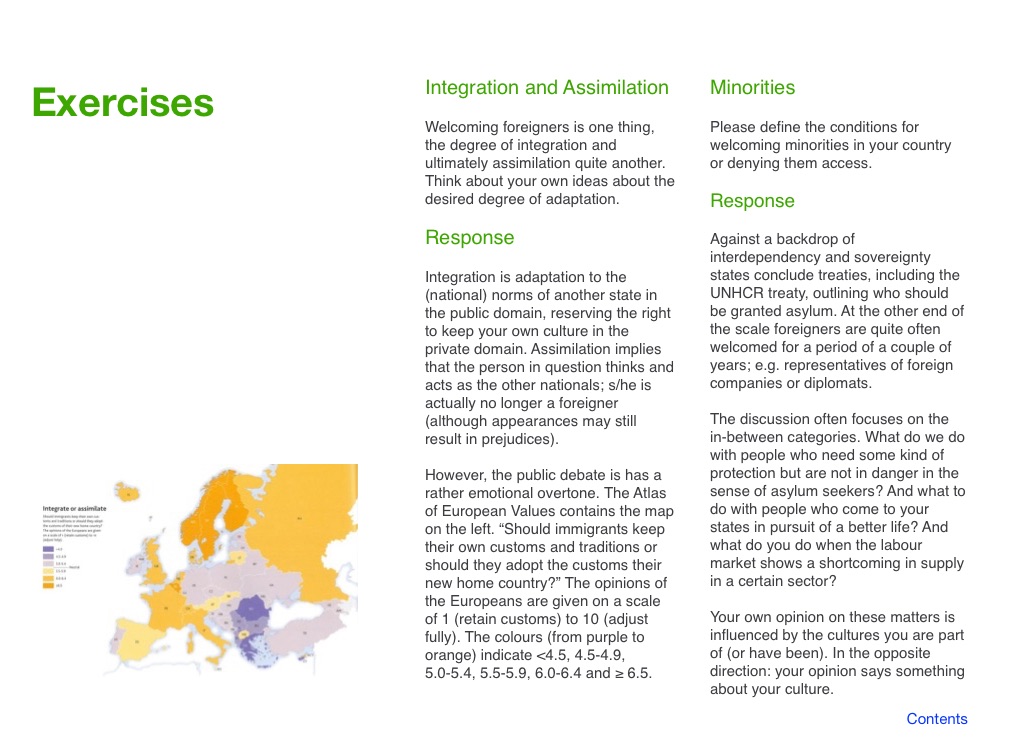
Integration and Assimilation Welcoming foreigners is one thing, the degree of integration and ultimately assimilation quite another. Think about your own ideas about the desired degree of adaptation. Response Integration is adaptation to the (national) norms of another state in the public domain, reserving the right to keep your own culture in the private domain. Assimilation implies that the person in question thinks and acts as the other nationals; s/he is actually no longer a foreigner (although appearances may still result in prejudices). However, the public debate is has a rather emotional overtone. The Atlas of European Values contains the map on the left. “Should immigrants keep their own customs and traditions or should they adopt the customs their new home country?” The opinions of the Europeans are given on a scale of 1 (retain customs) to 10 (adjust fully). The colours (from purple to orange) indicate <4.5, 4.5-4.9, 5.0-5.4, 5.5-5.9, 6.0-6.4 and ≥ 6.5.
Minorities Please define the conditions for welcoming minorities in your country or denying them access. Response Against a backdrop of interdependency and sovereignty states conclude treaties, including the UNHCR treaty, outlining who should be granted asylum. At the other end of the scale foreigners are quite often welcomed for a period of a couple of years; e.g. representatives of foreign companies or diplomats. The discussion often focuses on the in-between categories. What do we do with people who need some kind of protection but are not in danger in the sense of asylum seekers? And what to do with people who come to your states in pursuit of a better life? And what do you do when the labour market shows a shortcoming in supply in a certain sector? Your own opinion on these matters is influenced by the cultures you are part of (or have been). In the opposite direction: your opinion says something about your culture.
Contents
Further Reading
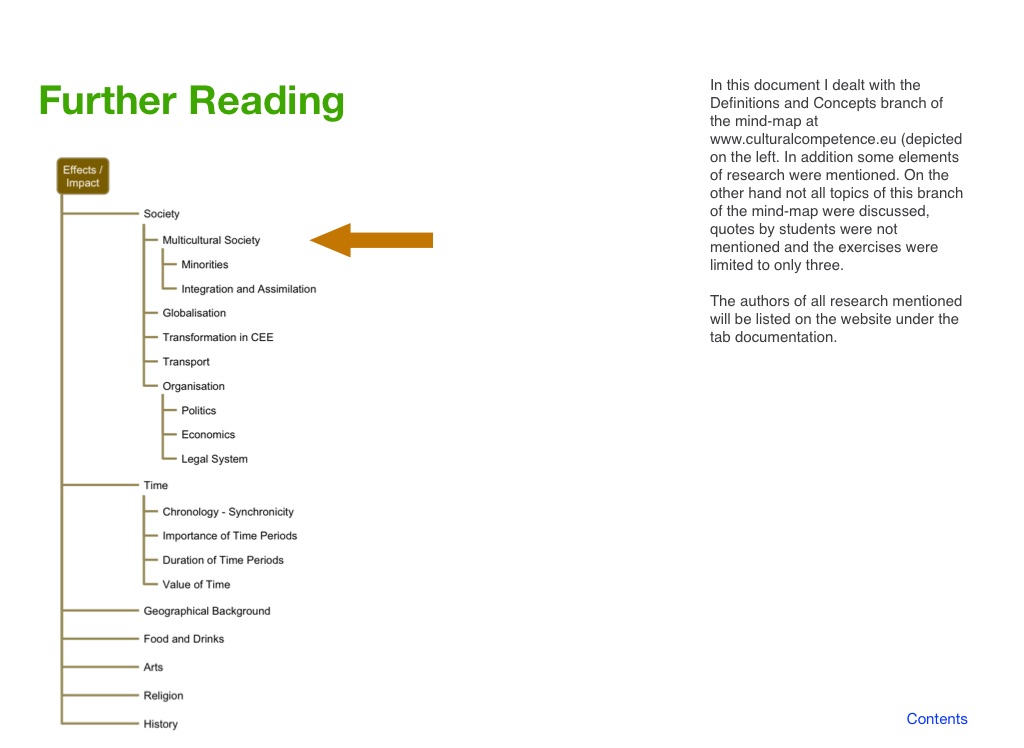
In this document I dealt with the Definitions and Concepts branch of the mind-map at www.culturalcompetence.eu (depicted on the left. In addition some elements of research were mentioned. On the other hand not all topics of this branch of the mind-map were discussed, quotes by students were not mentioned and the exercises were limited to only three. The authors of all research mentioned will be listed on the website under the tab documentation.