








Chinese north korean relations of strategic convenience
Analysis on Chinese-North Korean Relations
VIBANDOR and YUZON
USCHINA A52
Dr. Elaine Tolentino
refresher on Sino-DPRK relations
introduction
Sino-DPRK relations are built on the foundation of life and bloodshed by the old generations of revolutionaries
An analysis of this alliance is necessary in light of recent events. Chinese public opinion has started to question this relationship due to North Korea's numerous nuclear tests and the execution of Jang Sung-Thaek, China's mediator to Kim Jong-Un.
China and North Korea have been strong allies since the Korean War
Why is this analysis important?
The benefits of a
Sino-DPRK alliance
will prove to be of strategic convenience.
Main Argument
DPRK Dependence
First Argument:
China keeps influence in Pyongyang
China holds the key to preventing conflict and a larger crisis in the Korean Peninsula and maintaining relative peace.
North Korea is economically dependent on China which gives China influence in Pyongyang.
North Korea acts as a dependent buffer state that distances China from South Korea and the USA due to threats near China's border. China has nothing to fear on a unified Korea with nuclear assets that is allies with the US.
China Gains Power
Second Argument:
China checks a potential threat
Other great powers see China as the one who keeps a big threat in check. This gives China a reputation of power. North Korea is wholly dependent on China that North Korean assets would fall without Chinese support.
Chinese foreign policy in the peninsula remains to have risk-aversion characteristics.
China's Distraction
Third Argument:
North Korea is China's deterrent
North Korea diverts great powers' full attention from China which gives China liberty to act more freely with less international interventions.
North Korea receives overattention from other great powers while China remains in the background, thus passing the responsibility of the world's critical eye to North Korea.
Neutral China
Fourth Argument:
China as mediator
Because of China's goal in attaining economic and political stability internationally, it wants to make its image more accessible. China wants the world to see that they are not a threat. China wants to gain power over US and DPRK by overcoming the US as the hegemon
China acts as the mediator to North Korea's threats to project a good international image.
Conclusion
And so...
China's relationship with North Korea will serve as China's "Great Wall" that would protect their security and plans.
China must balance its relationship with North Korea at the same time with the US and South Korea to reach its goal in achieving greater autonomy from the global community. If China stops tolerating North Korea from their nuclear activities, then the full attention of the world will focus on China itself since it plays a major role in challenging western ideas.
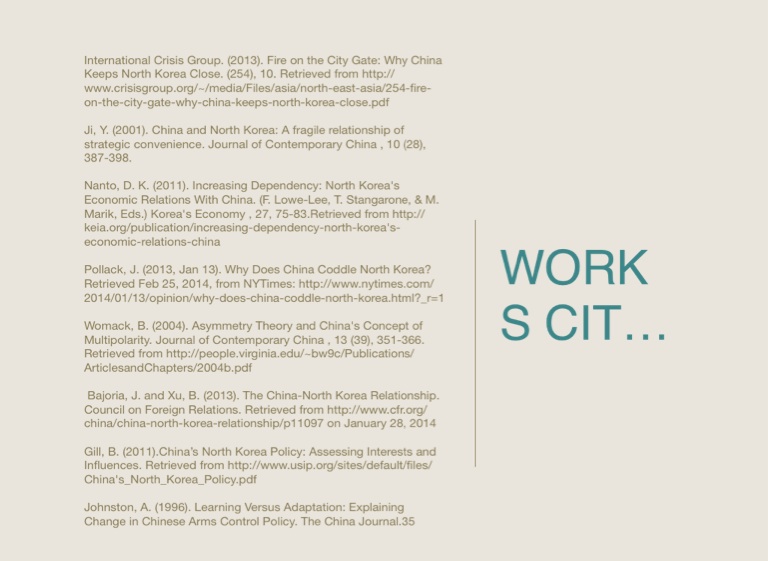
WORKS CITED
International Crisis Group. (2013). Fire on the City Gate: Why China Keeps North Korea Close. (254), 10. Retrieved from http://www.crisisgroup.org/~/media/Files/asia/north-east-asia/254-fire-on-the-city-gate-why-china-keeps-north-korea-close.pdf Ji, Y. (2001). China and North Korea: A fragile relationship of strategic convenience. Journal of Contemporary China , 10 (28), 387-398. Nanto, D. K. (2011). Increasing Dependency: North Korea's Economic Relations With China. (F. Lowe-Lee, T. Stangarone, & M. Marik, Eds.) Korea's Economy , 27, 75-83.Retrieved from http://keia.org/publication/increasing-dependency-north-korea's-economic-relations-china Pollack, J. (2013, Jan 13). Why Does China Coddle North Korea? Retrieved Feb 25, 2014, from NYTimes: http://www.nytimes.com/2014/01/13/opinion/why-does-china-coddle-north-korea.html?_r=1 Womack, B. (2004). Asymmetry Theory and China's Concept of Multipolarity. Journal of Contemporary China , 13 (39), 351-366. Retrieved from http://people.virginia.edu/~bw9c/Publications/ArticlesandChapters/2004b.pdf Bajoria, J. and Xu, B. (2013). The China-North Korea Relationship. Council on Foreign Relations. Retrieved from http://www.cfr.org/china/china-nort...
thank you
presenters
VIBANDOR, Vian YUZON, Isabella
USCHINA A52 Dr. Elaine Tolentino April 3, 2014