Sign up for FlowVella
Sign up with FacebookAlready have an account? Sign in now
By registering you are agreeing to our
Terms of Service
Loading Flow

Downloading Image /
Downloading Image /
Downloading Image /
Japanese 1000 BC
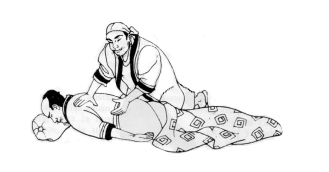
In about 1,000 BC Japanese monks began to study Buddhism in China. They witnessed the healing methods of traditional Chinese medicine and took them back to Japan. In Japan the practice of medicine mostly consisted of diagnosis and treatment with massage-type methods. The Japanese not only adopted the Chinese style, but also began to enhance it by introducing new combinations, eventually reaching a unique Japanese form called Shiatsu. Shiatsu is a Japanese word derived from ‘shi’ meaning finger and ‘atsu’ meaning pressure. It is a technique similar to that used in acupuncture but without needles and with extra movements involved.
Shiatsu
When the founder of Shiatsu Therapy, Tokujiro Namikoshi-sensei, was seven years old, he completely cured his mother who suffered from rheumatism. He used only his thumbs, fingers and palms in applying pressure to her body. This was the beginning of Shiatsu in 1912. His continuing studies lead him to the establishment of an anatomical and physiological theory of Shiatsu. He further developed his theory at his school which he opened to train Shiatsu therapists. As a result of continued presentation of his work, in 1964 the Ministry of Health of the Japanese National Government recognized Shiatsu as a uniquely Japanese therapeutic treatment.
The word "Shiatsu" is thought to have been used first by Tenpeki Tamai about the year 1900. Namikoshi-sensei was influenced by this, and gave the name "Shiatsu Ryoho(Treatment)" to the therapeutic method he had invented, thus establishing modern Shiatsu therapy.
Downloading Image /
Downloading Image /
Downloading Image /
Downloading Image /
Downloading Image /
Downloading Image /
Downloading Image /
Downloading Image /



FlowVella, Previously Known As Flowboard
© 2026 FlowVella
 FlowVella