








Culture 1 Definitionns and Concepts
Culture 1 What is Culture?
This slidedoc gives you an overview of definitions and concepts of culture. It starts with an indication of why it is so difficult to study culture.
Pieter van Nispen Senior Lecturer Researcher, retired
December 2017
Table of Contents
page
page
page
page
Introduction and Overview
Barriers in Studying Culture
Definitions of Culture
Concepts of Culture
page
page
Exercises
Further Reading
Introduction
This introduction on culture is meant to give an idea of what culture is. Although it is a complex phenomenon, it is not slippery. Ultimately everyone has his or her own idea of culture. This documents will be followed by up to nine other texts on e.g. national cultures, organisational culture, values, living and working abroad, multicultural society and dealing with cultural differences. Furthermore, these documents are part of a wider project, enhancing the understanding of culture and learning how to deal with it. The core of this project is the website www.culturalcompetence.eu. The website consists of a mind-map with some 100 labels on culture. Each label contains three icons, one with quotes on the topic in question, one with a summary of the literature and one with a self-study exercise.
This text is based on my fifteen years of teaching on culture at BA and MA level and before that my experience as a diplomat and an international consultant. However, the major source of inspiration consists of the papers of over 1,000 MA students about their experiences with living and working abroad. This document discusses 1. barriers to studying culture 2. definitions of culture 3. concepts of culture The choice of the front’s colour is inspired by the colour theory of change management guru De Caluwé. Yellow stands for power oriented organisations and has been chosen here for the power of culture.
Learning about culture is learning about yourself!
Overview
This pictogram depicts the barriers that need to be overcome in order to be able to study culture. They come back when we discuss dealing with cultural differences.
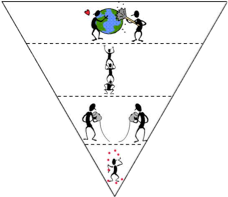
The triangle with four layers represents the key model used in this slidedoc but more definitions and concepts of culture are discussed.
The waves indicate ‘above and below the surface’; on the surface national cultures (relatively superficial due to representative samples and the use of averages) and below the surface values and beliefs (the layer of culture below our thinking and feeling). In between you find the topics ‘organisational culture’ and ‘living and working abroad’.
Finally, bridging cultural differences may only be done if you have an idea of your own culture and the culture of the other, an attitude of respect and a orientation towards commonalities (rather than differences).
Culture is a firm softness, firm in the way it affects our thinking, acting and feeling, soft in the difficulty in getting a grip on it.
Barriers in Studying Culture
See next pages for further clarification.
Barrier 1: You are Part of It!
Culture is an integral part of human beings, influencing out thinking, acting and feeling. You cannot live without culture. This implies that you can never talk objectively about culture; you cannot separate you yourself from you yourself! The consequence is that you have to be really careful in your research design, methodology, implementation et cetera.
Culture may be adaptive and maladaptive, helping you or blocking you in reacting and behaving in the proper way. This idea is also depicted by the illustrations below. On the left the idea is that culture is always there, even subconsciously (in your sleep). In the middle culture is like your own home in which you feel comfortable. On the right culture is like a tight barrel, restraining you. This introduction culture should assist you in finding that middle position. Knowing not enough about your own culture is no good because you are then controlled by forces you are not even aware of! The uncomfortable position on the right is no good either, because you are just trying to cope, not even realising your potential.
Barrier 2: Definition Problems
Barrier 3: Commonalities and Differences
In the two graphs below, developed by Trompenaars, you see two imaginary bell curves of the French and the American culture. The overlap is much bigger than the differences. However, people have a tendency to look at or to stress the differences. Nevertheless, the commonalities give you common ground!
Barrier 4: Fallacy of Averages
In the drawing below on the right you see two equally sized groups of ones and three. Their average is then a collection of twos but each two is just a calculated construct. We have only ones and threes. Imagine that you are participating in an opinion poll and you have to select one of two statements, A or B. You choose either A or B, but you may read in the results that people favored A by 74%. However, no respondent answered with 74% A and 26% B; rather 100% A or 100% B. If the groups of ones stand for women and the group of threes stand for men, what is then the average?
When researchers study culture, they often take representative samples of people, submit questions to them and calculate the average answers. However, a representative sample is always an approximation of the composition of people in a given group. And the questions may not be properly grounded in theory or not formulated carefully or … The biggest problem, however is the calculation of averages because the average does not show the variation (standard deviation) and hence, not the richness of culture. Bringing down an aspect of culture to a specific number can for that reason not be more than an indication of where you might be finding answers to your quest of understanding the other culture.
Barrier 5: Stereotypes and Prejudices
Below you see an example of prejudices, one of the many examples you may find on internet. In trainings you might do an exercise in which you have to guess the nationality of people, photographed against a neutral background. Time and time again this exercise shows that we have ideas on how certain people would look like but we actually do not know.
Human beings have in their way of thinking a tendency to put information in categories or boxes. The value of the information may be limited (superficial) but neutral; stereotypes. Or the information may be limited but have a negative connotation; prejudices. Next to that we have of course also verified information. The point is that we all work with stereotypes and prejudices, subconsciously and the trick is to become aware of them as much as possible.
Definitions of Culture
Although not fully accurate one may say that the study of culture started some 200 years ago with the efforts of Europeans to ‘civilise the world’. The key vehicle for doing so was religion and hence, missionaries were sent abroad. They often lived for years with their assigned tribe and started to write down the behaviour, the myths and so on of that tribe; its culture. This had its impact on an emerging science, cultural anthropology. Hence, the first definitions came from this research (see stack on the left). A major conclusion was and is that the expression of culture may differ considerably but that the process shows many similarities (e.g. trying to find an answer to why man is on earth and where s/he goes to after death). Around the Fist World War sociology got interested because it studied the behavior of groups of people and if culture is about the behavior of people … The same happened around the Second World War and psychology because culture is patterns of thinking …
In the sixties of the previous century international business recognized a need for knowing more about culture. Staff in a daughter company abroad clearly needed to be instructed in other way than ‚at home’. The question was how to deal with cultural differences through a comparison of two or more cultures. This opened a new window in the research on culture. The idea was (and is) to describe different national cultures with the same tools and in such a way that the outcome of this comparison would give you handles on how to deal with these differences. The first effort was the one by Hofstede. He described each national culture on the basis of four dimensions (later six) and gave a value for the position of a given country on each of these dimensions. By a careful description of each dimension and its implication one could anticipate differences in accordance with the positions on each dimension, including the ways and means of dealing with these difference.
Paradigm
Between definitions and concepts culture may be considered as a paradigm jungle (Barker). In order to understand this idea we need to start with explaining paradigms as such. Below you find a definition of a paradigm. Barker gives an example from tennis. If you do not know anything from tennis, you just see people in funny clothes with an instruments in their hands, a net, lines on the ground and a ball. These people try to hit the ball (or not?) and get sometimes excited or angry. To understand why you have to know the rules and to know when someone scores: the paradigm of tennis!
If you click on the icon in the middel of the stack below, you will first see this definition again. Clicking on the right you will see an exercise: a square of nine dots. You have to connect these dots in accordance with the instructions next to them. The final picture in the stack gives you a solution. A person is a member of dozens, even hundreds of groups. They range from the small and specific (e.g. family) to the large and abstract (e.g. all women in a given country). Each group has its own culture, its own way of thinking, acting and feeling. Each of us shifts all the time through those cultures or paradigms to find the proper response in the given situation. In that sense culture is a paradigm jungle. Even worse: if you cannot find a suitable paradigm, you have to develop one!
Concepts of Culture
Instead of trying to define culture, many researchers developed concepts (models, graphs, colors and so on). First the model of Van Asperen is mentioned, giving some basic ideas of culture. Secondly, the model of Pinto stresses a key element in many studies of culture, the dichotomy between individual and group. Then we move on to the concept of Thomas and Inkson (which might be seen as the cultural competence), the triangle of Richard D. Lewis and the triangle of Van Nispen.
According to Van Asperen (and in line with the findings of cultural anthropology) people may show three basic perceptions of culture. The first is monism or 'my culture is better’, the idea of superiority of one culture over another. An example is the attitude of Europeans vis-à-vis the rest of the world over a century ago; but also the attitude of some politicians in the West regarding the Islam. Secondly, relativism stresses that cultures are equal but also that you can never (fully) learn the culture of another. Although you respect other cultures, each culture stays on its own and does not mingle with other cultures. Together but separately, like a China town in San Francisco where you cannot find anything in English. The problem is then of course to create a municipal or national community. The third idea builds on relativism but emphasizes that cultures have common elements, which may be used to build bridges between cultures. Van Asperen uses the example of universal human rights but in view of widely divergent interpretations of these rights, this example complicates things rather than clarifying.
Individual and Group; Pinto
A key theme in the research on culture is the degree in which people are focused on the individual or on the group. Prof. Pinto takes this as the core of his concept of culture and talks about tight and loose structures. A tight structure equals a group oriented culture. In such a culture the focus is on the position of the group in society and the individual person has to contribute to the enhancement of that position. In a somewhat extreme way one may say that the group determines all and everything; what school you are going to, what job you are going to do, which partner to marry and what house to live in. The individual is boxed in, a tight culture.
The loose structure or individualistic culture is just the opposite. The individual person has a dream future and s/he uses all and everybody to realise it. In Pinto’s graph you see smaller and wider boxes in a matrix of cultures, representing tighter and looser structures. If you open the stack you see how the pyramid of Maslow is affected by this theory. Indeed, Maslow is clearly based on Western individualistic culture (loose structure) and does not recognise that tight structures result in different values.
Cultural Competence
Although not intended as such, the concept of Thomas and Inkson may be considered as the cultural competence. A major part of Dutch education is competence based and in this context a competence is an integral combination of knowledge, skills and attitudes. Thomas and Inkson focus on Cultural Intelligence (CQ), which consists of knowledge, skills and mindfulness. Knowledge relates to the different theories on culture and the acknowledgement of their effects. Skills range from mastering languages to adaptation of behavior in another culture. Mindfulness is just one of the attitudes required for the cultural competence and the term itself is suboptimal. Thomas and Inkson did not want to use the term ’respect’ in view of its rather fuzzy nature nowadays. What they mean is that people should wait with judging the behavior of others till they have sufficient information. In that sense mindfulness might well replace respect. However, in many countries mindfulness is a mediation technique, something clearly not intended!
Nature - Nurture
A frequent but unanswered question is how much of patterns of thinking and acting is part of the nature of man and how much is learned (nurture). The first picture of the gallery on the left deals with that question and may be found in many textbooks (but I did not see a proper reference yet). The picture is clear by its simplification but also raises a series of questions. For instance, how universal is the nature of man? We do know that climate affects your bloodstream and even your taste; and certainly the nature of men and women are not the same. Hence, the picture may offer some understanding of the relationship between nature and nurture but should not be used in any strict, delineating way. If you open the stack you may see two additional pictures, developed by Hofman. They use the idea in somewhat more detail. The second picture shows the overlap of three of these triangles, representing three different persons. The third picture adds details to each of the layers.
Richard Lewis
Richard Lewis developed the concept on the right, mostly from a linguistic background. In his books and trainings he clearly shows the practical consequences, for instance in adapting communication and behavior. His theory is based on a three-pronged approach and the classification of countries accordingly. The three ’corners’ of his theory are linear active, multi-active and reactive societies; and of course not a single society is only one of them (only at the statistical national level). Linear-active stands for societies in which people take a step at a time. In multi-active societies people are involved in more activities simultaneously. People in reactive societies have a wait-and-see attitude, acting when the position of others is known.
Van Nispen Triangle
The triangle in the gallery has the size of groups as its starting point, the largest group on top and getting ever smaller to the bottom. At the top the focus is on national cultures, below that the larger groups as in organisational culture, then smaller groups like multicultural teams and finally the individual. As mentioned before the individual juggles the cultures of all groups s/he is or was a member of. At the same time - a human being not being perfect - you also make mistakes by not showing the proper behaviour; dropping one of the balls you are juggling. In the small group you are still known as an individual person and communication is added. In organisations your individuality counts for less and you become an instrument in realising the objectives of the organisation (human resources!). At the top you are even more of a number; the larger the state, the more military, economic or cultural power a state may project in the international arena. Between the four layers you see dotted lines because the individual moves across those lines all the time. The same applies to the research on culture. The different approaches may be divided over the four layers but not in a rigi...
Reality is of course more complex. You may think of for instance a Dutchman working for an American company, posted in Hong Kong and working in a team with people from Japan, mainland China and the Philippines. How many triangles overlap and actually need to be coordinated for a smooth cooperation? In the stack you also see two examples of the complexity of culture at the individual level. The second picture (developed by Hofman, adjusted) shows some of the groups an individual is a member of. The third picture puts all paradigms at the individual level in a cultural backpack. If an individual comes in a new situation, s/he will look in this backpack to see whether a suitable paradigm is already available. If so, fine; otherwise a paradigm needs to be developed, whatever the effort its costs. The fourth picture shows the relation between culture and civilisation. Culture enables people to accept the organisation of society and answers ’the question of death’: where are we coming from, why are we here on Earth and where are we going to after our death? Finally, in the fifth picture the concept is summarised, including the idea of internal and external culture (a culture you are a me...
Exercises
Definition In this document you found a few definitions of culture. You may have heard of or read some others. You may use for instance internet to find some more. Now you may use these building blocks to draft your own definition. This definition may be used (implicitly or explicitly) when you are reading more about culture, developing your understanding of the concept. Response Ultimately, culture has as many definitions as the number of people on Earth, because each of us is a unique combination of all the cultures of all the groups s/he is or was a member of. The mind-map also shows a series of ‘official’ definitions. These definitions vary at least in three different ways: according the discipline; the focus on behaviour, thinking or both; and the level of culture (national cultures, organisational culture, team culture and even individual culture).
Triangle This exercise aims at a better understanding of what culture is for you, in particular your cultural backpack. The triangle model describes four layers of culture: national cultures, cultures of larger groups like organisational culture, cultures of smaller groups and individual culture (the net combination of all cultures you have ever been exposed to). Describe yourself (in cultural terms) on these four levels. On the national level you may think of the influence of national culture and how do you fit in? In terms of organisational culture you may think about the desirable working environment and the degree to which you have found it. And how do you like working in a team? Ultimately you may face you yourself as the unique combination of all cultures of all groups you have ever been a members of; from small to large groups and from rather specific to rather intangible. You may obtain a better understanding of culture and how it influences you. The better it is, the better you also grasp the idea of dealing with cultural differences.
Further Reading
In this document I dealt with the Definitions and Concepts branch of the mind-map at www.culturalcompetence.eu (depicted on the left. In addition some elements of research were mentioned. On the other hand not all topics of this branch of the mind-map were discussed, quotes by students were not mentioned and the exercises were limited to only three. The authors of all research mentioned will be listed on the website under the tab documentation.