Sign up for FlowVella
Sign up with FacebookAlready have an account? Sign in now
By registering you are agreeing to our
Terms of Service
Loading Flow

Downloading Image /
Downloading Image /
Downloading Image /
Downloading Image /
Downloading Image /
Downloading Image /

Artist: The artist is unknown, but Hammurabi was responsible for having them carved.
Date: 1750 BC
Medium: black diorite
Provenance: Ancient Mesopotamia
Source: louvre.fr
Hammurabi's Code
Description-
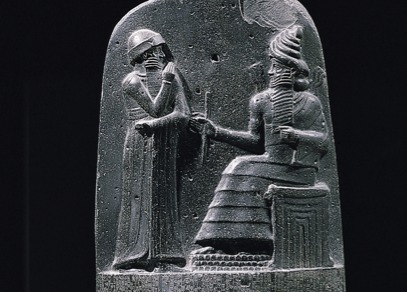
Description: Hammurabi's Code is a seven foot pillar of black diorite. On the top, is the emperor Hammurabi receiving a staff from the god of justice, Marduk. On the bottom part of the pillar are 282 laws that have been inscribed in the substance.
Analysis Of Elements Of Art: This piece has a combination of both geometric and organic forms. The organic forms are the two human figures while the geometric forms are much more abundant. We see the geometric forms on and around the humans. This includes the dome on the person on the left's head, the rectangle that makes of the throne, and the triangle on the man on the right's head. Even though this is not a fully carved out statue, it is 3D because the images pop out of the stone.
Analysis Of Principles Of Design: The artist creates emphasis on the man on the right by embellishing his form. He is sat on a throne by which the other man is not his crown is much bigger and detailed, and even though he is sitting down, he maintains the same height, but broader width than the man on the left. The eye is drawn to the one on the right. Movement is created through emphasis. At first the eye is drawn towards the second man. Then, our sight shifts to the staff in his hand. Finally, we see the first man. It shows the process by which the staff if given.
Interpretation: In this piece, the straight jagged lines represent the power of these two men. The use of soft, flowy lines are not seen because that would represent weakness in this particular piece. Since straight lines are never ending, it is used to represent the rulers because it states that their rule will also be never ending. The giving of the staff represents a share in power. It shows that Marduk will work with Hammurabi to bring the empire under one rule, their view. One staff; one rule.
Judgement: This piece was very pleasing to me for many reasons. I am very interested in the topic of history, so when. I came across this piece, I was very excited. I also liked the way that the artist did not ex tiredly carve out the people. It makes the scene more life like than if it were carved out. The one if law that I find with this piece is the lack of a backdrop. The scene is great, but it looks blank without something behind it. Overall however, this is a very well put together piece of art.
Downloading Image /
Downloading Image /
Downloading Image /


FlowVella, Previously Known As Flowboard
© 2025 FlowVella
 FlowVella