Sign up for FlowVella
Sign up with FacebookAlready have an account? Sign in now
By registering you are agreeing to our
Terms of Service
Loading Flow

Downloading Image /


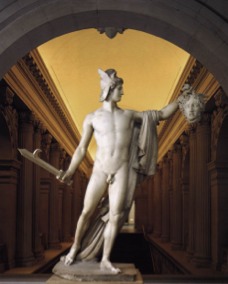
Artist: Antonio Canova
Title: Perseus with the Head of Medusa
Date: 1804-6
Medium: Sculpture
Provenance: Venice
Source: Metropolitan Museum of Art
1. Description: Perseus is holding the head of Medusa in his left hand and a sword in his right. He wears a hat that looks like a smurf’s with what appears to be wings emerging from it. Also, on his left arm he has his clothing hanging. Perseus stands tall and proud profile in this sculpture with his left arm extended in front of his nose.
2. Analysis of Elements of Art:
-Line: In this piece, Canova used straight lines to depict Perseus’s abdominal muscles. Lines also create the silhouette of Perseus’s body.
-Shape: This sculpture has circles like in the head of Medusa and triangles created through placement such as the space between his two legs and the space between his feet.
-Form: Organic forms are seen in this sculpture through the realistic height of Perseus, his width and roundness, and the depth of the sculpture.
-Color: The lack of color in this sculpture accentuates the lines and focuses upon the substance of the sculpture
-Space: The sculpture occupies the space of a slightly larger human being. On the pedastole the only unused space is the space between Perseus’s feet.
Analysis Principles of Design:
-Balance: Canova creates balance by placing an object in each of Perseus’s hands making the sculpture slightly symmetrical. Mostly, the balance leans towards Perseus’s left side.
-Emphasis: Emphasis in this sculptures leans toward the head of Medusa in Perseus’s left hand. The sculptor has the head held up high and Perseus’s body weight leans toward its support.
-Movement: Movement shows Perseus raising up the head of Medusa in sign of victory.
-Unity: Unity is shown through the entirety of the sculpture made from the same material and the entire direction of the body of the sculpture standing to the left.
3. Interpretation: Personally, I see this piece as a proud hero who has just conquered his enemy. With the lines Canova uses, Perseus seems to be presenting the world with the head of Medusa to inform them that they are now safe.
1. In this piece, Canova used straight lines to depict Perseus’s abdominal muscles. Lines also create the silhouette of Perseus’s body.
a. curved lines
b. vertical lines
2. These lines cause me to follow them around the silhouette of the human in the sculpture. They seem to lead my eyes to take in the entirety of the sculpture, but mostly cause me to focus upon the head of Medusa.
4. Judgement: In this sculpture I like the rouching of the cloth Perseus carries. The artist draws my attention positively toward the head of Medusa.I do not quite feel involved in the piece because I personally do not relate to any Greek mythology other than pure enjoyment of the stories. Visually, I enjoy the piece other than the vulgar element towards the private part of the man’s body. I do believe Canova successfully conveys the importance and victory of Perseus who decapitated Medusa.
Downloading Image /
Downloading Image /
Downloading Image /
Downloading Image /
Downloading Image /
Downloading Image /
Downloading Image /
Downloading Image /



FlowVella, Previously Known As Flowboard
© 2025 FlowVella
 FlowVella