
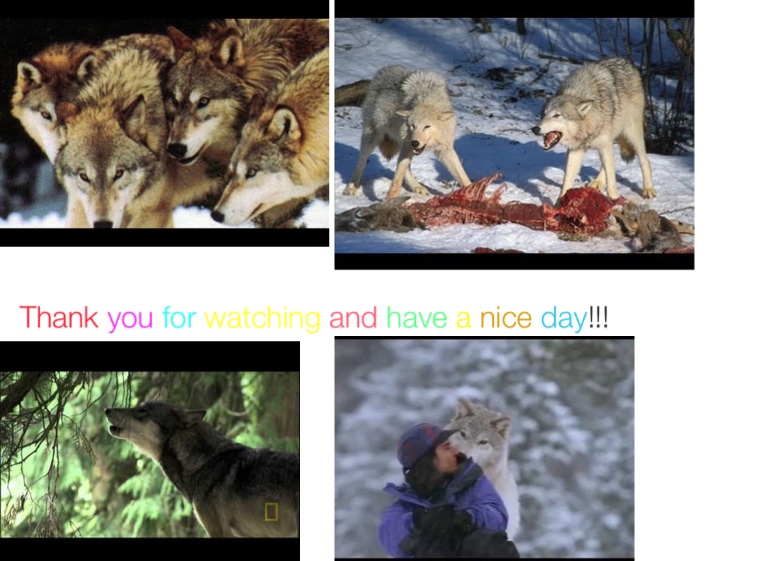






Wolf facts
WARNING: if a wolf comes to you or is at your house, you do not feed it or anything else like that because wolves are wild and majestic animals and if you feed them or anything else they will depend on you to feed them and all of the other stuff, so plz let wolves be wolves.
These are some wolf facts
There is 10 pages of wolf facts -->
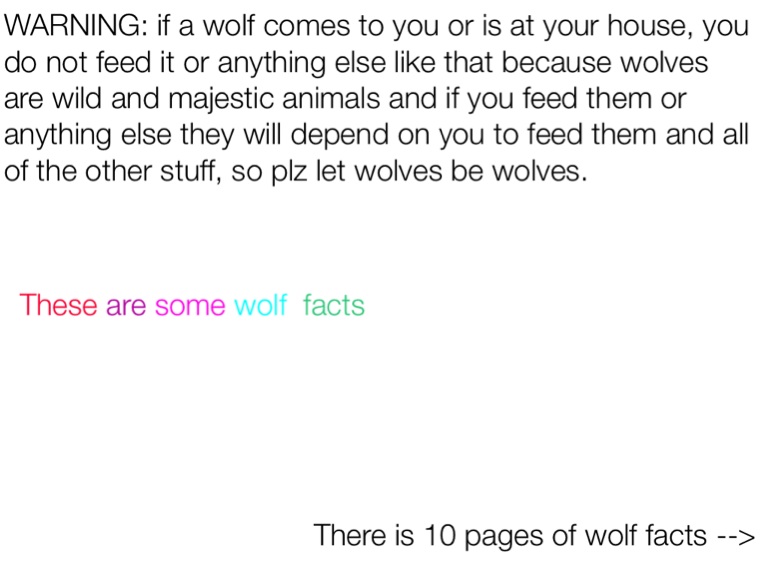
Wolves hunt in packs
The gray wolf also known as the timber wolf, or western wolf, is a canid native to the wilderness and remote areas of North America, Eurasia, and northern, eastern and western Africa.
Fun fact- gray wolves are not always gray in color!
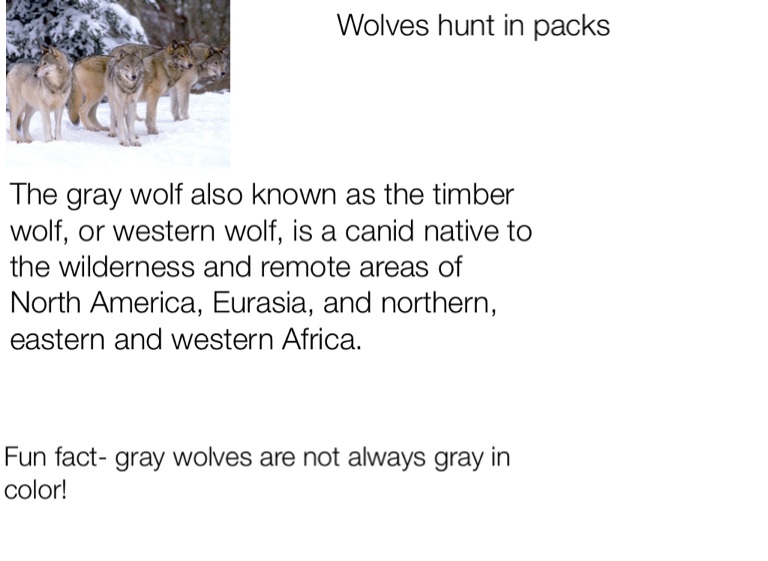
Howl ya doing?
The Ethiopian wolf is a canid native to the Ethiopian Highlands. It is similar to the coyote in size and build, and is distinguished by its long and narrow skull, and its red and white fur.
Fun fact--The species' current range is limited to seven isolated mountain ranges at altitudes of 3,000–4,500m, with the overall adult population estimated at 360-440 individuals in 2011, more than half of them in the Bale Mountains.
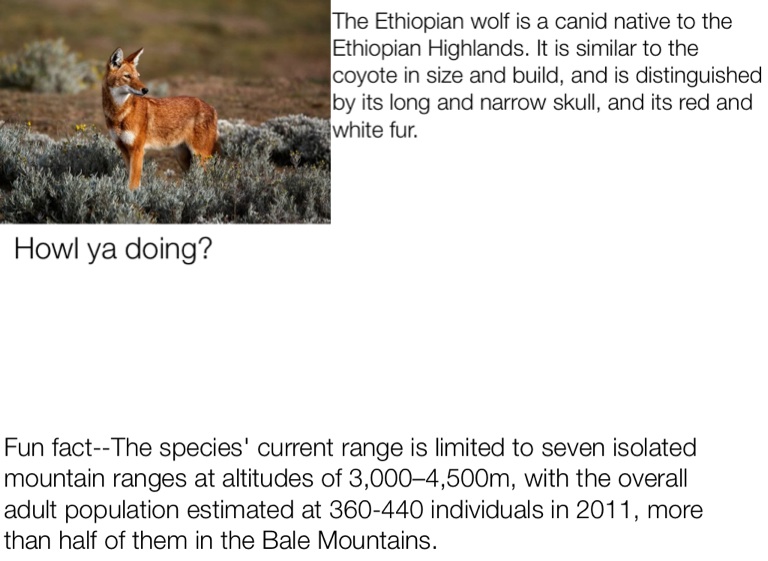
The Alexander Archipelago wolf (Canis lupus ligoni), also known as the Archipelago wolf and the Islands wolf, is a subspecies of the gray wolf, Canis lupus, and is unique to the Alexander Archipelago of southeastern Alaska. The Tongass National Forest comprises about eighty percent of the region.
The Alexander Archipelago wolf, also known as the Canis lupus ligoni, is found in coastal southeast Alaska. A large portion of them reside within Alaska's Tongass National Forest.
Baffin Island wolves are found exclusively on Baffin Island and a few small adjacent islands.
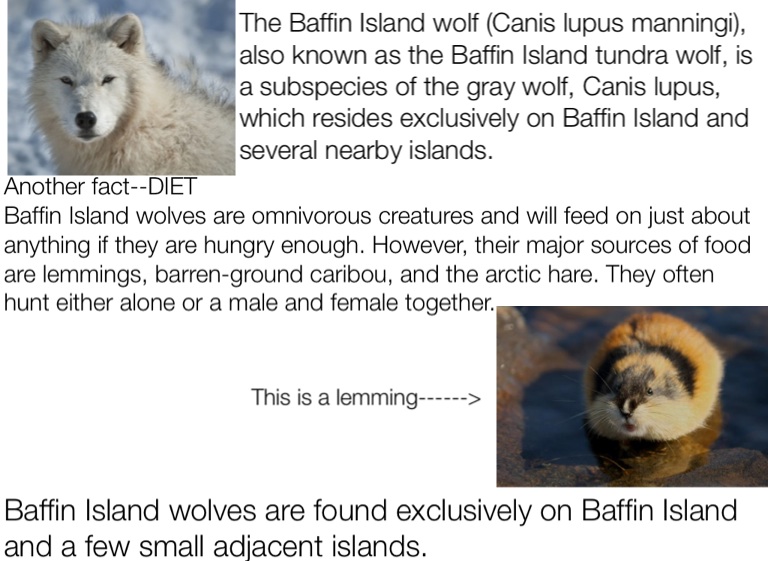
The Baffin Island wolf (Canis lupus manningi), also known as the Baffin Island tundra wolf, is a subspecies of the gray wolf, Canis lupus, which resides exclusively on Baffin Island and several nearby islands.
Another fact--DIET Baffin Island wolves are omnivorous creatures and will feed on just about anything if they are hungry enough. However, their major sources of food are lemmings, barren-ground caribou, and the arctic hare. They often hunt either alone or a male and female together.
This is a lemming------>
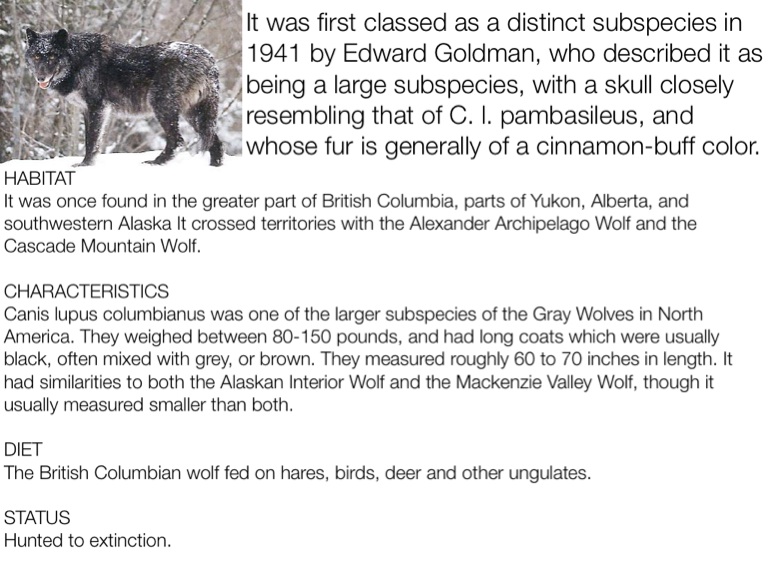
It was first classed as a distinct subspecies in 1941 by Edward Goldman, who described it as being a large subspecies, with a skull closely resembling that of C. l. pambasileus, and whose fur is generally of a cinnamon-buff color.
HABITAT It was once found in the greater part of British Columbia, parts of Yukon, Alberta, and southwestern Alaska It crossed territories with the Alexander Archipelago Wolf and the Cascade Mountain Wolf. CHARACTERISTICS Canis lupus columbianus was one of the larger subspecies of the Gray Wolves in North America. They weighed between 80-150 pounds, and had long coats which were usually black, often mixed with grey, or brown. They measured roughly 60 to 70 inches in length. It had similarities to both the Alaskan Interior Wolf and the Mackenzie Valley Wolf, though it usually measured smaller than both. DIET The British Columbian wolf fed on hares, birds, deer and other ungulates. STATUS Hunted to extinction.
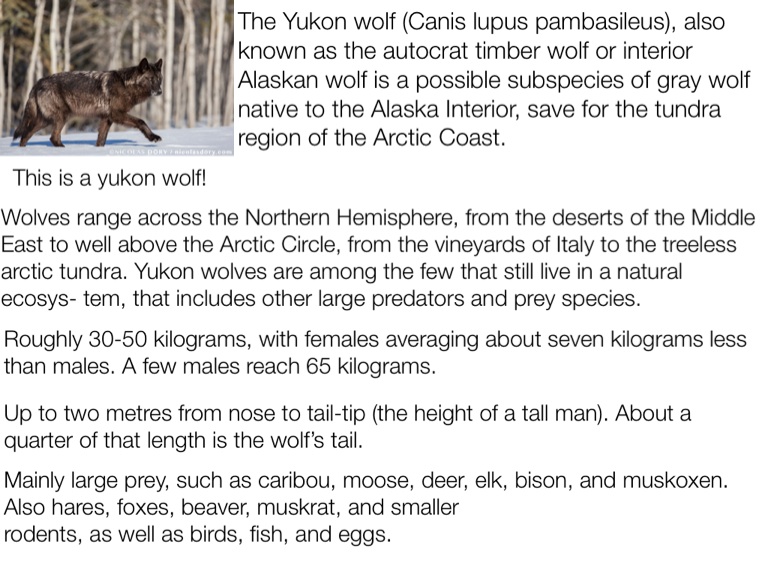
The Yukon wolf (Canis lupus pambasileus), also known as the autocrat timber wolf or interior Alaskan wolf is a possible subspecies of gray wolf native to the Alaska Interior, save for the tundra region of the Arctic Coast.
This is a yukon wolf!
Wolves range across the Northern Hemisphere, from the deserts of the Middle East to well above the Arctic Circle, from the vineyards of Italy to the treeless arctic tundra. Yukon wolves are among the few that still live in a natural ecosys- tem, that includes other large predators and prey species.
Roughly 30-50 kilograms, with females averaging about seven kilograms less than males. A few males reach 65 kilograms.
Up to two metres from nose to tail-tip (the height of a tall man). About a quarter of that length is the wolf’s tail.
Mainly large prey, such as caribou, moose, deer, elk, bison, and muskoxen. Also hares, foxes, beaver, muskrat, and smaller rodents, as well as birds, fish, and eggs.
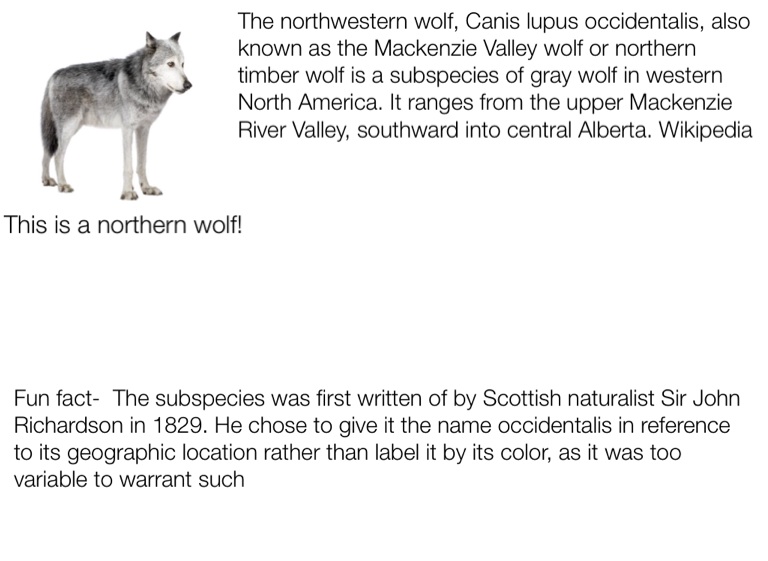
This is a northern wolf!
The northwestern wolf, Canis lupus occidentalis, also known as the Mackenzie Valley wolf or northern timber wolf is a subspecies of gray wolf in western North America. It ranges from the upper Mackenzie River Valley, southward into central Alberta. Wikipedia
Fun fact- The subspecies was first written of by Scottish naturalist Sir John Richardson in 1829. He chose to give it the name occidentalis in reference to its geographic location rather than label it by its color, as it was too variable to warrant such
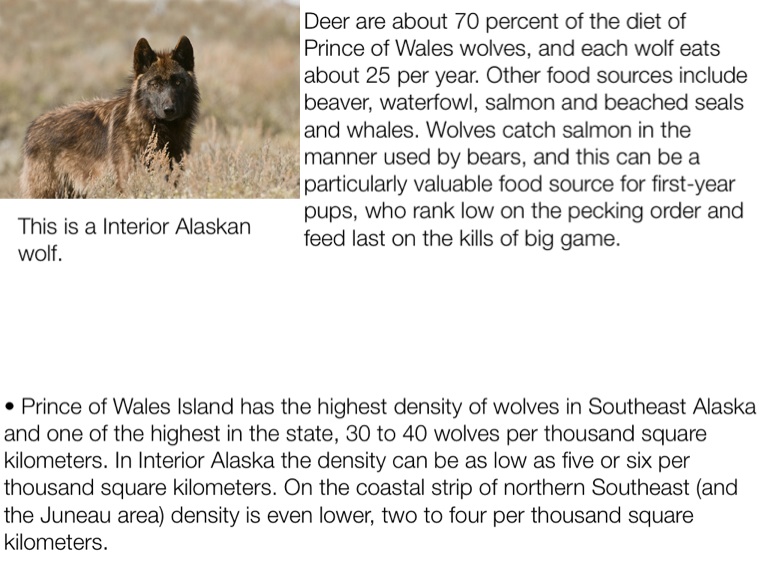
Deer are about 70 percent of the diet of Prince of Wales wolves, and each wolf eats about 25 per year. Other food sources include beaver, waterfowl, salmon and beached seals and whales. Wolves catch salmon in the manner used by bears, and this can be a particularly valuable food source for first-year pups, who rank low on the pecking order and feed last on the kills of big game.
This is a Interior Alaskan wolf.
• Prince of Wales Island has the highest density of wolves in Southeast Alaska and one of the highest in the state, 30 to 40 wolves per thousand square kilometers. In Interior Alaska the density can be as low as five or six per thousand square kilometers. On the coastal strip of northern Southeast (and the Juneau area) density is even lower, two to four per thousand square kilometers.
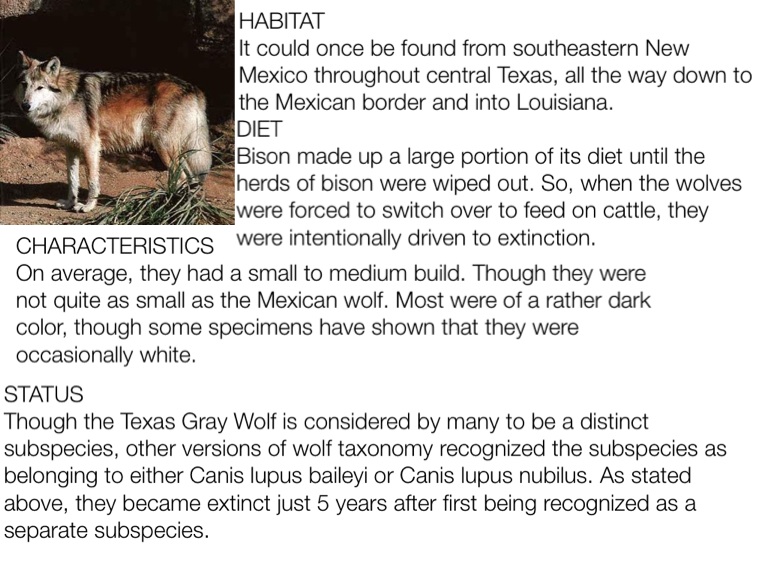
HABITAT It could once be found from southeastern New Mexico throughout central Texas, all the way down to the Mexican border and into Louisiana.
DIET Bison made up a large portion of its diet until the herds of bison were wiped out. So, when the wolves were forced to switch over to feed on cattle, they were intentionally driven to extinction.
CHARACTERISTICS On average, they had a small to medium build. Though they were not quite as small as the Mexican wolf. Most were of a rather dark color, though some specimens have shown that they were occasionally white.
STATUS Though the Texas Gray Wolf is considered by many to be a distinct subspecies, other versions of wolf taxonomy recognized the subspecies as belonging to either Canis lupus baileyi or Canis lupus nubilus. As stated above, they became extinct just 5 years after first being recognized as a separate subspecies.
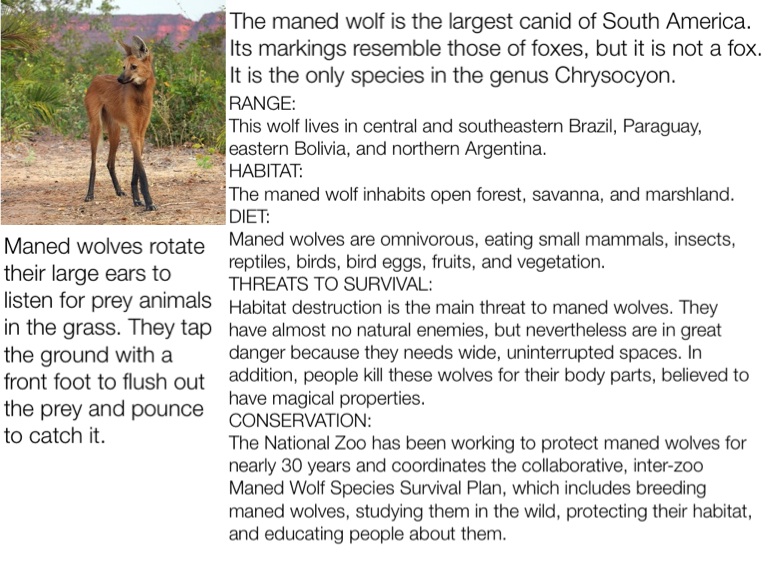
The maned wolf is the largest canid of South America. Its markings resemble those of foxes, but it is not a fox. It is the only species in the genus Chrysocyon.
RANGE: This wolf lives in central and southeastern Brazil, Paraguay, eastern Bolivia, and northern Argentina. HABITAT: The maned wolf inhabits open forest, savanna, and marshland. DIET: Maned wolves are omnivorous, eating small mammals, insects, reptiles, birds, bird eggs, fruits, and vegetation. THREATS TO SURVIVAL: Habitat destruction is the main threat to maned wolves. They have almost no natural enemies, but nevertheless are in great danger because they needs wide, uninterrupted spaces. In addition, people kill these wolves for their body parts, believed to have magical properties. CONSERVATION: The National Zoo has been working to protect maned wolves for nearly 30 years and coordinates the collaborative, inter-zoo Maned Wolf Species Survival Plan, which includes breeding maned wolves, studying them in the wild, protecting their habitat, and educating people about them.
Maned wolves rotate their large ears to listen for prey animals in the grass. They tap the ground with a front foot to flush out the prey and pounce to catch it.