Sign up for FlowVella
Sign up with FacebookAlready have an account? Sign in now
By registering you are agreeing to our
Terms of Service
Loading Flow

Downloading Image /
Downloading Image /
Downloading Image /

Egypt
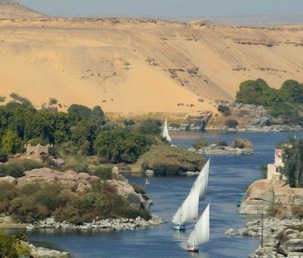
It was well known that the Nile was a most fertile land, agriculture needing only the annual flood to replenish it (but not of course to accomplish it). Accordingly, the fields were not irrigated, but were inundated, this requiring a rise of river level optimally of 16 cubits to cover all the (previously leveled) farmland. In addition to the leveling, the construction of dykes and ditches/canals managed the inundation and ponded water back for thorough soaking of the soil.
The Egyptians thus figured out how to harness the flood waters of the Nile. Since the Egyptians were so homogeneous, they could all follow the same ruler more easily than the Sumerians, whose city-states often fought among themselves for resources of land and water. The Egyptian villages did not fight as much among each other as the Sumerians. The Egyptians needed to cooperate with each other to make use of the complex irrigation system. For the Egyptians, there was plenty of water as long as they worked the irrigation system to make use of the regular flood waters that arrived each year. For the Sumerians, the floods were unpredictable; so many times there was not enough water to go around; hence they fought over water at times.
Unlike the Tigris and Euphrates rivers, the Niles River was gentle and predictable; it flooded the same time every year. Also, the Niles predictably brought about 200 million tons of silt that made Egyptian lands among the most fertile in the world, more so than Mesopotamia’s lands. The Nile was particularly slow moving around where Egyptian villages were forming. This experience of a gentle river developed a perception among the Egyptians that their gods were gentle and benevolent, which stood in sharp contrast to the tempestuous deities of the Mesopotamians. Overall, the conditions for agriculture were superior to Mesopotamia’s. The Egyptians had a more optimistic outlook on life as a result of the predictable cycle of the floods.
Downloading Image /
Downloading Image /



FlowVella, Previously Known As Flowboard
© 2026 FlowVella
 FlowVella