Sign up for FlowVella
Sign up with FacebookAlready have an account? Sign in now
By registering you are agreeing to our
Terms of Service
Loading Flow

Downloading Image /
Downloading Image /
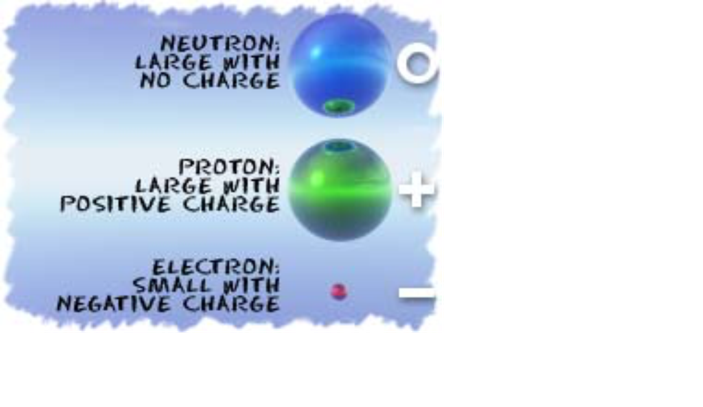
CHARGES OF ATOMS
You can see that each part of an atom is labeled with a "+", "-", or a "0." Those symbols refer to the charge of the particle. The electron always has a "-", or negative, charge. The proton always has a "+", or positive, charge. If the charge of an entire atom is "0", or neutral, there are equal numbers of positive and negative charges. Neutral atoms have equal numbers of electrons and protons. The third particle is the neutron. It has a neutral charge, also known as a charge of zero. Since the number of protons in an atom does not change, fewer or extra electrons can create a special atom called an ion which is an atom or molecule with a net electric charge due to the loss or gain of one or more electrons.
Downloading Image /
Downloading Image /
Downloading Image /



FlowVella, Previously Known As Flowboard
© 2026 FlowVella
 FlowVella