






BRACED Annual Learning Event 2016
Annual Learning Event 2016
BRACED Annual Learning Event 2016 Summary Report
Building Resilience and Adaptation to Climate Extremes and Disasters (BRACED) is a major programme funded by the UK government, which aims to improve the lives of up to five million vulnerable people facing climate extremes and disasters. Over four years, this will be achieved through the efforts of 15 major consortia operating across the Sahel, East Africa and Asia.
Dakar, Senegal
9-11 February 2016
Introducing the BRACED Annual Learning Event
Connecting- Collaborating - Creating Sharing learning and insights from BRACED
In February 2016 the BRACED family came together for three days of shared learning. It wouldn’t be possible to document all of the lessons learned or exchanged during the three day event, but we will share new ways of learning that we used and hope that this can stimulate creative and innovative knowledge exchange. Objectives of the Annual Learning Event * Collective reflection and sharing experiences of early implementation across the BRACED programme to improve future practice. * Sharing knowledge, new evidence and research around what works to strengthen resilience, including emerging findings, innovative methods, reflective learning processes and more to equip us with the latest approaches for addressing difficult challenges. * Engage with external partners to learn about BRACED and promote collaboration and uptake through identification of common strategic objectives to achieve more together.
click to open
What is BRACED?
Here, the BRACED Knowledge Manager discusses what the programme has achieved so far, and plans for 2016.
What do BRACED projects hope to achieve in 2016?
Some of the BRACED Implementing Partners discuss what they hope to achieve on the ground in 2016.
Elements of the Learning Event
One year into the BRACED programme was a great opportunity to pause and reflect. An annual learning event allowed us to create innovative methods to learn and share new knowledge that had already been built in the first year. We invited external parters to join us at the event and learn more about BRACED. This provided opportunities to link up on similar areas of work and better plan for the future.
Sharing ways of learning to inspire and improve resilience programming within and beyond BRACED
Making linkages between BRACED's work and the wider resilience community
Reflecting on our own ways on working to better inform the future of BRACED
Ways of Learning
The Annual Learning Event included a range of learning approaches such as group work, debates, brain-teasers, high level panels, theatre, serious games, learning market places, learning clinics and more. Here are some of the highlights:
Applied Improvisation Network
Reality of Resilience
Forum Theater
Resilience Classroom
Learning Marketplace
The Gender Walk
Open facilitation guides by clicking on icons
The Applied Improvisation Network
Try out some Applied Improvisation Exercises
We partnered with the Applied Improvisation Network to enhance the design and facilitation of the event. They also ran innovative and energising exercises that boosted energy, allowed for participants to meet new people and think about and experience different ways to learn. The sessions were run by Barbara Tint, Renatus Hoogenraad and Lesley Adams.
Mirror leading
The Clap
click to open
Sparkling Conversation
Read the blog
Forum Theater
Exploring conflict and space for action
Forum Theater - Dialogue for transformation Forum Theatre is a participatory drama technique used to facilitate community dialogue on social issues, involving the communities in the search of transformative actions. Forum theatre is part of the system drama techniques called Theatre of the Oppressed, developed by the Brazilian director Augusto Boal from the 70ies to his death in 2009. We incorporated Forum Theatre into the annual learning event, to enable dialogue around important community issues that BRACED projects often face. Please contact us, if you would like to use Forum Theatre approach in your project area: [email protected]
Engaging in an interactive process
Specific to the local context and language
Learning Market Place
Learning in a diverse group
A learning market place is an excellent way to facilitate the exchange of knowledge or tools. Participants were encouraged to explore the market place and discover innovations and ideas that may be relevant to their own work. Its was also a great way to make new connections in everyones field of work and beyond. There was not a set amount of time given per stand. Similar to a real market place, “visitors” were invited to stay for as long as they are interested. The overall process was facilitated to ensure all participants had an idea of what was on offer, and that the interactions were dynamic during the session. A learning marketplace can take 60-120 minutes.
Energised sharing and discussions
Learning through open dialogue
Download the Reality of Resilience summary here
Reality of Resilience
About Reality of Resilience Extreme events are crucial moments for reflection and learning that can provide a testing ground for what works to build resilience during an actual climate shock or stress. Reality of Resilience (RoR) uses remotely sensed information from satellites, rain gauges, and flood models to detect where extreme rainfall may lead to flooding, and where lack of rainfall or soil moisture deficits may lead to drought. During the Annual Learning Event, we shared some stories from the field and explored how this approach could be used in other BRACED project areas to support learning and uptake.
Download the English or French report of 'Gender and Resilience here
Gender and Resilience
The contribution that external interventions make to individual, household and community resilience to climate extremes and disasters will largely depend on the suitability of those activities to the local context and the extent to which implementing agencies address existing social dynamics and power relations. Exploring the gender dimension of resilience to disasters and climate change encourages researchers and practitioners working in these fields to focus on people's different relationships to the environment and access to resources. It also encourages them to assess how projects aimed at managing risk and building resilience are affected by social norms, including those pertaining to gender-based inequalities.
Download Gender and Resilience: from theory to practice here
In the gender and resilience session participants experienced the gender walk. If you would like to know more about this exercise click on the icon.
Read the blog
Download the report ‘The 3 As: Tracking Resilience Across BRACED’ here
Resilience Classroom
Concepts of resilience are complex and ever expanding, making it difficult for practitioners and policy makers to properly implement resilience into their planning. The Resilience Classroom was introduced at this year’s Annual Learning Event to demystify resilience through four, one-hour sessions. These sessions tackled the foundations of how to measure and track resilience based on existing theories. The sessions were received very positively by those who attended for a number of reasons. First, they were designed to be highly interactive. Each session had an exercise aimed at helping people apply the knowledge gained. Second, the sessions also helped explore key topics in resilience through the prism of BRACED, making it highly relevant to the cohort. There were of course lessons learned as well. For instance, it was evident that audience members attending the four sessions had very different degrees of expertise in the topic being discussed. This points to the need for reaching out to potential audiences ahead of next year’s ALE and tailoring content more carefully. Also, the topics that the Resilience Classroom focussed on this year were selected by the organisers and it was fe...
Download the “Monitoring & Evaluation Guidance Notes’ here
Monitoring & Evaluation For Resilience
BRACED M&E: what have we learned so far? Implementing Partners shared their experiences of setting up and starting to implement project M&E within the BRACED M&E framework - in particular what the challenges, solutions and lessons have been. There was much interest and enthusiasm to share and, as a result of the session, a few implementing partners volunteered to write about their collective experiences so far. This will be aimed at M&E practitioners both inside and outside BRACED. Resilience measurement - beyond the conceptual to the practical - a call to action. The aim was to inspire and engage implementing partners to share their expertise and experience in resilience measurement while ‘pledging’ to contribute to and support a BRACED resilience measurement ‘call to action.’ The session outlined key challenges in resilience measurement and encouraged implementing partners to think about the practical experience they have gained through BRACED. Implementing partners were invited to ‘pledge’ a contribution to an informal learning process on resilience measurement under BRACED – a call to action. A total of 16 pledges were received! The Knowledge Manager is currently in the process...
BRACED and the wider world
Sendai framework
Millenium Sustainability Goals
Linking with other programmes
COP21 Paris Agreement
Reaching out
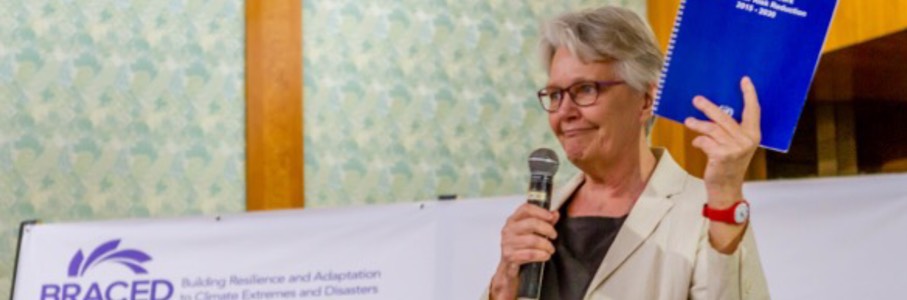
At the Annual Learning Event, participants heard from Margareta Wahlström, former head of the UN Office for Disaster Risk Reduction, about how "this new framework... opens a major new chapter in sustainable development as it outlines clear targets and priorities for action which will lead to a substantial reduction of disaster risk and losses in lives, livelihoods and health". Indeed in the year 2015 ‘resilience’ featured prominently across several global frameworks on disasters, climate change and development. National and subnational governments now have a clear mandate and responsibility to translate our three big global deals – the Sustainable Development Goals, the Paris Agreement, and the Sendai Framework for Disaster Risk Reduction – into national plans and policies that support resilience, especially for the poorest and most vulnerable. Over the coming year, through a series of dialogues on implementation of post-2015 frameworks, the Knowledge Manager will use BRACED findings to make linkages between bottom up and top down policy processes, integrating local information about the root causes of risk and how to build resilience into development and official planning across a...
Sendai framework
Millenium Sustainability Goals
Reflections
“Opportunities for moderated (e.g. learning clinic) and unmoderated discussions with colleagues provided opportunity to gain different perspectives and also understand common challenges.”
If you have any questions or would like to share your lessons learnt, please contact us: [email protected]
Reflections on the Annual Learning Event
"Amazing facilitation and games that quickly broke down barriers and got people talking and interacting, and that made concepts easy to understand. I can remember an event previously where I was nodding off to powerpoint. But not here!”.
Annual Learning Events - a place for sharing and learning The three days of the Annual Learning Event were filled with interactions between BRACED partners. In the final reflection on the event, participants expressed a strong appreciation for sharing experiences and learning through reflecting on challenges, approaches and tools. Many Implementing partners are also keen to create more spaces for active sharing of experiences, creating space for in-depth thematic discussions as they emerge and to create more informal spaces for learning. We would like to thank all participants for openly sharing their learning and to contribute to the open and constructive learning atmosphere! In the coming year, the Knowledge Manager will further engage with BRACED partners to document and summarise lessons learnt that will inform future programming and implementation.
“It was really thought provoking and eye opening.”
“The workshop helped me to develop the confidence over various difficult conceptual issues, for example measuring resilience.”