Sign up for FlowVella
Sign up with FacebookAlready have an account? Sign in now
By registering you are agreeing to our
Terms of Service
Loading Flow

Downloading Image /
Downloading Image /
A. Describe the popular trade items inside the Indian subcontinent.
As early as the fifth century B.C.E., Indian merchants had traveled to the islands of Indonesia and the southeast Asian mainland, where they exchanged pearls, cotton, black pepper, and Indian manufactured goods for spices and exotic local products. Many of those goods did not remain in India but, instead, traveled west through the Arabian Sea to the lands bordering the Persian Gulf and the Red Sea. Indian products also found markets in the Mediterranean basin. Indian pepper became so popular there that the Romans established direct commercial relations and built several trading settlements in southern India.
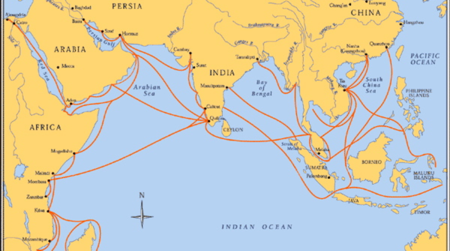
B. What bodies of water were used to exchange trade items? What were some key trade routes?
Within the subcontinent itself trade was most active along the Ganges River, although trade routes also passed through the Ganges delta east to Burma and down the east Indian coast to the Deccan and southern India. Roads built by Ashoka also facilitated overland commerce within the subcontinent. Meanwhile, the volume of long-distance trade also grew as large imperial states in China, southwest Asia, and the Mediterranean basin provided a political foundation enabling merchants to deal with their counterparts in distant lands. Direct political and military links with foreign peoples drew Indians into long-distance commercial relations. Beginning with Cyrus, the Achaemenid rulers of Persia coveted the wealth of India and included the northern kingdom of Gandhara as a province of their empire. The presence of Persian administrators in India and the building of roads between Persia and India facilitated commerce between the two lands. Alexander of Macedon’s conquests helped to establish even more extensive trade networks by forging links between India and the Mediterranean basin by way of Bactria, Persia, and Anatolia. From India, long-distance trade passed overland in two directions: through the Hindu Kush mountains and the Gandharan capital of Taxila to Persia and the Mediterranean basin, and across the silk roads of central Asia to markets in China. Cotton, aromatics, black pepper, pearls, and gems were the principal Indian exports, in exchange for which Indian merchants imported horses and bullion from western lands and silk.
C. What special commodities were produced for the commercial market? (Indian Artisans)
Internal trade was self-sufficient in staple foods, such as rice, wheat, barley, and millet. However, specialized crops grew only in special regions. Some of these including salt, pepper, iron, copper, spices, etc. Some of these products were traded nearby as some long distanced. This increased their economic growth.
Topic 2:
Trade
Monica Su
WHAP - 1 Caussey
Downloading Image /
Downloading Image /



FlowVella, Previously Known As Flowboard
© 2026 FlowVella
 FlowVella