Sign up for FlowVella
Sign up with FacebookAlready have an account? Sign in now
By registering you are agreeing to our
Terms of Service
Loading Flow

Downloading Image /
Downloading Image /
Anatomy
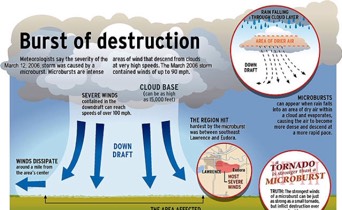
There are a handful of factors that cause microbursts to develop, including mid-level dry air entrainment, cooling beneath the thunderstorm cloud base, sublimation (occurs when the cloud base is above the freezing level), and the existence of rain and/or hail within the thunderstorm (i.e. precipitation loading). Some microbursts are driven by a combination of these factors while others may only be driven by one factor. Due to this, microbursts can be subdivided into three primary types -- wet, dry, and hybrid. Cooling beneath the thunderstorm cloud base and sublimation are the primary forcing mechanisms with dry microbursts. Dry microbursts typically occur with very little precipitation at the surface or aloft, hence the dry type. Wet microbursts, on the other hand, are primarily driven by entrainment of mid-level dry air and precipitation loading. Hybrid microbursts possess characteristics of both wet and dry microbursts. They are forced in the mid-levels by dry air entrainment and/or precipitation loading and in the low-levels by cooling beneath the cloud base and/or sublimation.
Downloading Image /
Downloading Image /
Downloading Image /
Downloading Image /
Downloading Image /



FlowVella, Previously Known As Flowboard
© 2025 FlowVella
 FlowVella