







Culture 2 National Cultures
Culture 2 National Cultures
This document gives you an overview of the theories that enable you to compare cultures and give you handles to deal with the differences in question.
Pieter van Nispen Senior Lecturer and Researcher, retired
January 2018
Table of Contents
page
page
page
page
page
Introduction
Geert Hofstede
Fons Trompenaars
Hofstede and Trompenaars compared
Richard D. Lewis
page
page
page
page
page
Solomon and Schell
Erin Meyer
Clusters
Exercise
Further reading
Contents
Introduction
This document is part of a series of documents on culture, which in turn is part of a wider project. The overall objective is to enhance the understanding of culture and to learn how to deal with it. The core of this project is the website www.culturalcompetence.eu. The website consists of a mind-map with some 100 labels on culture. Each label contains three icons, one with quotes on the topic in question, one with a summary of the literature and one with a self-study exercise. The study of national cultures originates from needs of international business in the sixties of the last century. Business learned rather quickly that it had to deal with staff in a daughter company abroad in a different way to succeed; but how? Business had a need for a model or theory through which it could compare national cultures in such a way that the results of that comparison would give instructions on how to deal with the differences found.
Just like the triangle model in Culture 1 the video on the left reminds you that national culture is just one way of looking at culture. Just because the description of national cultures is based on national surveys with all their limitations, they are in a way rather superficial. Persons and national cultures are two different things; an individual person might quite deviate from what the national picture indicates (fallacy of averages). The research may help you in dealing with first impressions and even as a warning signal but ultimately you have to look at individual persons! At the same time, as illustrated by the quote, national cultures are quite important. We need indeed a proper understanding of them for whatever co-operation.
National cultures are particularly important in international business because of the concept of national sovereignty and the need to conduct business affairs within national, legal, and political frameworks. Thomas and Inkson
Overview
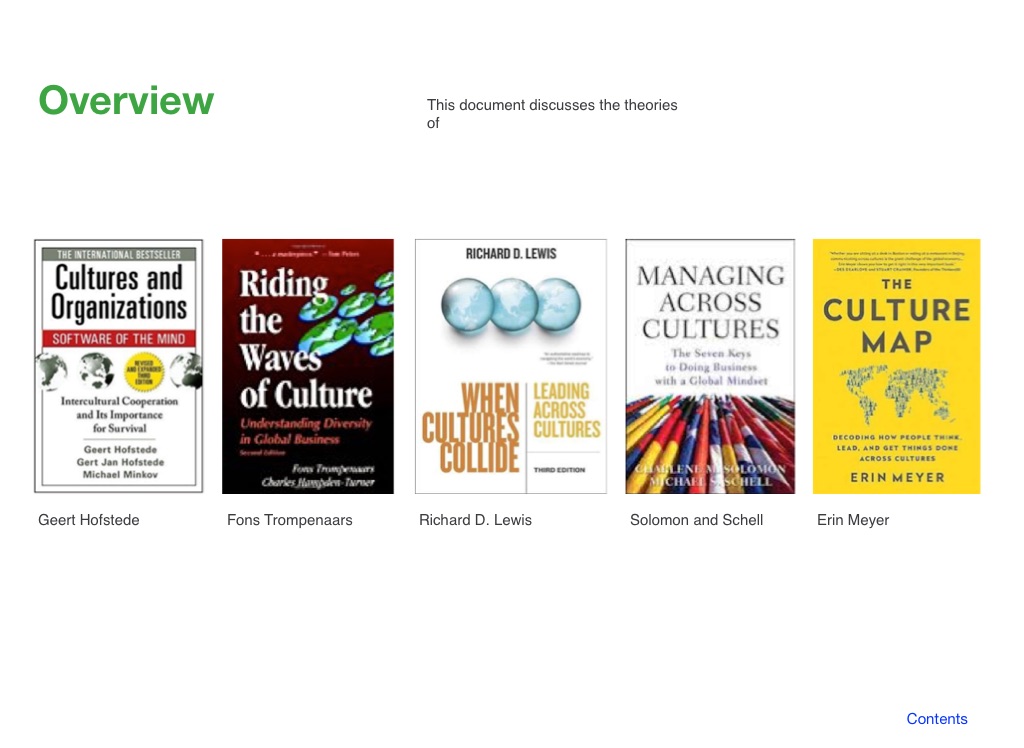
This document discusses the theories of
Geert Hofstede
Fons Trompenaars
Richard D. Lewis
Solomon and Schell
Erin Meyer
Contents
Geert Hofstede
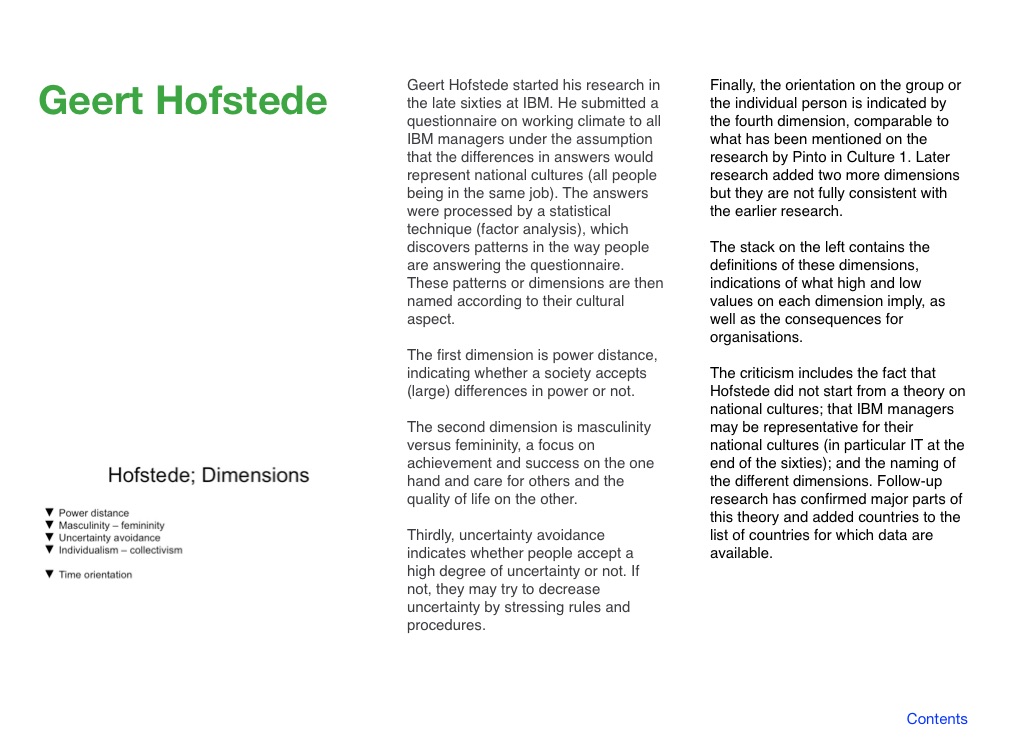
Geert Hofstede started his research in the late sixties at IBM. He submitted a questionnaire on working climate to all IBM managers under the assumption that the differences in answers would represent national cultures (all people being in the same job). The answers were processed by a statistical technique (factor analysis), which discovers patterns in the way people are answering the questionnaire. These patterns or dimensions are then named according to their cultural aspect. The first dimension is power distance, indicating whether a society accepts (large) differences in power or not. The second dimension is masculinity versus femininity, a focus on achievement and success on the one hand and care for others and the quality of life on the other. Thirdly, uncertainty avoidance indicates whether people accept a high degree of uncertainty or not. If not, they may try to decrease uncertainty by stressing rules and procedures.
Finally, the orientation on the group or the individual person is indicated by the fourth dimension, comparable to what has been mentioned on the research by Pinto in Culture 1. Later research added two more dimensions but they are not fully consistent with the earlier research. The stack on the left contains the definitions of these dimensions, indications of what high and low values on each dimension imply, as well as the consequences for organisations. The criticism includes the fact that Hofstede did not start from a theory on national cultures; that IBM managers may be representative for their national cultures (in particular IT at the end of the sixties); and the naming of the different dimensions. Follow-up research has confirmed major parts of this theory and added countries to the list of countries for which data are available.
Contents
Geert Hofstede
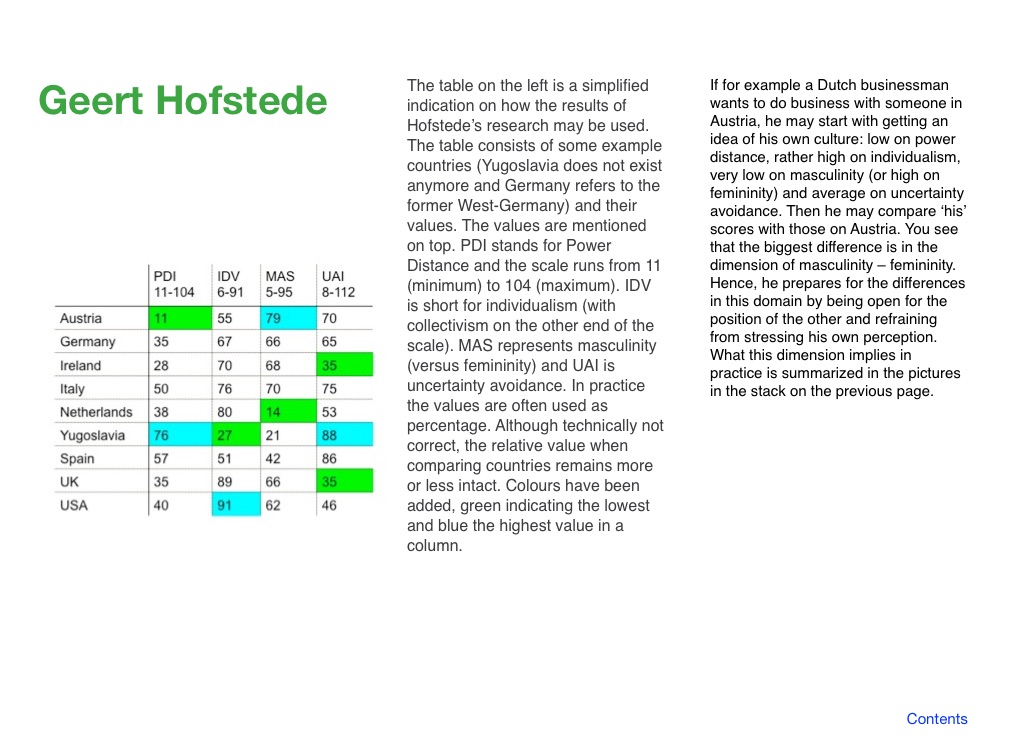
The table on the left is a simplified indication on how the results of Hofstede’s research may be used. The table consists of some example countries (Yugoslavia does not exist anymore and Germany refers to the former West-Germany) and their values. The values are mentioned on top. PDI stands for Power Distance and the scale runs from 11 (minimum) to 104 (maximum). IDV is short for individualism (with collectivism on the other end of the scale). MAS represents masculinity (versus femininity) and UAI is uncertainty avoidance. In practice the values are often used as percentage. Although technically not correct, the relative value when comparing countries remains more or less intact. Colours have been added, green indicating the lowest and blue the highest value in a column.
If for example a Dutch businessman wants to do business with someone in Austria, he may start with getting an idea of his own culture: low on power distance, rather high on individualism, very low on masculinity (or high on femininity) and average on uncertainty avoidance. Then he may compare ‘his’ scores with those on Austria. You see that the biggest difference is in the dimension of masculinity – femininity. Hence, he prepares for the differences in this domain by being open for the position of the other and refraining from stressing his own perception. What this dimension implies in practice is summarized in the pictures in the stack on the previous page.
Contents
Frons Trompenaars
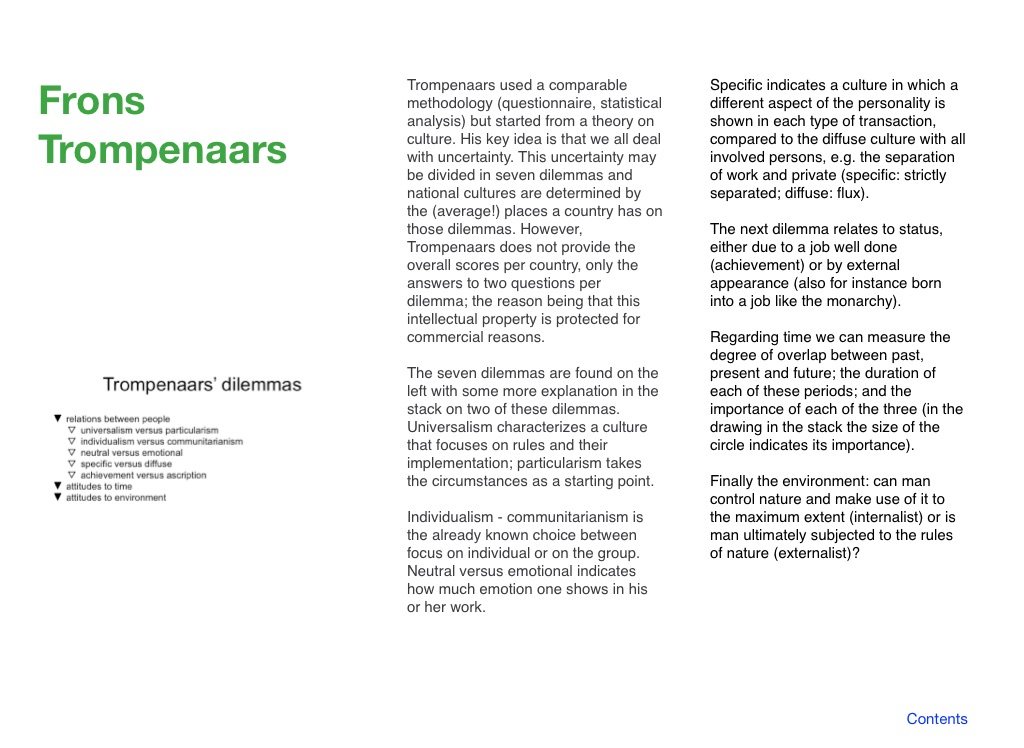
Trompenaars used a comparable methodology (questionnaire, statistical analysis) but started from a theory on culture. His key idea is that we all deal with uncertainty. This uncertainty may be divided in seven dilemmas and national cultures are determined by the (average!) places a country has on those dilemmas. However, Trompenaars does not provide the overall scores per country, only the answers to two questions per dilemma; the reason being that this intellectual property is protected for commercial reasons. The seven dilemmas are found on the left with some more explanation in the stack on two of these dilemmas. Universalism characterizes a culture that focuses on rules and their implementation; particularism takes the circumstances as a starting point. Individualism - communitarianism is the already known choice between focus on individual or on the group. Neutral versus emotional indicates how much emotion one shows in his or her work.
Specific indicates a culture in which a different aspect of the personality is shown in each type of transaction, compared to the diffuse culture with all involved persons, e.g. the separation of work and private (specific: strictly separated; diffuse: flux). The next dilemma relates to status, either due to a job well done (achievement) or by external appearance (also for instance born into a job like the monarchy). Regarding time we can measure the degree of overlap between past, present and future; the duration of each of these periods; and the importance of each of the three (in the drawing in the stack the size of the circle indicates its importance). Finally the environment: can man control nature and make use of it to the maximum extent (internalist) or is man ultimately subjected to the rules of nature (externalist)?
Contents
Frons Trompenaars
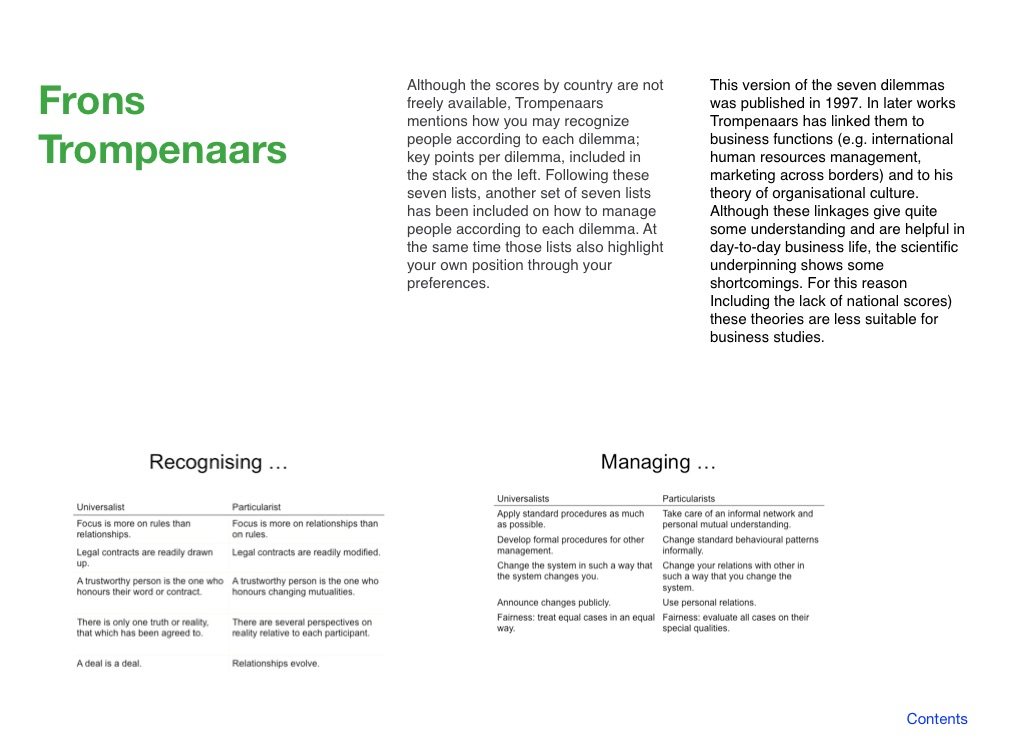
Although the scores by country are not freely available, Trompenaars mentions how you may recognize people according to each dilemma; key points per dilemma, included in the stack on the left. Following these seven lists, another set of seven lists has been included on how to manage people according to each dilemma. At the same time those lists also highlight your own position through your preferences.
This version of the seven dilemmas was published in 1997. In later works Trompenaars has linked them to business functions (e.g. international human resources management, marketing across borders) and to his theory of organisational culture. Although these linkages give quite some understanding and are helpful in day-to-day business life, the scientific underpinning shows some shortcomings. For this reason Including the lack of national scores) these theories are less suitable for business studies.
Contents
Hofstede and Trompenaars compared
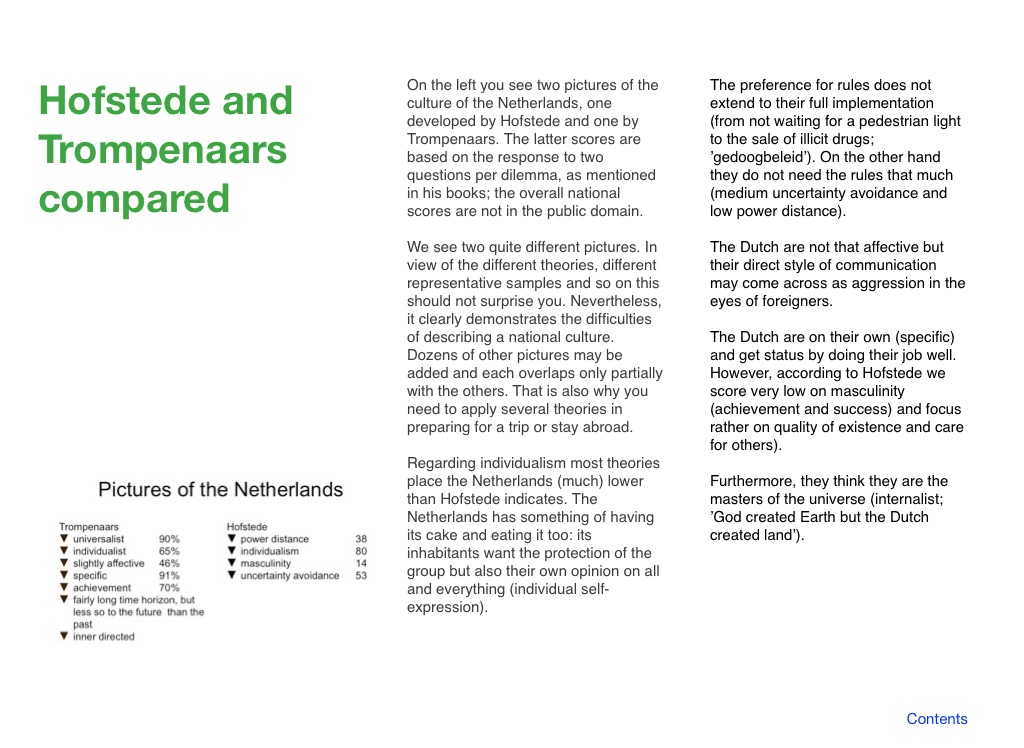
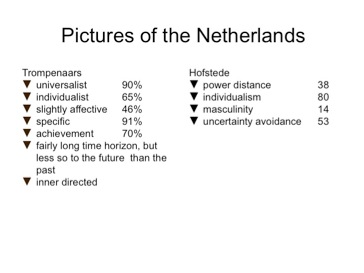
On the left you see two pictures of the culture of the Netherlands, one developed by Hofstede and one by Trompenaars. The latter scores are based on the response to two questions per dilemma, as mentioned in his books; the overall national scores are not in the public domain. We see two quite different pictures. In view of the different theories, different representative samples and so on this should not surprise you. Nevertheless, it clearly demonstrates the difficulties of describing a national culture. Dozens of other pictures may be added and each overlaps only partially with the others. That is also why you need to apply several theories in preparing for a trip or stay abroad. Regarding individualism most theories place the Netherlands (much) lower than Hofstede indicates. The Netherlands has something of having its cake and eating it too: its inhabitants want the protection of the group but also their own opinion on all and everything (individual self-expression).
The preference for rules does not extend to their full implementation (from not waiting for a pedestrian light to the sale of illicit drugs; ’gedoogbeleid’). On the other hand they do not need the rules that much (medium uncertainty avoidance and low power distance). The Dutch are not that affective but their direct style of communication may come across as aggression in the eyes of foreigners. The Dutch are on their own (specific) and get status by doing their job well. However, according to Hofstede we score very low on masculinity (achievement and success) and focus rather on quality of existence and care for others). Furthermore, they think they are the masters of the universe (internalist; ’God created Earth but the Dutch created land’).
Contents
Richard D. Lewis
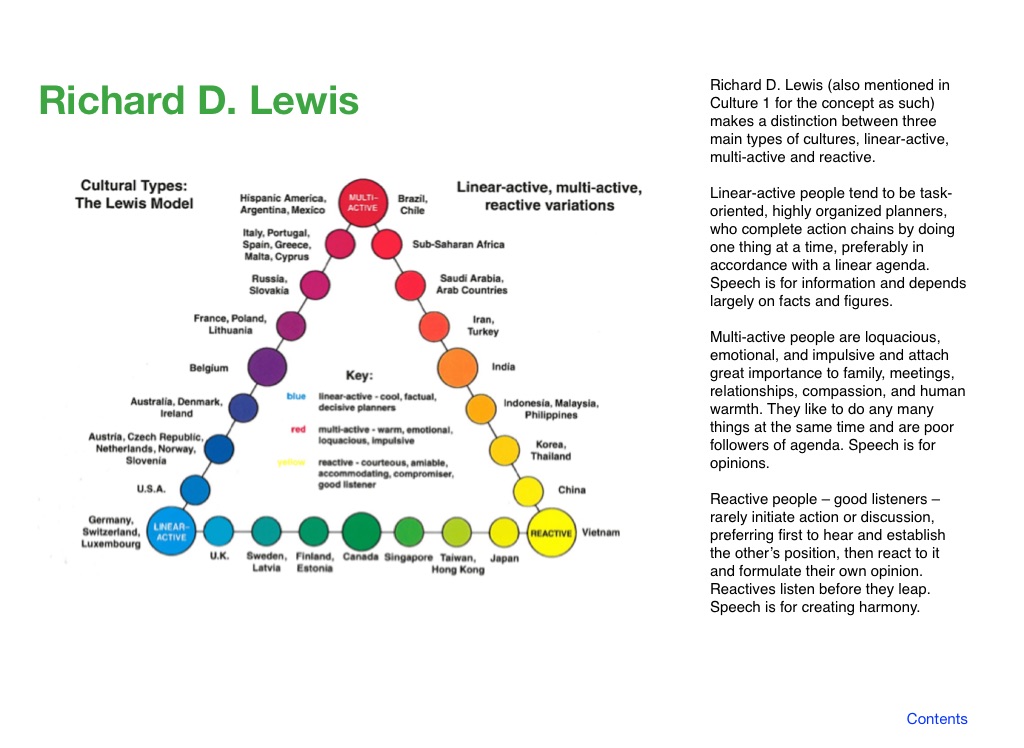
Richard D. Lewis (also mentioned in Culture 1 for the concept as such) makes a distinction between three main types of cultures, linear-active, multi-active and reactive. Linear-active people tend to be task-oriented, highly organized planners, who complete action chains by doing one thing at a time, preferably in accordance with a linear agenda. Speech is for information and depends largely on facts and figures. Multi-active people are loquacious, emotional, and impulsive and attach great importance to family, meetings, relationships, compassion, and human warmth. They like to do any many things at the same time and are poor followers of agenda. Speech is for opinions. Reactive people – good listeners – rarely initiate action or discussion, preferring first to hear and establish the other’s position, then react to it and formulate their own opinion. Reactives listen before they leap. Speech is for creating harmony.
Contents
Solomon and Schell
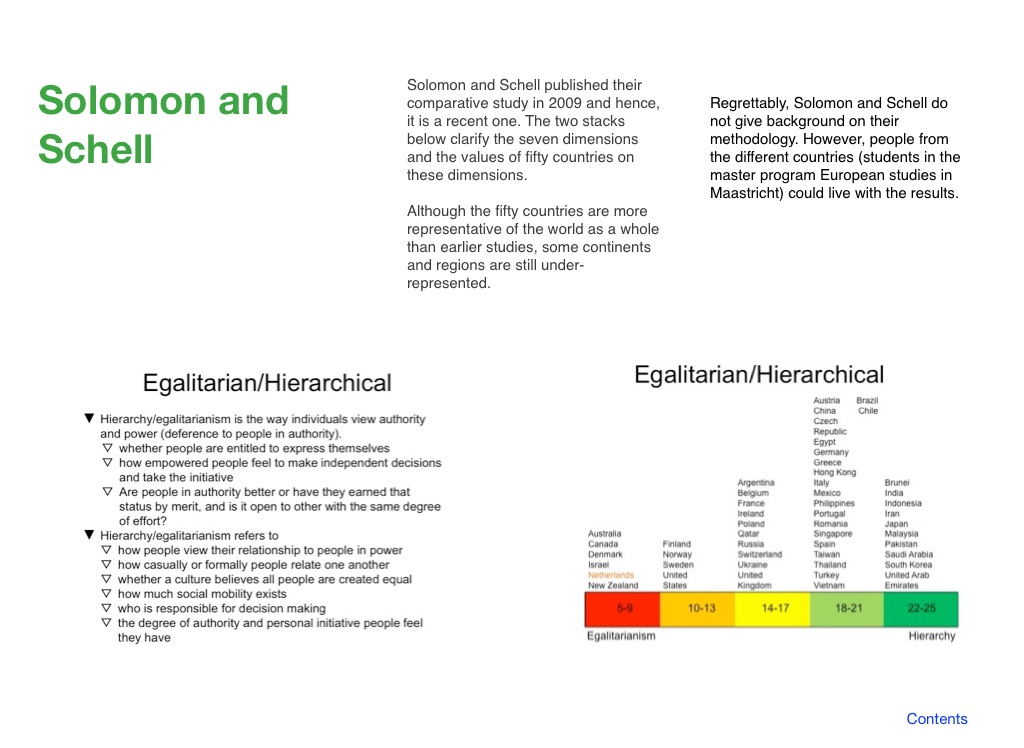
Solomon and Schell published their comparative study in 2009 and hence, it is a recent one. The two stacks below clarify the seven dimensions and the values of fifty countries on these dimensions. Although the fifty countries are more representative of the world as a whole than earlier studies, some continents and regions are still under-represented.
Regrettably, Solomon and Schell do not give background on their methodology. However, people from the different countries (students in the master program European studies in Maastricht) could live with the results.
Contents
Erin Meyer
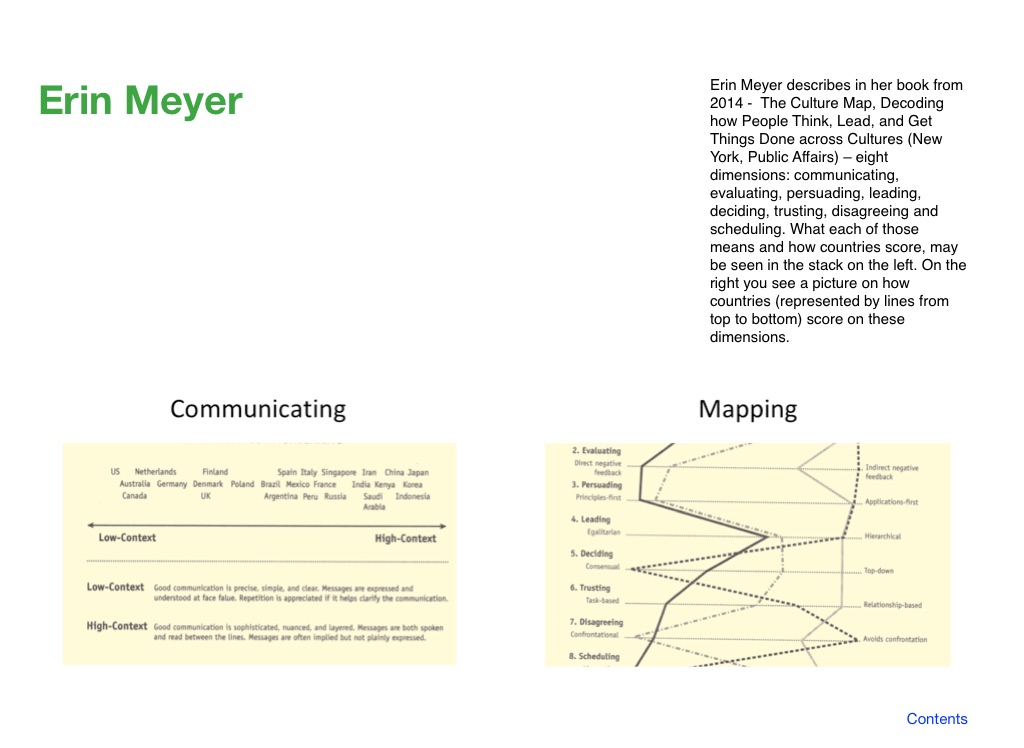
Erin Meyer describes in her book from 2014 - The Culture Map, Decoding how People Think, Lead, and Get Things Done across Cultures (New York, Public Affairs) – eight dimensions: communicating, evaluating, persuading, leading, deciding, trusting, disagreeing and scheduling. What each of those means and how countries score, may be seen in the stack on the left. On the right you see a picture on how countries (represented by lines from top to bottom) score on these dimensions.
Contents
Clusters
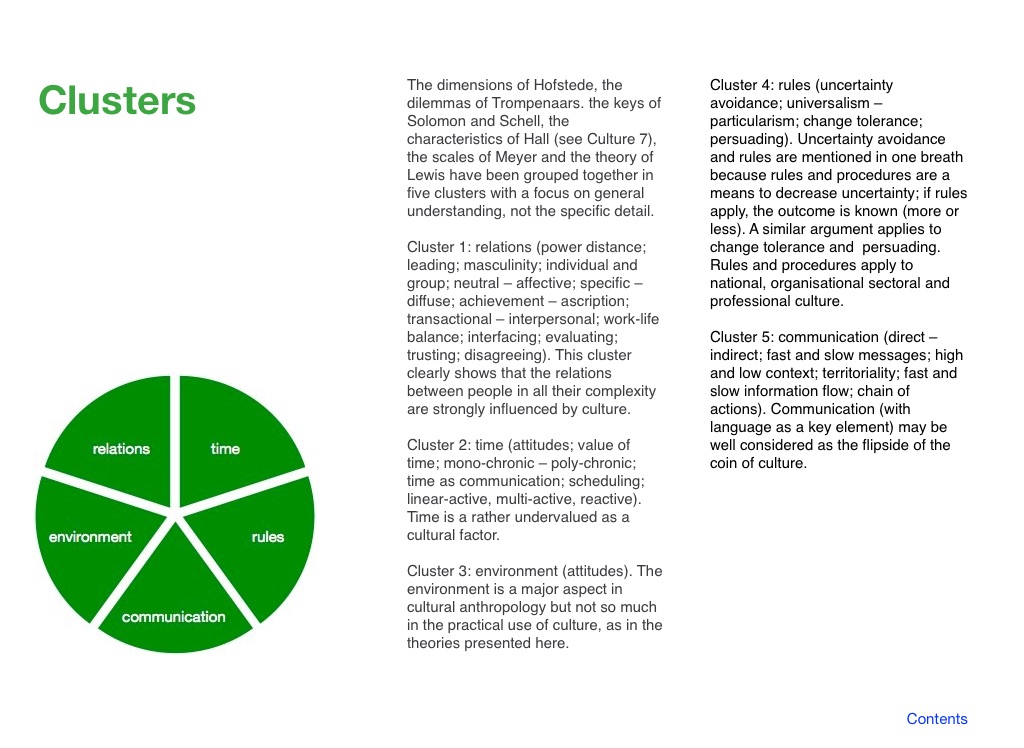
The dimensions of Hofstede, the dilemmas of Trompenaars. the keys of Solomon and Schell, the characteristics of Hall (see Culture 7), the scales of Meyer and the theory of Lewis have been grouped together in five clusters with a focus on general understanding, not the specific detail. Cluster 1: relations (power distance; leading; masculinity; individual and group; neutral – affective; specific – diffuse; achievement – ascription; transactional – interpersonal; work-life balance; interfacing; evaluating; trusting; disagreeing). This cluster clearly shows that the relations between people in all their complexity are strongly influenced by culture. Cluster 2: time (attitudes; value of time; mono-chronic – poly-chronic; time as communication; scheduling; linear-active, multi-active, reactive). Time is a rather undervalued as a cultural factor. Cluster 3: environment (attitudes). The environment is a major aspect in cultural anthropology but not so much in the practical use of culture, as in the theories presented here.
Cluster 4: rules (uncertainty avoidance; universalism – particularism; change tolerance; persuading). Uncertainty avoidance and rules are mentioned in one breath because rules and procedures are a means to decrease uncertainty; if rules apply, the outcome is known (more or less). A similar argument applies to change tolerance and persuading. Rules and procedures apply to national, organisational sectoral and professional culture. Cluster 5: communication (direct – indirect; fast and slow messages; high and low context; territoriality; fast and slow information flow; chain of actions). Communication (with language as a key element) may be well considered as the flipside of the coin of culture.
Contents
Contents
Exercise
National Culture Through internet you may find all kinds of descriptions of national cultures. On my website www.culturalcompetence.eu you find for instance the scores of 50 states according to Solomon and Schell. Find a description of your national culture and relate yourself to it. How closely do you fit the national profile, point by point? And how much do you feel yourself a national of your state? Response The use of a profile, based on averages, is a construct, an approach of reality but does not represent reality itself. Individual persons vary from these answers and you will never meet an individual who fits all the averages. Hence, you need to be careful how to use these answers. In dealing with cultural difference you will always need to look beyond the statistics and try to see the individual.
Contents
Further Reading
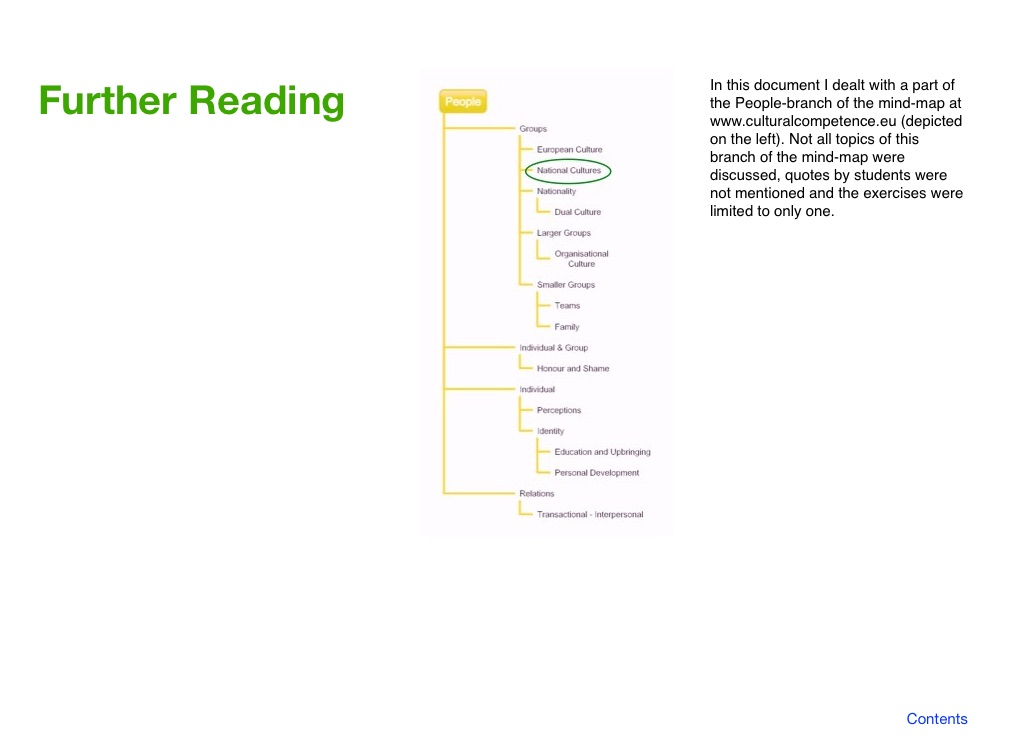
In this document I dealt with a part of the People-branch of the mind-map at www.culturalcompetence.eu (depicted on the left). Not all topics of this branch of the mind-map were discussed, quotes by students were not mentioned and the exercises were limited to only one.