Sign up for FlowVella
Sign up with FacebookAlready have an account? Sign in now
By registering you are agreeing to our
Terms of Service
Loading Flow

Downloading Image /
Downloading Image /
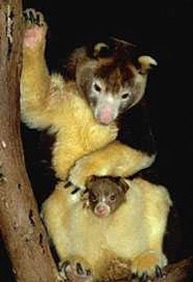
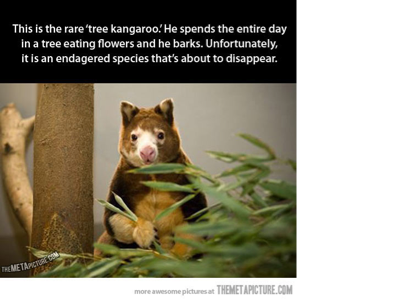
The tree kangaroo
Tree kangaroos have fur which is usually a deep shade of red or brown. They dwell in trees which have similar shades of leaves and branches, which offers a great camouflage for these little animals.
The adult tree kangaroo is usually about 20-30 inches long and has an equally long tail!
The forearms of the tree kangaroos are longer and much more stronger than land dwelling kangaroo species. The tree kangaroo also has shorter feet with broader proportions, as this allows the animal to grip rounder tree surfaces. The feet have rubbery soles, which protect the animal from slipping. All the limbs have sharp and long claws which are slightly curved inwards, these offer the animal with a great grip while scaling trees.
The animals tail supports its body weight and is used for balancing. The tail wraps around the branch while it is stationary and will prevent it from falling.
These kangaroos are clumsy on land and hop while propelling their upper body forward, and have obvious difficulties handling their long heavy tails.
On the contrary, when ascending or descending trees, these animals are powerful and extremely fast. Tree kangaroos live at altitudes as high as 6000 feet and can jump from almost 59 feet above the ground, without a moments hesitation, and without getting injured!
They are also excellent at skipping trees and will jump from one tree to a tree that is 30 feet away within a matter of seconds!
These kangaroos usually feed on leaves, fruits and fresh shoots. However, they also enjoy eating bird eggs, small birds, grain, fruits and sap.
The animal's teeth are better suited for omnivorous diet, making it easy for it to chew on tree bark, and leaves. They do not feed on grass as they cannot digest the thin blades well.
They have huge stomachs which are populated with bacteria and enzymes, which help the animal digest vegetation efficiently.
These are solitary animals and are extremely territorial in nature. The males become aggressive when another male tree kangaroo tries to encroach its domain.
These animals have milk glands and thus fall into the category of Metatheria, also deemed as ever changing animals.
The mating season is undefined and the gestation period lasts for 32 days, after which 1 young one is born to each female.
Read more at Buzzle: http://www.buzzle.com/articles/adaptations-of-tree-kangaroos-explained.html
http://www.buzzle.com/articles/adaptations-of-tree-kangaroos-explained.html
Downloading Image /
Downloading Image /
Downloading Image /
Downloading Image /
Downloading Image /
Downloading Image /
Downloading Image /
Downloading Image /
Downloading Image /
Downloading Image /
Downloading Image /
Downloading Image /
Downloading Image /



FlowVella, Previously Known As Flowboard
© 2025 FlowVella
 FlowVella