Sign up for FlowVella
Sign up with FacebookAlready have an account? Sign in now
By registering you are agreeing to our
Terms of Service
Loading Flow

Downloading Image /
Downloading Image /
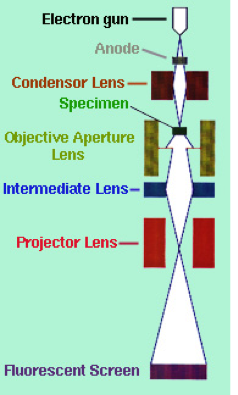
The transmission electron microscope works similarly to the light microscope however the light rays are replaced by a beam of electrons. These can be focused using magnets in the magnetic/ objective aperture lens. The projector lens then focuses the electrons onto the fluorescent screen and electrons which were scattered by the specimen leave an image.
Resolution: The resolution of a TEM is much higher then that of light microscope. (0.2 nm) This is because the wave length of the electron beam is much shorter.
TEM microscopes
Pros:
-higher resolution so you are able to see finer detail more clearly.
-higher magnification
-higher control of image formation as electrons can be focused using electromagnets due to their charge
Cons:
-cannot observe living specimens
-images are not formed in colour but in grey scale although false colour images are produced
- need to stain specimens and they need to be thin therefore specimens have to be altered a lot sometimes
Uses and effectiveness: The TEM microscopes are great for seeing things in finer details and observing small features. However they are expensive and very expensive so more useful in intricate studies
Suitable for:
- detailed lab work for example research on cell organelles.
Downloading Image /
Downloading Image /



FlowVella, Previously Known As Flowboard
© 2026 FlowVella
 FlowVella