







TPISC_on_the_BBS-ISL_Matrix
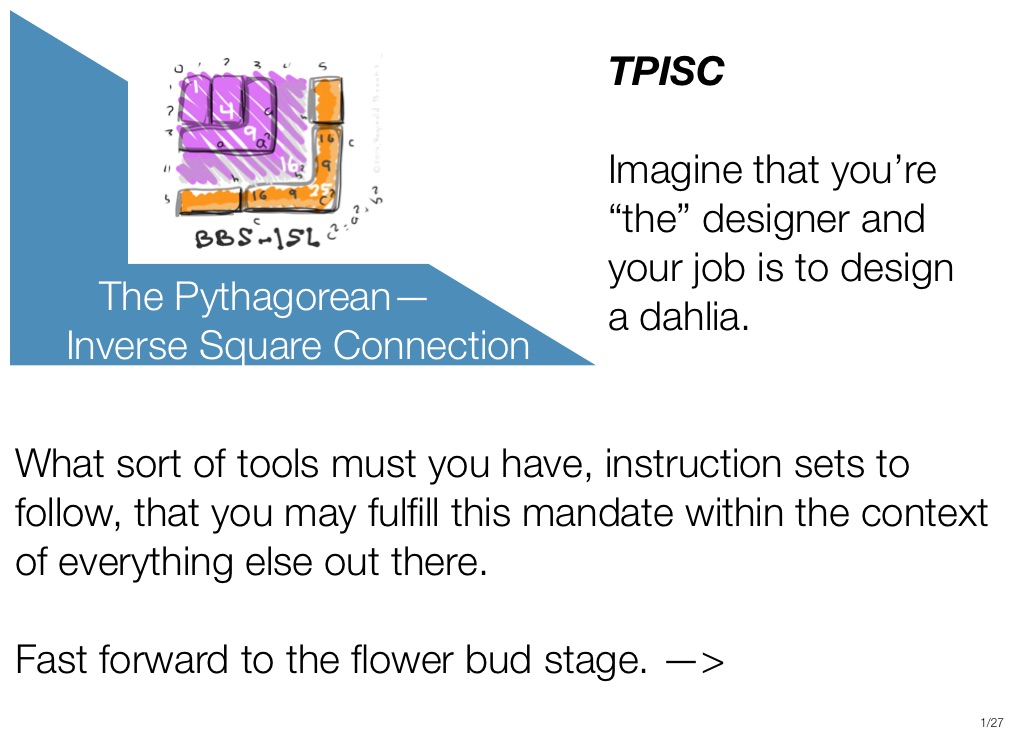
TPISC Imagine that you’re “the” designer and your job is to design a dahlia.
The Pythagorean— Inverse Square Connection
What sort of tools must you have, instruction sets to follow, that you may fulfill this mandate within the context of everything else out there. Fast forward to the flower bud stage. —>
1/27
You have already locked in the nutrient-grabbing root structure and its co-dependent energy-gathering leaf structure. But now you must differentiate leaf buds into flower buds. But where, how many and in what order should they evolve? Let’s look at the design of a single dahlia flower—mum style—with its near-perfect global sphere shape formed from nearly-identical sets of petals curled into slightly flared cylinder—all neatly packed into an array across the “face” of the flower, accentuated with a dazzling center, contrasting target screaming out to the bees, the butterflies, the hummingbirds—pollinate me, pollinate me!
2/27
Every stage of this unfolding design must be unpacked from the initial differentiated bud! Just what kind of instruction set can give rise to a whole Universe upon the end of a long stem? Surely, there are some common themes underlying it all. Well, as surely as chemistry informs the biology, as physics defines the chemistry, as mathematics describes the physics, numbers—simple, quantifying numbers—are chief architects of it all. Numbers become the geometry that informs the mathematics that describes the physics and chemistry of it all—animate and inanimate.
3/27
Being that the ISL is built around “squared” numbers—SQUARES—it naturally follows and builds ST with pure, ideal, highly symmetrical circle-sphere and square-cube isosceles right-triangle geometry. Ubiquitously embedded within the infinity expandable ISL is a 2nd geometry—the Pythagorean Triangles, a.k.a. the Pythagorean Triples—that introduce asymmetry in the form of non-isosceles, right-triangles forming bi-laterally symmetrical, non-square rectangles and ovals into the ST forming mix.
4/27
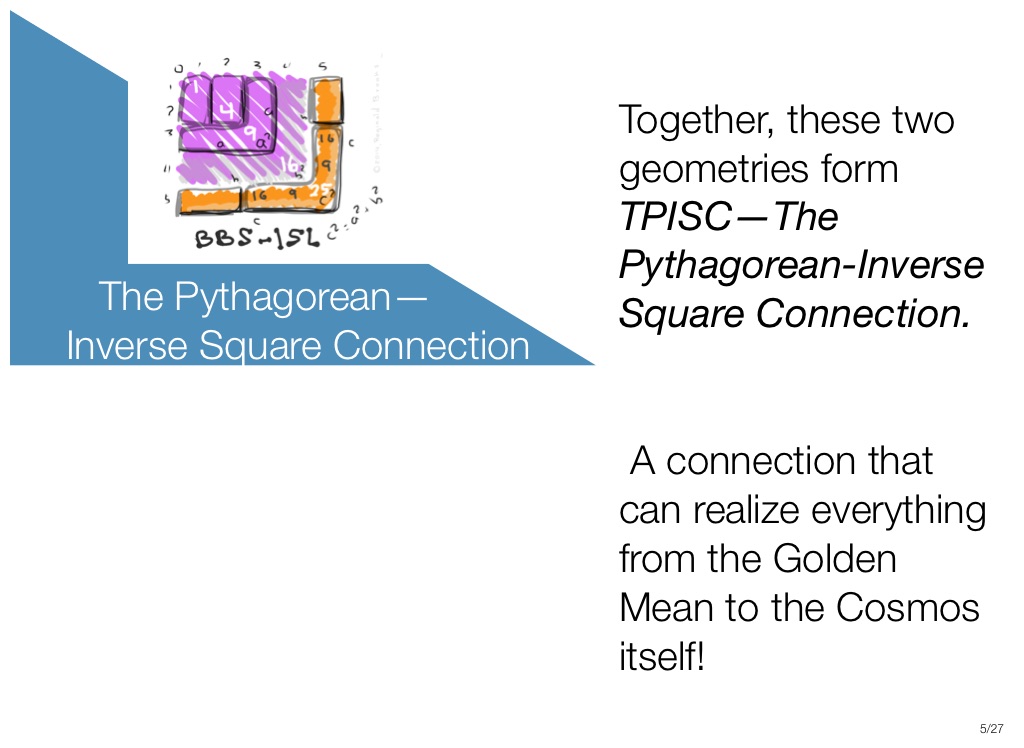
Together, these two geometries form TPISC—The Pythagorean-Inverse Square Connection. A connection that can realize everything from the Golden Mean to the Cosmos itself!
The Pythagorean— Inverse Square Connection
5/27
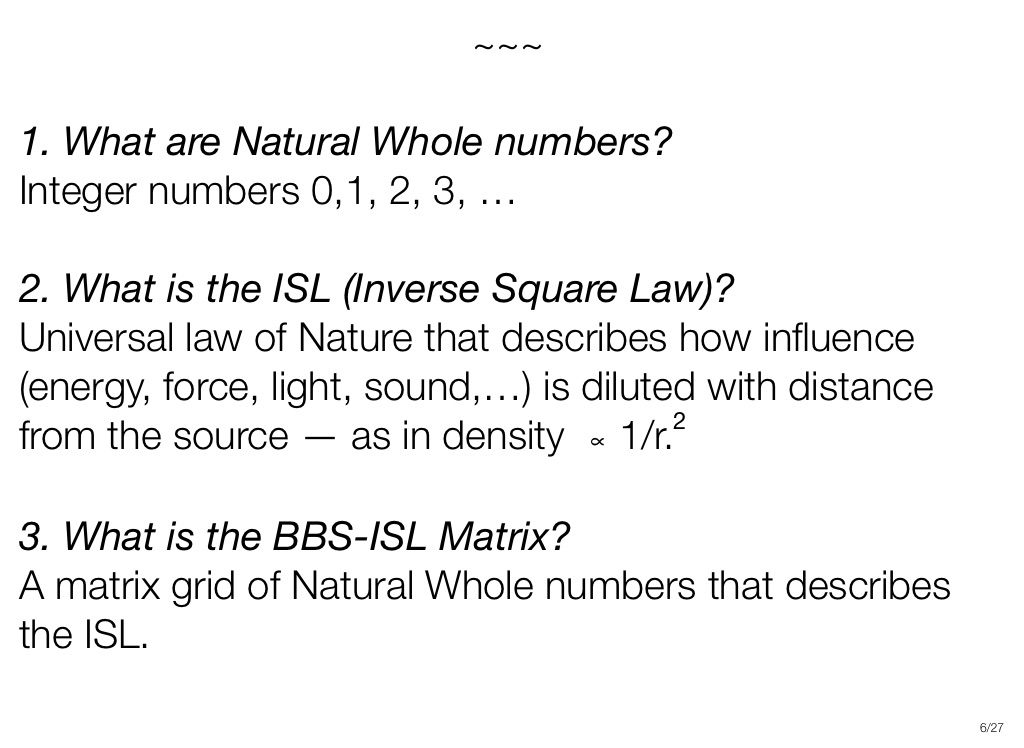
~~~ 1. What are Natural Whole numbers? Integer numbers 0,1, 2, 3, … 2. What is the ISL (Inverse Square Law)? Universal law of Nature that describes how influence (energy, force, light, sound,…) is diluted with distance from the source — as in density ∝ 1/r. 3. What is the BBS-ISL Matrix? A matrix grid of Natural Whole numbers that describes the ISL.
6/27
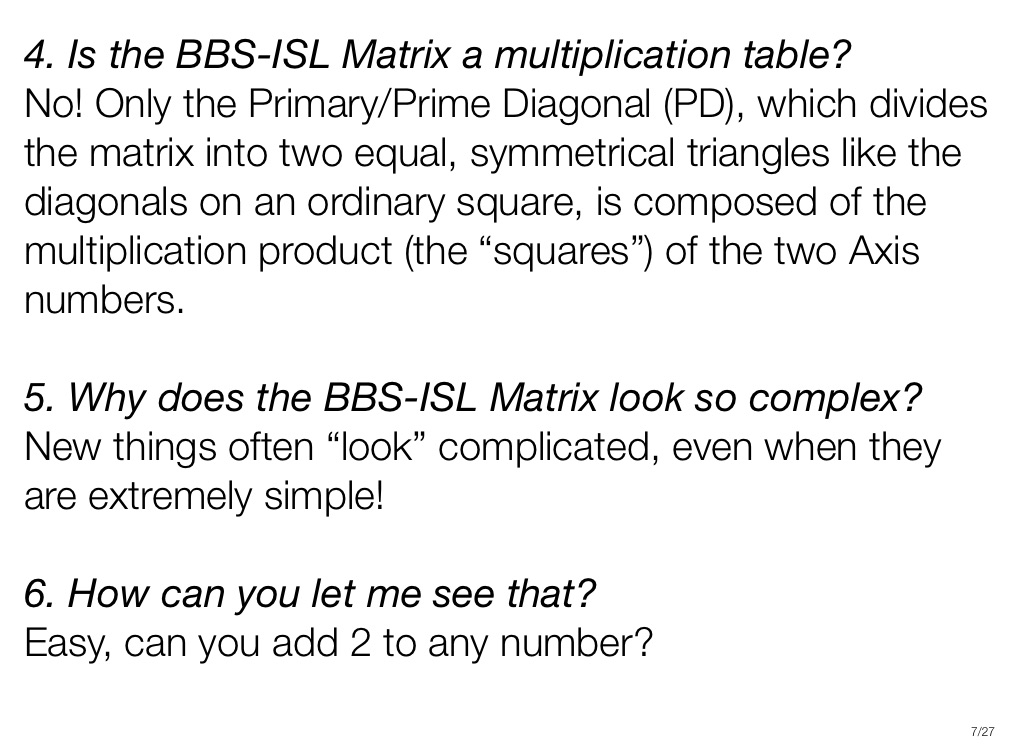
4. Is the BBS-ISL Matrix a multiplication table? No! Only the Primary/Prime Diagonal (PD), which divides the matrix into two equal, symmetrical triangles like the diagonals on an ordinary square, is composed of the multiplication product (the “squares”) of the two Axis numbers. 5. Why does the BBS-ISL Matrix look so complex? New things often “look” complicated, even when they are extremely simple! 6. How can you let me see that? Easy, can you add 2 to any number?
7/27
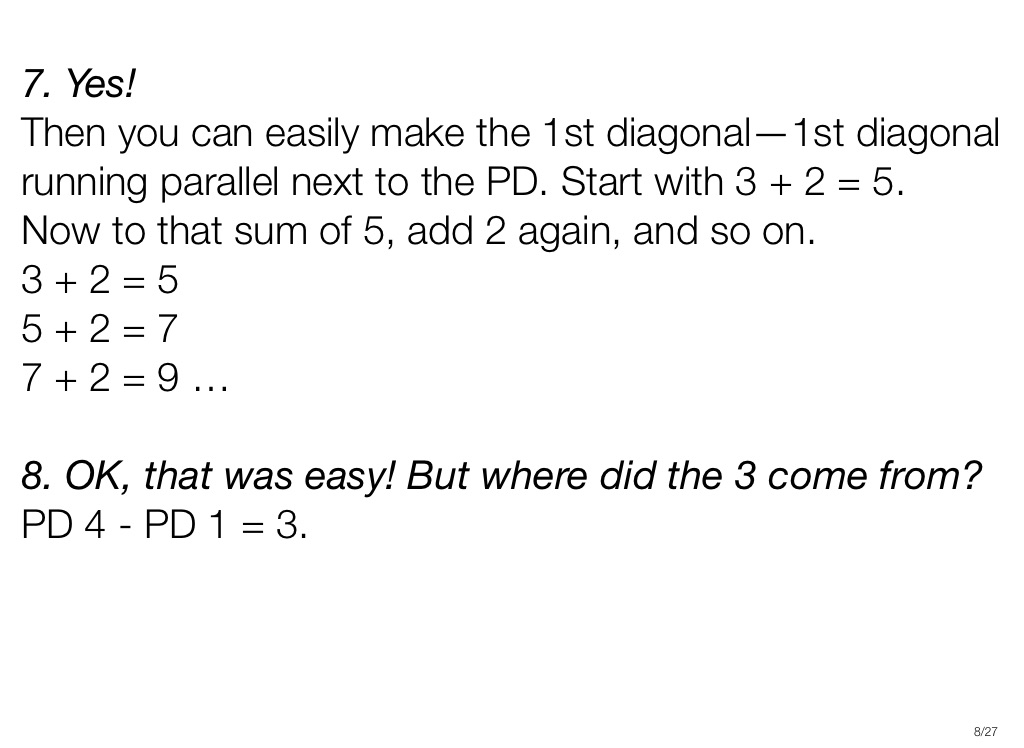
7. Yes! Then you can easily make the 1st diagonal—1st diagonal running parallel next to the PD. Start with 3 + 2 = 5. Now to that sum of 5, add 2 again, and so on. 3 + 2 = 5 5 + 2 = 7 7 + 2 = 9 … 8. OK, that was easy! But where did the 3 come from? PD 4 - PD 1 = 3.
8/27
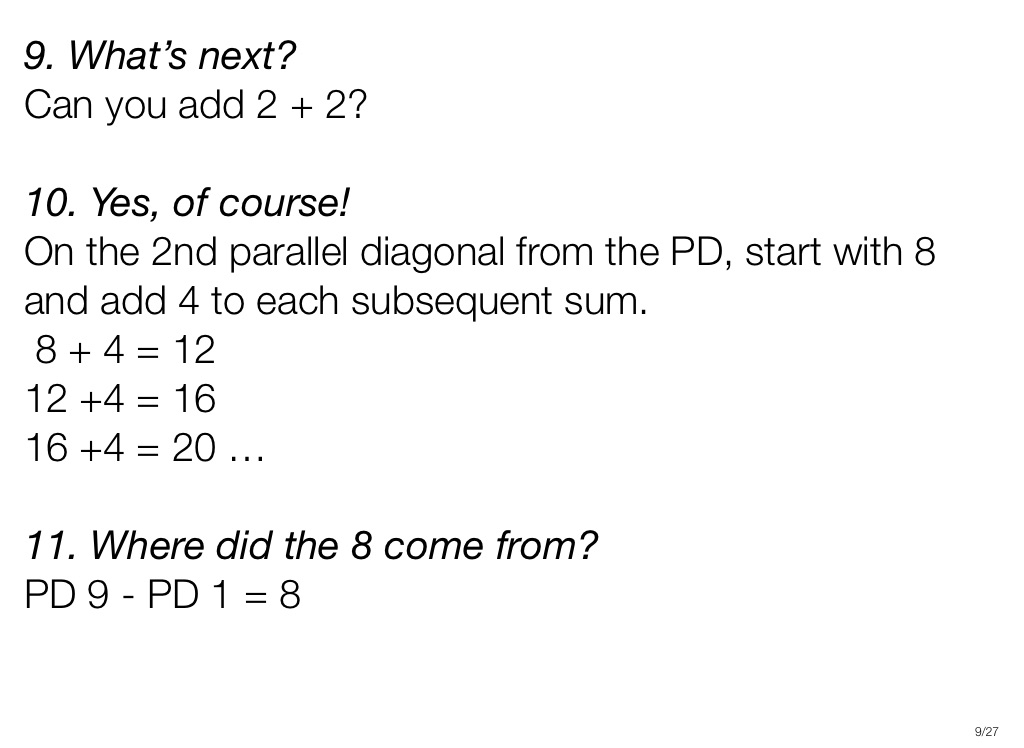
9. What’s next? Can you add 2 + 2? 10. Yes, of course! On the 2nd parallel diagonal from the PD, start with 8 and add 4 to each subsequent sum. 8 + 4 = 12 12 +4 = 16 16 +4 = 20 … 11. Where did the 8 come from? PD 9 - PD 1 = 8
9/27
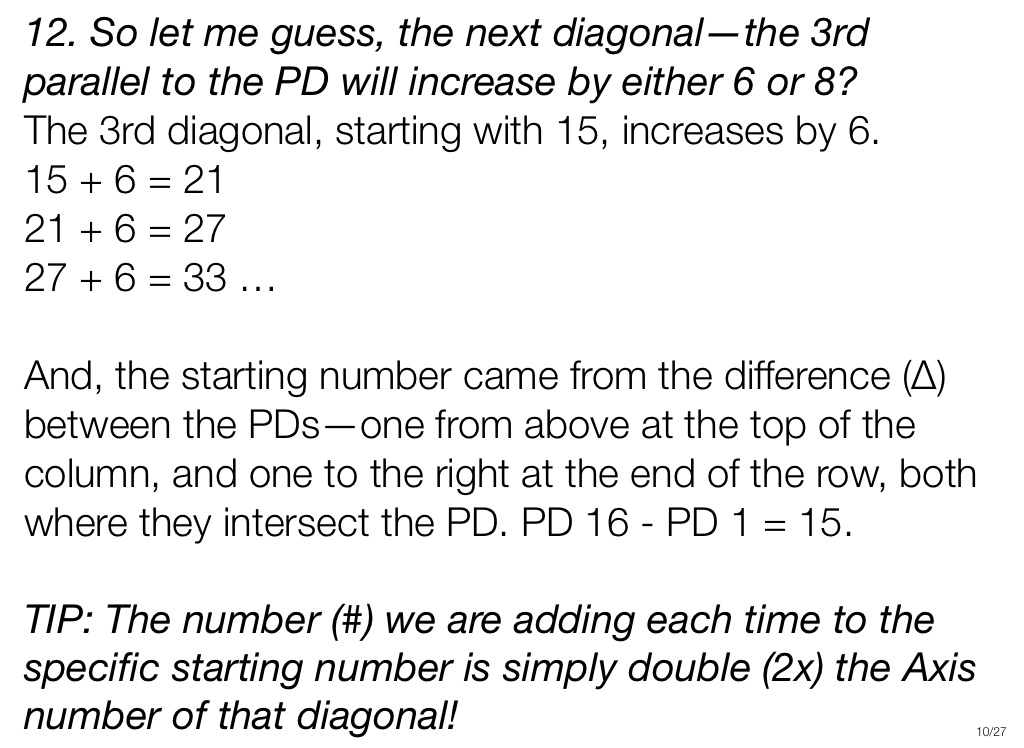
12. So let me guess, the next diagonal—the 3rd parallel to the PD will increase by either 6 or 8? The 3rd diagonal, starting with 15, increases by 6. 15 + 6 = 21 21 + 6 = 27 27 + 6 = 33 … And, the starting number came from the difference (∆) between the PDs—one from above at the top of the column, and one to the right at the end of the row, both where they intersect the PD. PD 16 - PD 1 = 15. TIP: The number (#) we are adding each time to the specific starting number is simply double (2x) the Axis number of that diagonal!
10/27
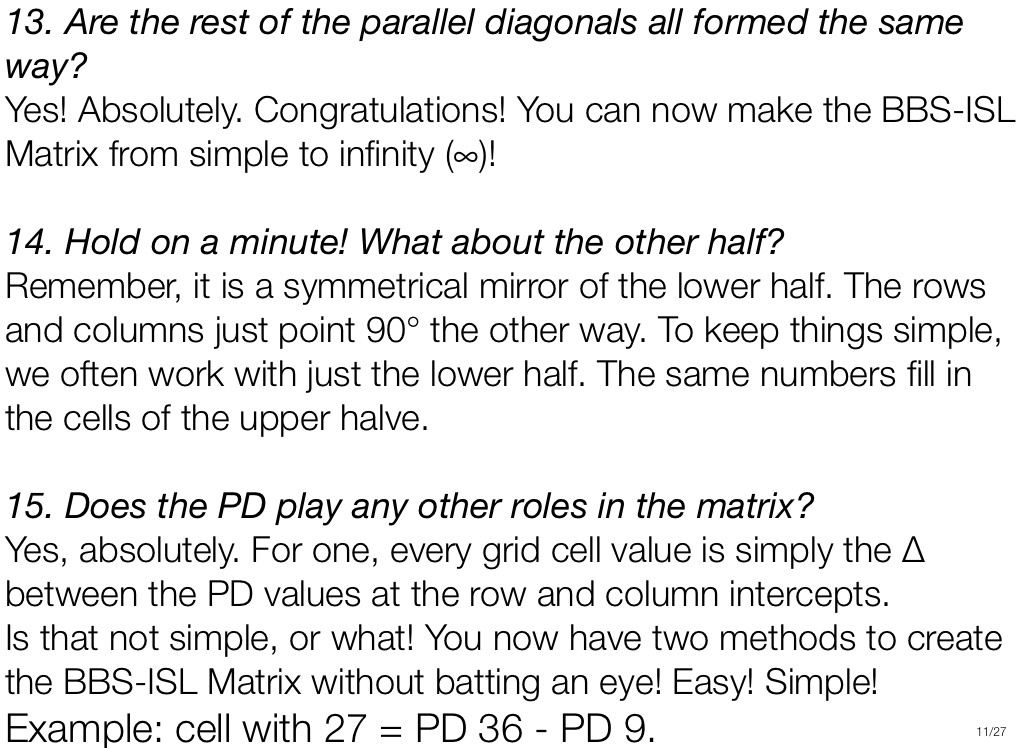
13. Are the rest of the parallel diagonals all formed the same way? Yes! Absolutely. Congratulations! You can now make the BBS-ISL Matrix from simple to infinity (∞)! 14. Hold on a minute! What about the other half? Remember, it is a symmetrical mirror of the lower half. The rows and columns just point 90° the other way. To keep things simple, we often work with just the lower half. The same numbers fill in the cells of the upper halve. 15. Does the PD play any other roles in the matrix? Yes, absolutely. For one, every grid cell value is simply the ∆ between the PD values at the row and column intercepts. Is that not simple, or what! You now have two methods to create the BBS-ISL Matrix without batting an eye! Easy! Simple! Example: cell with 27 = PD 36 - PD 9.
11/27
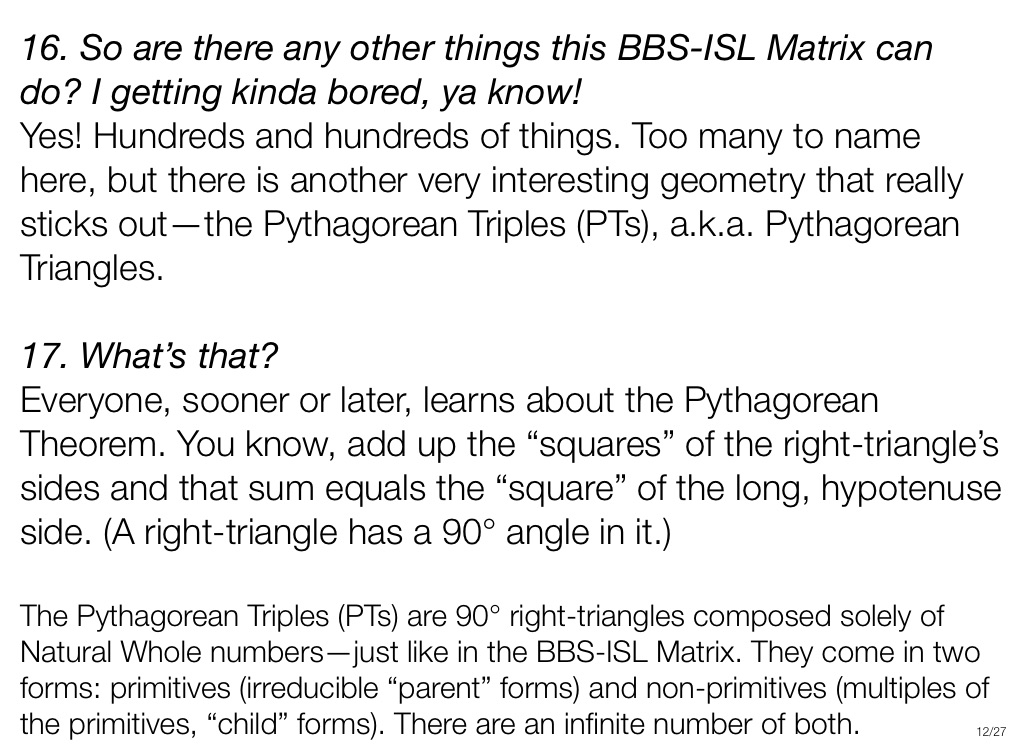
16. So are there any other things this BBS-ISL Matrix can do? I getting kinda bored, ya know! Yes! Hundreds and hundreds of things. Too many to name here, but there is another very interesting geometry that really sticks out—the Pythagorean Triples (PTs), a.k.a. Pythagorean Triangles. 17. What’s that? Everyone, sooner or later, learns about the Pythagorean Theorem. You know, add up the “squares” of the right-triangle’s sides and that sum equals the “square” of the long, hypotenuse side. (A right-triangle has a 90° angle in it.) The Pythagorean Triples (PTs) are 90° right-triangles composed solely of Natural Whole numbers—just like in the BBS-ISL Matrix. They come in two forms: primitives (irreducible “parent” forms) and non-primitives (multiples of the primitives, “child” forms). There are an infinite number of both.
12/27
18. So what does that have to do with the BBS-ISL Matrix? Every PT resides uniquely on a row upon the matrix, and, the Pythagorean Theorem Proof of any, and all, such PTs is found by sliding the “squares” of the PT’s sides to the origins of the matrix. 19. Does every row have a PT? No. Only those rows with Squared numbers from the PD above. 20. Explain? Take a PD number from anywhere on the PD (9 +). Drop down that column until you intersect with a row cell value that is also a Squared PD number. Next, go along that same row until you reach a 2nd Squared PD number. Those two “squared” cell values = b and a , and, the c value will be at the end of that row on the PD. That is the c = a + b PT. Squared Pair-Sets.
13/27
21. Can the same PT be on different rows? No. It is always unique to a specific row. 22. Can more than one PT be on the same row? Yes, there can be 2, 3, 4, … other sized PTs that occupy the same row—each has its Squared Pair-Sets of b and a values. 23. Are the PTs connected in any way? Yes, absolutely! Every PT is ultimately connected to every other PT and that Number Sequence Patterning is presented in TPISC I: Basics (free) and TPISC II: Advanced.
14/27
24. OK, without my reading a math book—even one only about Natural Whole numbers—why should I care about this? What does a matrix grid-table of the ISL and the ubiquitously embedded PTs have to do with my reality??? The short answer: Everything! The ISL defines the SpaceTime (ST) of the Universe. No exceptions. That ST is in flux—it is dynamically generated and re-generated as to the energy density it is informing—sitting within a larger soup of other STs formed and forming.
15/27
The cell values of the ISL-matrix grid (BBS-ISL MATRIX) all relate back to the PD of that specific ST forming. Every cell value has a unique number value—representing a “quantity” of something—in that it is the ∆ between the PD at the top of its column and the PD value at the row’s end. Because the cell values are known and fixed throughout the entire infinitely expandable matrix, it is immediately, simultaneously known—without the need of transmission of information by any means from point “A” to “B”—bypassing the critical speed of light limit—effectively becoming instant and simultaneous, i.e., faster than the speed of light.
16/27
The information of the influence dilution (energy, force, light, sound, ….) that the ISL conveys is completely known from the onset! The exact same thing occurs for the embedded PTs. They, too, are ubiquitously present and simultaneously known for all sizes of PTs form the smallest 3—4—5 to the infinite largest. So now, we have two geometries instantly and simultaneously present informing all of ST from zero to ∞.
17/27
25. Well, you’ve got me there! But, so what? Glad you asked! You see, the basis of the BBS-ISL Matrix is that of the circle/square. Perfectly symmetrical geometric forms containing 90° right-angle isosceles triangles. These inform ST in a manner reflecting these properties. Now, enter the PTs. PTs are based on 90° right-angle NON-isosceles triangles, i.e., when paired they form NON-square rectangles as opposed to the squares of the ISL. Such rectangles are longer than they are wide (bilateral symmetry).
18/27
26. OK. Squares or rectangles, so what’s the big deal? Now you’re talking. Unlike the formation of ST on nothing but simple circle/square geometry, asymmetrical rectangles allow for specific, slightly different geometry to come into play—within the ISL layout—at articulated points of interest—nodes—that give the forming ST new instructions, e.i., at this nodal point of ST formation, your next expansion shall now follow the rectangular geometry of the PT versus the circle/square geometry of the strict ISL.
19/27
27. Where do these nodes occur? They occur along those rows that contain a PT. Specifically at the Squared Pair-Set values that defined that PT on a particular row. If you were to venture in to TPISC II: Advanced, you would find that the Extended Dickson Method lays out a complete geometric pattern for each PT, centered around the Squared Pair-Set values. 28. That’s it? We (Nature) can make things out of rectangles in addition to circles, squares and isosceles triangles? Evolution is based on, among other factors, the geometry that informs the structure—animate or inanimate.
20/27
All rectangles contain perfect circles, squares and isosceles triangles in addition to their own ovals, rectangles and non-isosceles triangles. (Ignoring Platonic Solids for this discussion.) In other words, the asymmetry introduced with the PT geometry brings an evolution of form to a level of greater complexity—more options, more possibilities—that enriches the creative expressive possibilities of a forming ST. Multiply this repeatedly and you end up with a dahlia, a galaxy, a cosmos! Together, the symmetric and asymmetric instructions sets of the ISL and PTs—respectively—give rise to the expression of ST.
21/27
29. Aren’t there other forms—including fractal-like forms, the golden rectangle, etc. that are so obviously in play in the ST forms we see with our eyes (and telescopes) everyday? Indeed, and the PTs are suggested as acting in just such a manner—as fractal-like forms with re-iterative, self-similar pattern-modes of form expression. TPISC reveals exactly how the PTs replicate and are related to each other, and, how they are related back to the ISL via the BBS-ISL Matrix. Their relationship with the Golden Mean/Proportion/Rectangle is built into the BBS-ISL Matrix itself.
22/27
30. How can I use my understanding of TPISC tomorrow when I wake up and start a new day? From your dreams of the impossible, wake up aware that you now have some knowing of just how Nature—Nature in all her profound wisdom—builds the very ST upon which you take your next breath, sip that favored cup of joe, while you peruse the headlines of idiots doing violence to others! A 5 minute movie, an animated Gif, a links page and a closing follows.
23/27
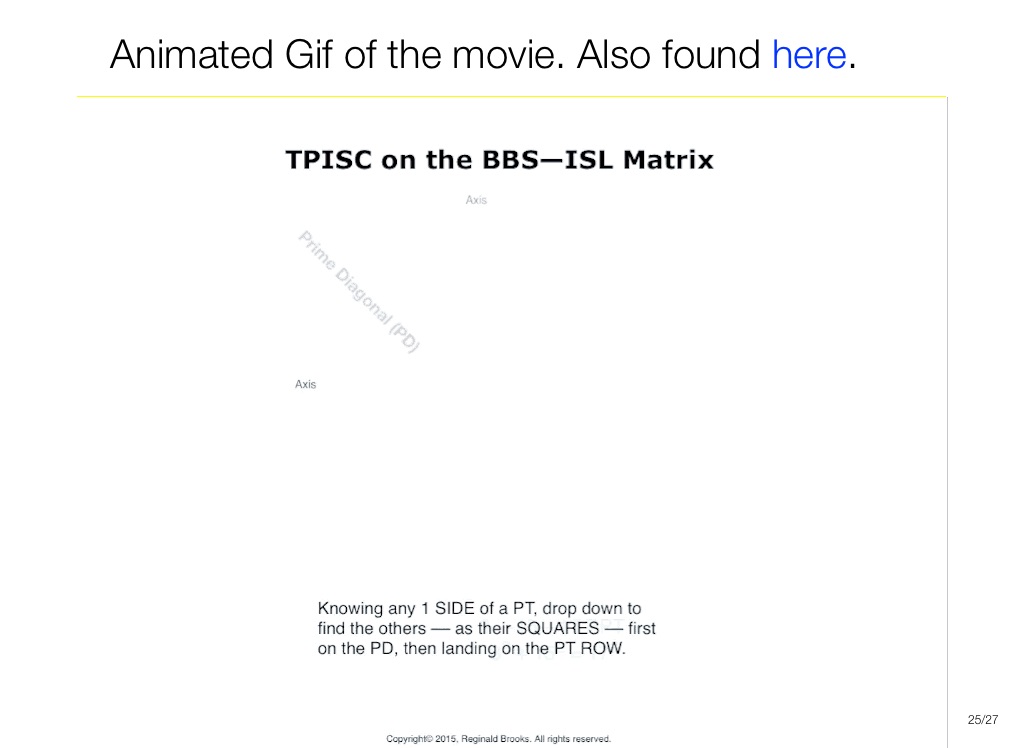
Animated Gif of the movie. Also found here.
25/27
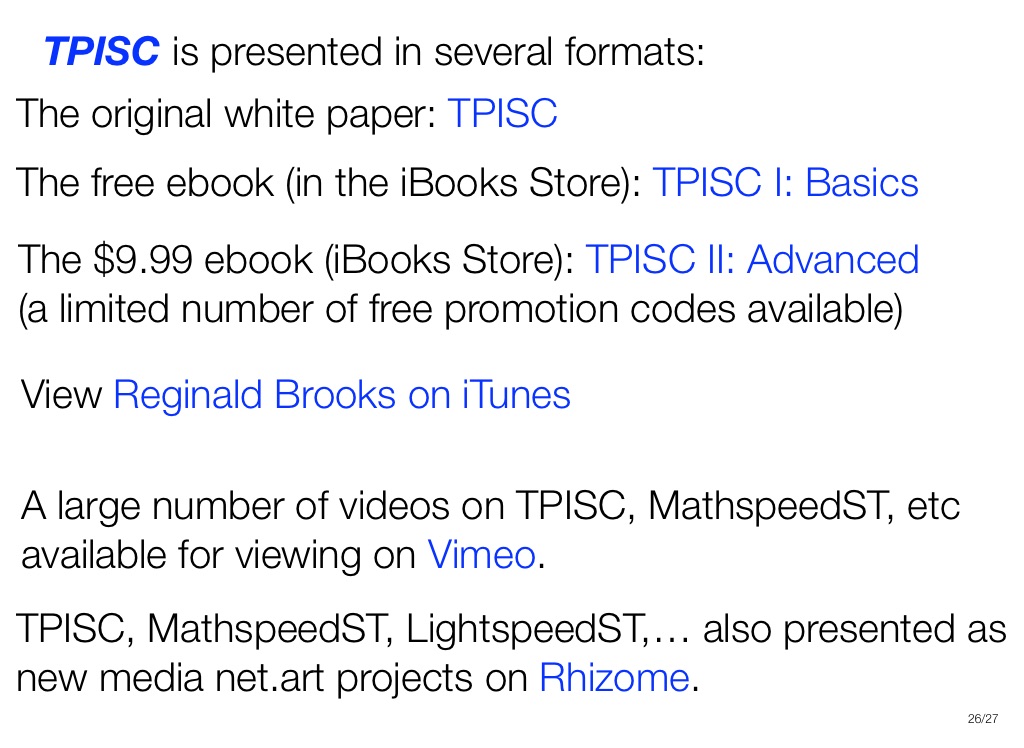
TPISC is presented in several formats:
The original white paper: TPISC
The free ebook (in the iBooks Store): TPISC I: Basics
The $9.99 ebook (iBooks Store): TPISC II: Advanced (a limited number of free promotion codes available)
View Reginald Brooks on iTunes
A large number of videos on TPISC, MathspeedST, etc available for viewing on Vimeo.
TPISC, MathspeedST, LightspeedST,… also presented as new media net.art projects on Rhizome.
26/27
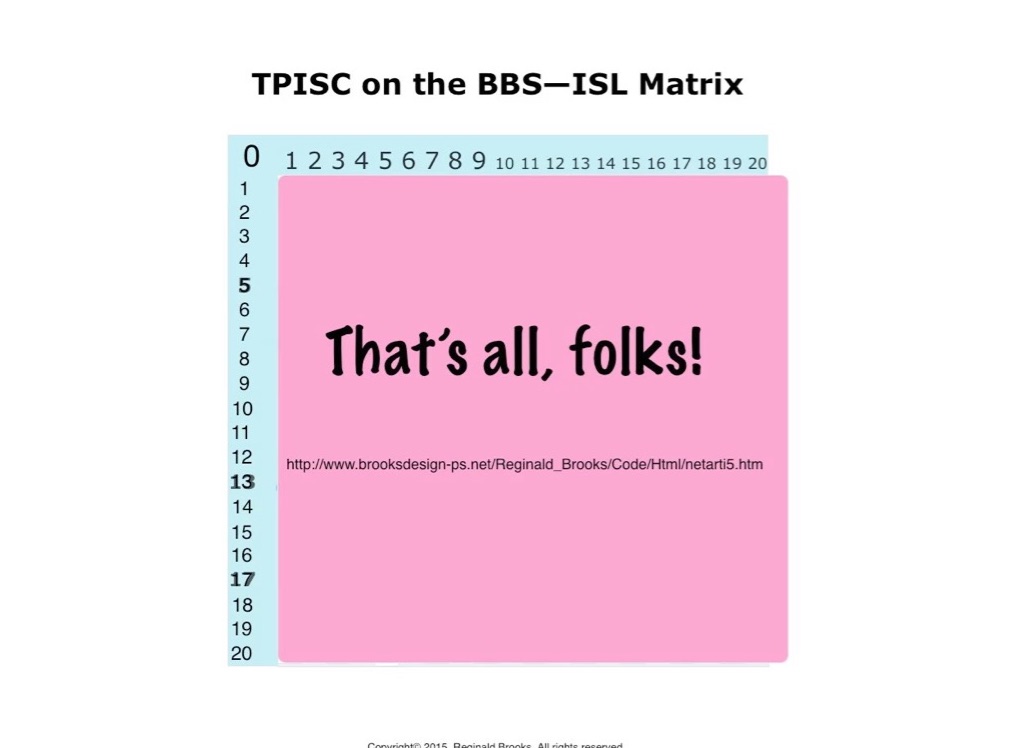
Thanks for viewing! Send me a request for the free promotion codes for TPISC: Advanced if you are interested in delving deeper. Ultimately, the mathematics and geometry of simple whole numbers are an amazing fertile ground for discovering how our world is put together. Although it does get more complex as it adds richness and variety to the mix, at the very early stages it is ridiculously simple. I urge you to share this with educators of open minds of all ages. You can “see it!” ~Reginald Brooks, copyright 2015. All rights reserved. http://www.brooksdesign-ps.net/Reginald_Brooks/Code/Html/netarti5.htm