






Culture 4 Organisational Culture
Culture 4 Organisational Culture
This document gives an overview of the theories on organisational culture and their limitations. They are a starting point but in itself insufficient for changing organisational culture.
Pieter van Nispen Senior Lecturer and Researcher, retired
February 2018
Table of Contents
page
page
page
page
page
Introduction
Groups
Biases in Research
Definitions
Aspects
page
page
page
page
page
Layers
Research: Mole, Philip d’Iribarne, Harrison, Quinn, Rohrbach, De Caluwé, Trompenaars, Hofstede, Dreimüller
Discussion
Exercise
Further Reading
Contents
Introduction
This document is part of larger project to bring the reality and theory of culture together. At its core it the website www.culturalcompetence.eu. The model used has the size of groups as its starting point, ranging from very large groups through larger and smaller groups to the individual. The three major larger groups are business, government and civil society, each with their own basic motivation (private interest, public interest and idealistically respectively) with major consequences on organisational cultures (e.g. why government can only draw lessons from business to a limited degree). The link with culture started with companies, in particular in international trade. The idea was simple: the more you understand your partner, the better deal you can make. This orientation widened abroad to investment (daughter company, joint venture and so on) and at home to organisational culture and dealing with multicultural society. In the latter case the idea is that better internal co-operation enhances effectiveness and efficiency with higher motivation and satisfaction and decreasing absence. It has an impact on stakeholders and a link with strategy, structure and control.
Yet, progress in research and applications is slow, due to conceptual differences and reliable instruments. Furthermore, each possible instrument is only a starting point for understanding and working with a specific organisational culture. The quest for understanding organisational culture is a maze of disciplines, inductive–deductive, theories, methods, empirical testing, concepts, perspectives, axes, typologies, divergence and diversity, colours, observations, descriptions, interviews, questionnaires, aspects, games, change, functions and use, enculturation, relation with climate, strong and weak cultures, industry cultures, occupational cultures, project cultures and more. Not surprisingly, this maze results in insufficient exchanges between researchers, countries and disciplines. Just one aspect of this discussion is the question (s) whether organisational culture is about values (and their consequences) or rather practices (how things are actually done); different starting point! The difficulty of researching values is discussed in Culture 6; practices differ from one company to another and are less easy to compare.
Companies need culture for doing business abroad, for dealing with multicultural society and for better understanding how things are done.
Contents
Groups
Below the national level we have hundreds of thousands of groups. From the perspective of the study of culture we may divide them in two, the larger and the smaller groups. Larger groups are too big to know one another and people are seen in terms of their contribution to that larger group. The smaller group is more oriented on individual persons. Another way of looking at larger groups is to take a specific aspect as a starting point, such as all men and all women in a given state. In the same vein one may target a specific profession or industry, as is frequently done in marketing. Again, these groups are too large to know one another individually but the group has its own culture as shown by a characteristic behaviour. The variety in types of larger groups is reflected in the scientific disciplines studying them. Specific larger groups often have their own niche in research, such as women’s studies and marketing.
The effort of understanding another culture may be helped along by looking at expressions of that culture, such as communication patterns, pride for this or that, heroes and symbols, habits and traditions, history and its effects.
Contents
Biases in Research
Research of organisational culture cannot be done without cultural biases but not all researchers are aware of it. An individual person is already a unique mix of the cultures of every group an individual is or was a member of (see Culture 1). Related to organisational culture, one pitfall has hardly been recognised, the effect of differences in economic systems. The Anglo-Saxon system focuses on shareholder value. A manager has tough decisions to make; a company may be terminated when it makes a profit and satisfies customers but with only a modest return on investment. The Rhineland model focuses on product and customer. A manager preferably comes from the ranks and is intimately involved in product or service. An investor does not get priority but is rather a means to an end. For these reasons for instance Japanese or American management models more often than not fail if implemented lock in another country.
The effect of economic systems may be recognised in for instance the work by Cameron and Quinn, focusing on effectiveness of organisations (actually companies). The work by Dutch researcher Dreimüller actually suffers from the same problem because he takes the Balanced Score Card, an American approach (based on the Anglo-Saxon model), as his starting point for outlining Dutch organisational cultures (based on the Rhineland model). He does not question the applicability of the BSC outside the USA. However, his research and the one by Hofstede are examples of European approaches. In addition, much of the research is focused on companies, not on government or NGO’s.
Contents
Definitions
In view of the divergence in biases, assumptions and perceptions a few definitions and perceptions are presented below. ▽ Schein: the total of all common and naturally experienced assumptions, which a group has learned in the course of its existence. ▽ Mole: the way we do things here! ▽ Hofstede: How members of an organisation relate to one another, their work and the outside world in comparison to other organisations. ▽ Trompenaars: Basic to understanding culture in organisations is that we can define culture as a series of rules and methods, which an organisation has evolved to deal with the regular problems that it faces.
This series of e-books is based on Vroom’s perception of culture as an institution and the triangle model (see Culture 1). Against this backdrop organisational culture is the way of thinking, acting and feeling of the group of people in an organisation. In addition, the influence of stakeholders (from suppliers to customers) on the organisational culture in question should also be taken into account.
Societies, organisations, and individuals represent the gardens, bouquets, and flowers of social science. Our research has shown that the three are related and part of the same social reality If we want to understand our social environment, we cannot fence ourselves into the confines of one level only: we should be prepared to count with all three. Hofstede (2010, p. 368)
Contents
Aspects
Aspects of organisational culture include its origin, its importance, its location, the relation with the maturity of the organisation and the internal relations. The origin of organisational culture is a combination of the founder(s) of the organisation, the employees, the interaction within the organisation, the stakeholders, the clients, the suppliers, the place of the organisation in the context of society, the objectives, strategy and structure and the sector (Schein). In addition, the history of the organisation should be taken into account. The importance of organisational culture is clarified through the effect of culture on the involvement of people, the success or failure of mergers, the strategy, the structure, systems and procedures and measurement (Hofstede, Schein). The location of organisational culture includes the organisation, the sector, the profession, the level of hierarchy, common experiences and backgrounds, relations, use of language, status, rewards, assumptions, values, key persons, stories and symbols.
The maturity of an organisation affects its culture; the older the more settled its culture is (in general) and the more difficult is becomes to change the organisation. Changing the culture is difficult, to start with because of the difficulty of grasping what that culture is (the view from the top most probably differs from that of the bottom). Furthermore, interventions (e.g. new procedures) may be realized but without paying attention to the related way of thinking they may well fail. On the other hand, paying attention to organisational culture first (however difficult) makes much of change management redundant. Regarding internal relations, a proper organisational culture ensures integration and involvement of people, amongst others through key persons (heroes), companies myths, symbols, status, acknowledgement; `the way we do things here`.
Contents
Layers
In order to get a grip on organisational culture researchers make a distinction between different layers in terms of the difficulty of observing and changing the culture in question. This idea is related to the discussion whether the focus of organisational culture should be on values or on practices. The easiest to observe are the artefacts, that what you see, hear and feel when you walk around; does the receptionist offer you coffee? They include the following ▽ rules on clothing ▽ degree of formality in relations of authority ▽ working hours ▽ meeting (frequency, way of chairing, duration) ▽ way of decision making ▽ communication: how do you get information? ▽ social events ▽ jargon, uniforms, identity characteristics ▽ rites and rituals ▽ how do they deal with differences of opinions and conflicts? ▽ relation between work and family
Deeper layers include acknowledged values and common assumptions. However, researchers disagree which of the two is at the core (and one may wonder why that matters). Values include for instance honesty, respect, reliability, involvement, caring, courage or justice. Walt Disney for instance stresses no cynicism; cherishing and spreading healthy American values; creativity, dreams, fantasy; and fanatical attention to consistency and detail. Sony on the other hand focuses on raising Japanese culture and national prestige; being a pioneer, realising the impossible; and individual capacities and encouraging creativity.
Contents
Research Mole
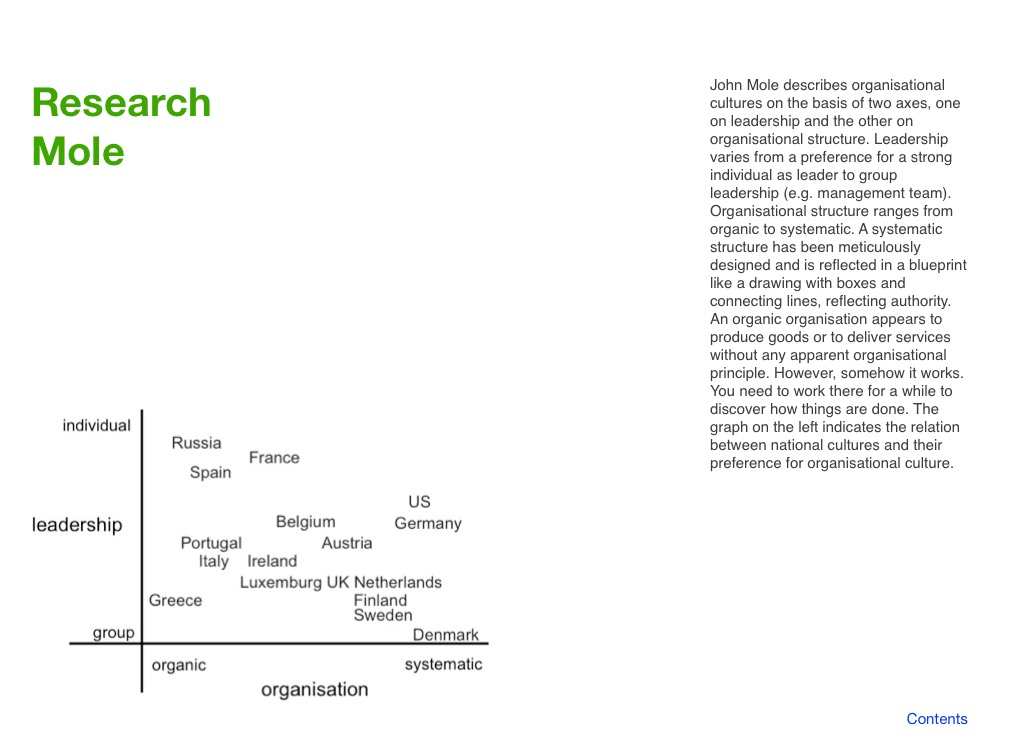
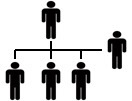
John Mole describes organisational cultures on the basis of two axes, one on leadership and the other on organisational structure. Leadership varies from a preference for a strong individual as leader to group leadership (e.g. management team). Organisational structure ranges from organic to systematic. A systematic structure has been meticulously designed and is reflected in a blueprint like a drawing with boxes and connecting lines, reflecting authority. An organic organisation appears to produce goods or to deliver services without any apparent organisational principle. However, somehow it works. You need to work there for a while to discover how things are done. The graph on the left indicates the relation between national cultures and their preference for organisational culture.
Contents
Research d’Iribarne
The French researcher Philip d’Iribarne demonstrated the interconnection of national and corporate cultures (Iribarne 1998). He researched three identical aluminium smelters in France, the United States and the Netherlands and found that although the three are technically identical (same raw materials, same machines, same production), in practice they function quite differently. An example of his work makes this clear. For a Frenchman, a job is a matter of honour. If he has to work overtime, he feels bounded by honour do the so. For the Americans, it is an entirely different issue. The Americans have an individualistic culture, where everything has to be defined explicitly (low-context communication). This is why they have detailed contracts in America. When an American has to work overtime, he looks to the conditions in the contract to see whether that can be asked of him. Conditions fulfilled? Then it’s okay. And what does the Dutchman? He will polder (sit together and discuss). Anyone agree? Let’s go. The Dutch translation of the work of D’Iribarne is called therefore honour, contract and consensus.
Contents
Research Harrison, Quinn, Rohrbach
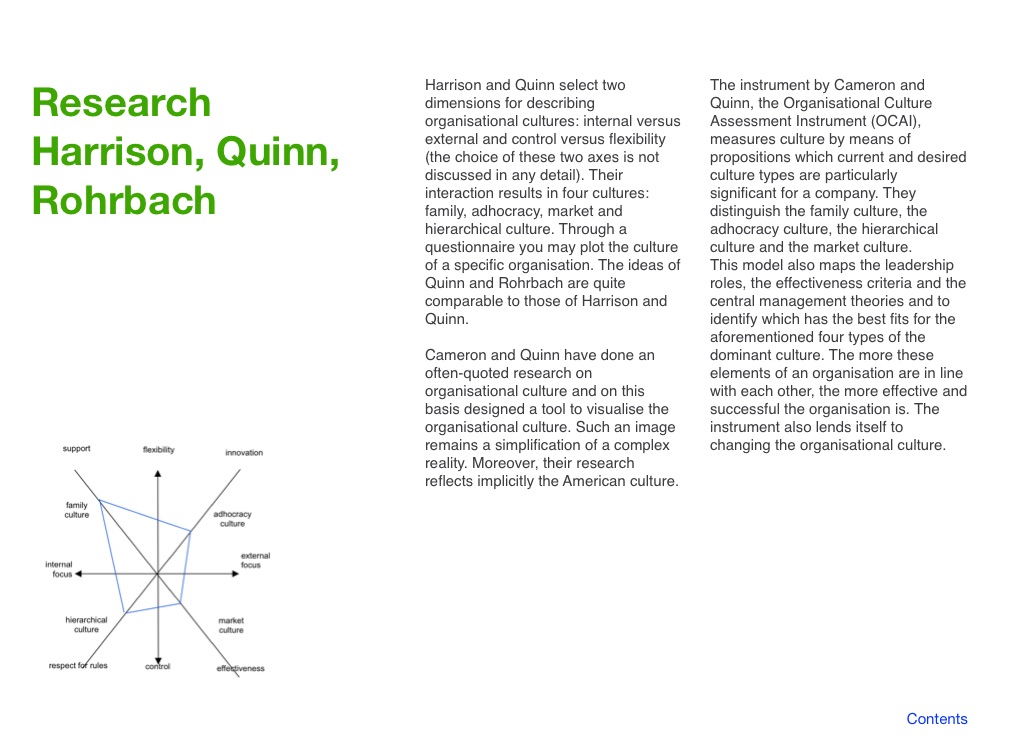
Harrison and Quinn select two dimensions for describing organisational cultures: internal versus external and control versus flexibility (the choice of these two axes is not discussed in any detail). Their interaction results in four cultures: family, adhocracy, market and hierarchical culture. Through a questionnaire you may plot the culture of a specific organisation. The ideas of Quinn and Rohrbach are quite comparable to those of Harrison and Quinn. Cameron and Quinn have done an often-quoted research on organisational culture and on this basis designed a tool to visualise the organisational culture. Such an image remains a simplification of a complex reality. Moreover, their research reflects implicitly the American culture.
The instrument by Cameron and Quinn, the Organisational Culture Assessment Instrument (OCAI), measures culture by means of propositions which current and desired culture types are particularly significant for a company. They distinguish the family culture, the adhocracy culture, the hierarchical culture and the market culture. This model also maps the leadership roles, the effectiveness criteria and the central management theories and to identify which has the best fits for the aforementioned four types of the dominant culture. The more these elements of an organisation are in line with each other, the more effective and successful the organisation is. The instrument also lends itself to changing the organisational culture.
Contents
Research De Caluwé
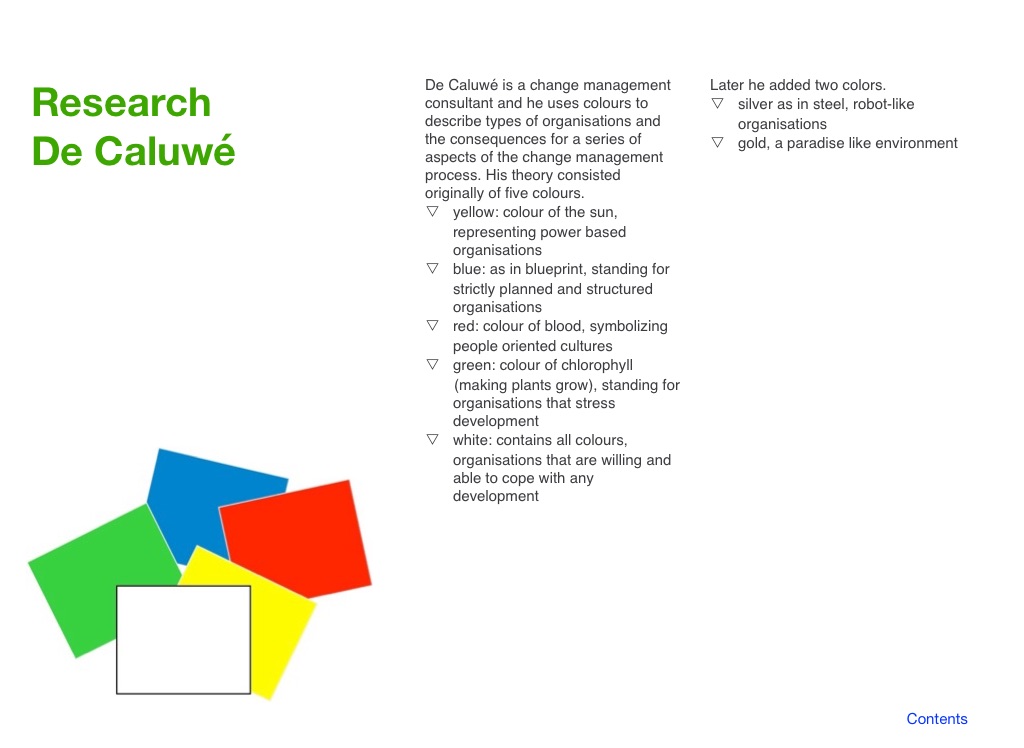
De Caluwé is a change management consultant and he uses colours to describe types of organisations and the consequences for a series of aspects of the change management process. His theory consisted originally of five colours. ▽ yellow: colour of the sun, representing power based organisations ▽ blue: as in blueprint, standing for strictly planned and structured organisations ▽ red: colour of blood, symbolizing people oriented cultures ▽ green: colour of chlorophyll (making plants grow), standing for organisations that stress development ▽ white: contains all colours, organisations that are willing and able to cope with any development
Later he added two colors. ▽ silver as in steel, robot-like organisations ▽ gold, a paradise like environment
Contents
Research Trompenaars
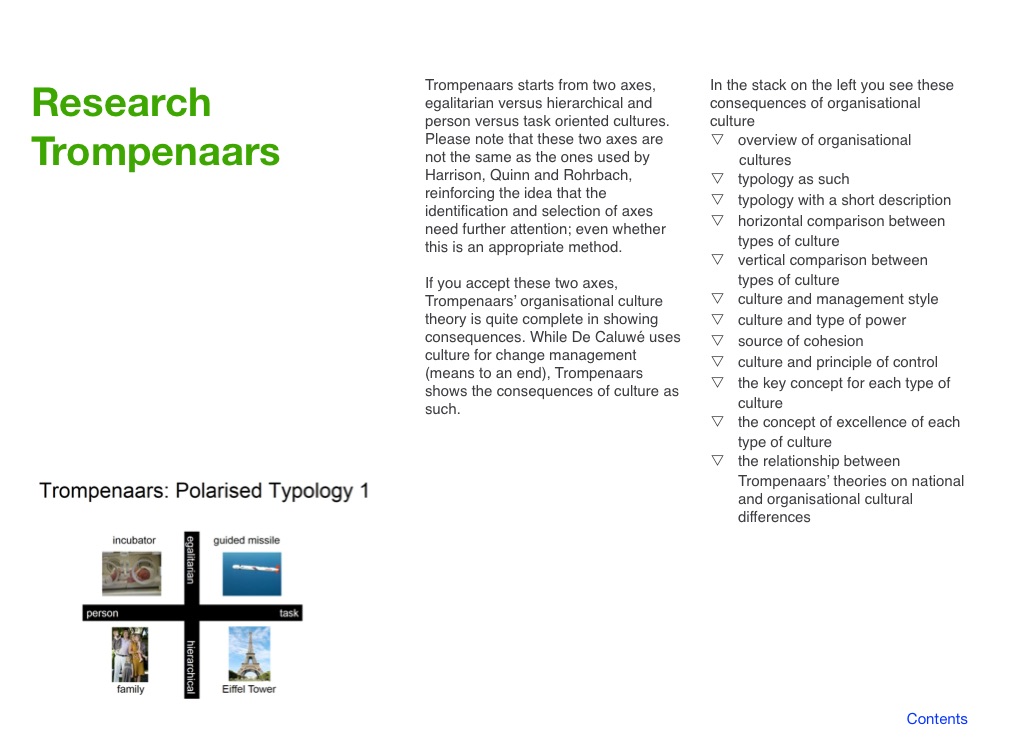
Trompenaars starts from two axes, egalitarian versus hierarchical and person versus task oriented cultures. Please note that these two axes are not the same as the ones used by Harrison, Quinn and Rohrbach, reinforcing the idea that the identification and selection of axes need further attention; even whether this is an appropriate method. If you accept these two axes, Trompenaars’ organisational culture theory is quite complete in showing consequences. While De Caluwé uses culture for change management (means to an end), Trompenaars shows the consequences of culture as such.
In the stack on the left you see these consequences of organisational culture ▽ overview of organisational cultures ▽ typology as such ▽ typology with a short description ▽ horizontal comparison between types of culture ▽ vertical comparison between types of culture ▽ culture and management style ▽ culture and type of power ▽ source of cohesion ▽ culture and principle of control ▽ the key concept for each type of culture ▽ the concept of excellence of each type of culture ▽ the relationship between Trompenaars’ theories on national and organisational cultural differences
Contents
Research Hofstede
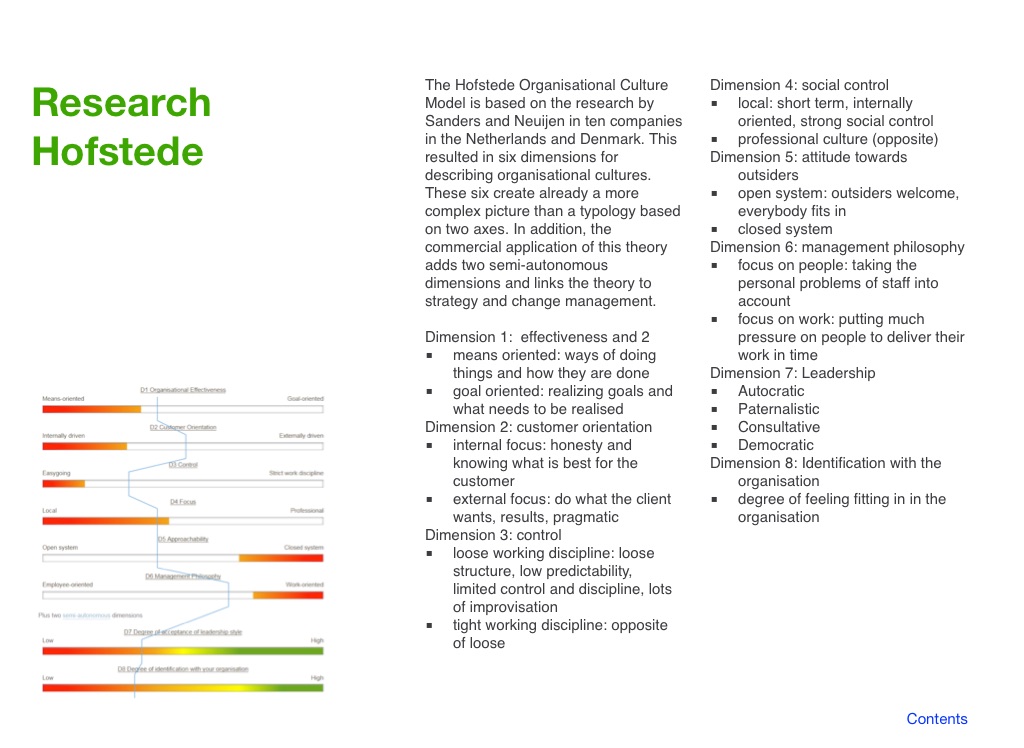
The Hofstede Organisational Culture Model is based on the research by Sanders and Neuijen in ten companies in the Netherlands and Denmark. This resulted in six dimensions for describing organisational cultures. These six create already a more complex picture than a typology based on two axes. In addition, the commercial application of this theory adds two semi-autonomous dimensions and links the theory to strategy and change management. Dimension 1: effectiveness and 2 ■ means oriented: ways of doing things and how they are done ■ goal oriented: realizing goals and what needs to be realised Dimension 2: customer orientation ■ internal focus: honesty and knowing what is best for the customer ■ external focus: do what the client wants, results, pragmatic Dimension 3: control ■ loose working discipline: loose structure, low predictability, limited control and discipline, lots of improvisation ■ tight working discipline: opposite of loose
Dimension 4: social control ■ local: short term, internally oriented, strong social control ■ professional culture (opposite) Dimension 5: attitude towards outsiders ■ open system: outsiders welcome, everybody fits in ■ closed system Dimension 6: management philosophy ■ focus on people: taking the personal problems of staff into account ■ focus on work: putting much pressure on people to deliver their work in time Dimension 7: Leadership ■ Autocratic ■ Paternalistic ■ Consultative ■ Democratic Dimension 8: Identification with the organisation ■ degree of feeling fitting in in the organisation
Contents
Research Dreimüller
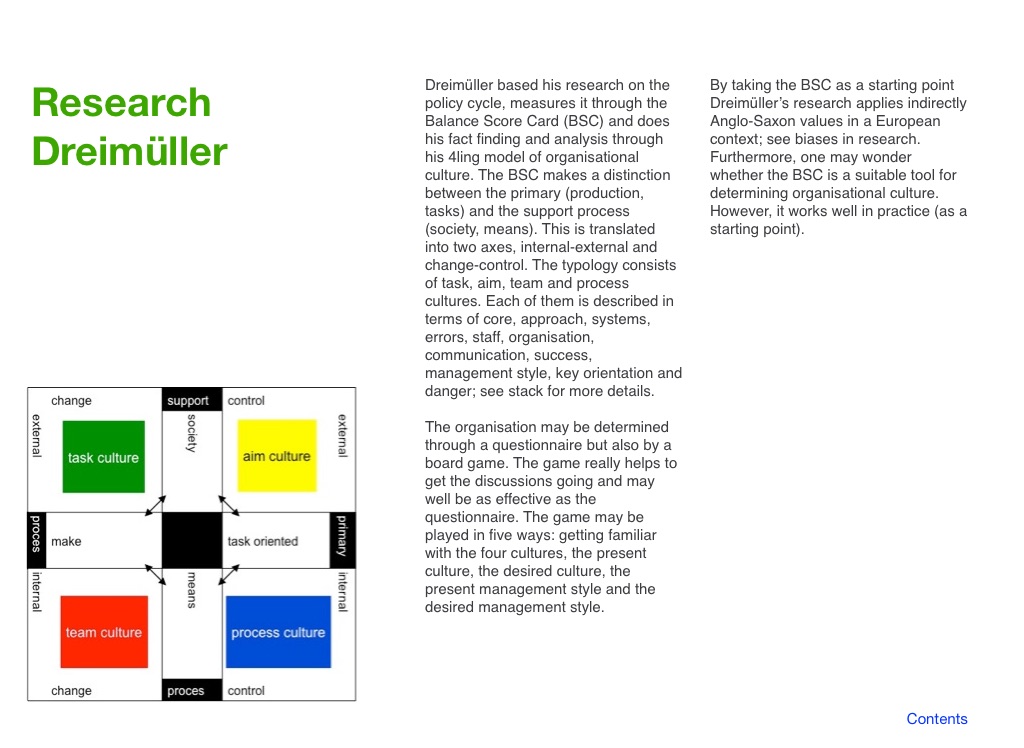
Dreimüller based his research on the policy cycle, measures it through the Balance Score Card (BSC) and does his fact finding and analysis through his 4ling model of organisational culture. The BSC makes a distinction between the primary (production, tasks) and the support process (society, means). This is translated into two axes, internal-external and change-control. The typology consists of task, aim, team and process cultures. Each of them is described in terms of core, approach, systems, errors, staff, organisation, communication, success, management style, key orientation and danger; see stack for more details. The organisation may be determined through a questionnaire but also by a board game. The game really helps to get the discussions going and may well be as effective as the questionnaire. The game may be played in five ways: getting familiar with the four cultures, the present culture, the desired culture, the present management style and the desired management style.
By taking the BSC as a starting point Dreimüller’s research applies indirectly Anglo-Saxon values in a European context; see biases in research. Furthermore, one may wonder whether the BSC is a suitable tool for determining organisational culture. However, it works well in practice (as a starting point).
Contents
Discussion
Although organisational culture is important and should be an important instrument for management (with HRM in the driving seat), it is neglected, even if doing so costs a lot of money. The neglect may be the result of a lack of understanding, a shortage of tools, insufficient research or the required effort to determine the culture and to delineate its consequences. An organisation may start to define its culture with a questionnaire or a game, both of which require effort and a considerable amount of time. In addition interviews with groups of colleagues are required, covering amongst others the company’s problem, the concept of culture (according to whatever perception), the determination of artefacts, the values of the organisation, the comparison of values and artefacts (consistency), common assumptions and the strength of the culture. Furthermore, one needs to consider to involve an external consultant or not.
If the determination of one’s own culture is already difficult, its consequences in doing abroad are really hard to assess; the relevant research is scarce but just enough to be scaring. These international aspects include the clash of organisational cultures, embedded in two or more national cultures and the expat discussion (foreigners working in the Netherlands and Dutchmen working abroad). Living and working abroad has such a positive status that a more balanced view, including its disadvantages (for the expat him or herself, the spouse and in particular the children) hardly gets the attention it needs (when it ends at the doctor’s, the damage is already done). The international dimension of organisational cultures may well show that the global village may easily turn into a nightmare, unless proper measures are taken.
Contents
Exercise
In this document a lot of elements, aspects, dimensions and typologies of organisational culture have been mentioned. Make a list of them and try to put them in a logical order (logical to you, that is). Work through this list and assess at each point how the organisation you are working for (or the organisation you may have in mind for another reason) scores. Then you may try to draw an overall picture or text from all these points with your assessments. You could take things a step further by starting the discussion on your view of the organisational culture with your colleagues. Such a discussion may focus on refining your perception or move on to proposing a change in the organisational culture and the ways and means of realising that. As an alternative you might fill out the questionnaire, developed by Dreimüller; see www.culturalcompetence.eu. On internet you may find a range of other questionnaires (with varying degrees of reliability and applicability). They may serve to clarify your perceptions.
Contents
Further Reading
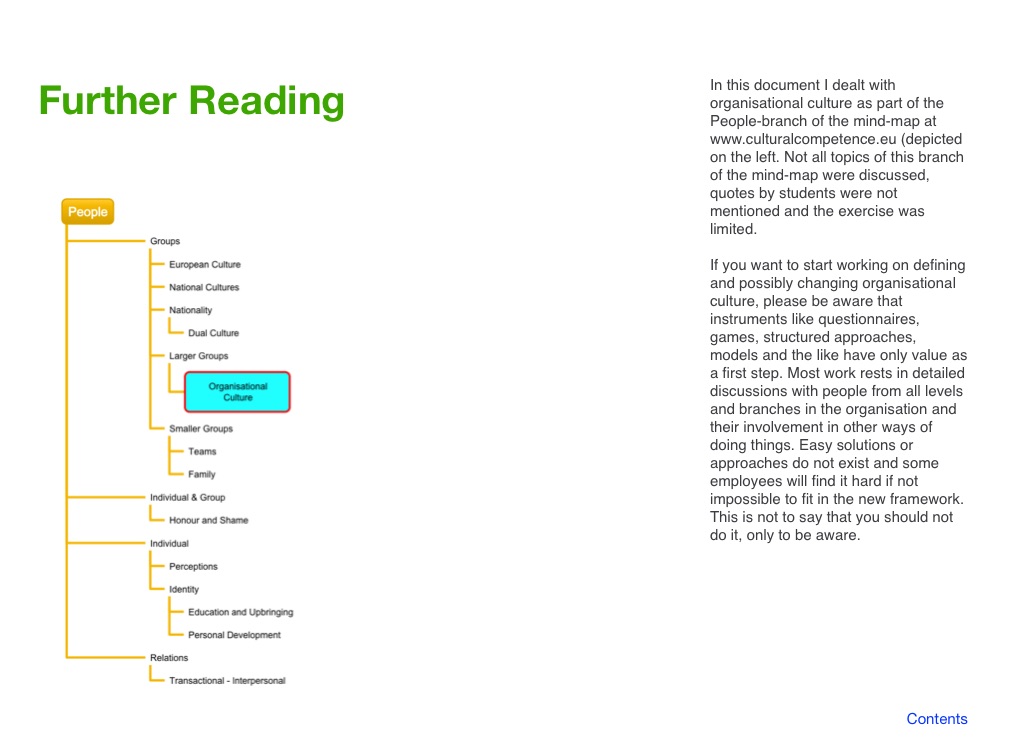
In this document I dealt with organisational culture as part of the People-branch of the mind-map at www.culturalcompetence.eu (depicted on the left. Not all topics of this branch of the mind-map were discussed, quotes by students were not mentioned and the exercise was limited. If you want to start working on defining and possibly changing organisational culture, please be aware that instruments like questionnaires, games, structured approaches, models and the like have only value as a first step. Most work rests in detailed discussions with people from all levels and branches in the organisation and their involvement in other ways of doing things. Easy solutions or approaches do not exist and some employees will find it hard if not impossible to fit in the new framework. This is not to say that you should not do it, only to be aware.